Bioponía
La bioponía es un enfoque innovador de la hidropónica orgánica que se centra en la creación de soluciones nutritivas sostenibles y ecológicas para el crecimiento de las plantas [1]. Al utilizar diversos materiales de desecho orgánicos y emplear bacterias beneficiosas y procesos energéticamente eficientes, labioponía ofrece una alternativa viable a los fertilizantes inorgánicos convencionales [2]. Tradicionalmente, la mayoría de las personas interactúan con labioponía simplemente comprando soluciones orgánicas comerciales como alternativa a las soluciones minerales/inorgánicas más extractivas. Exploraremos el concepto de bioponía, sus fuentes de nutrientes y los métodos utilizados para convertir los residuos orgánicos en nutrientes disponibles para las plantas.
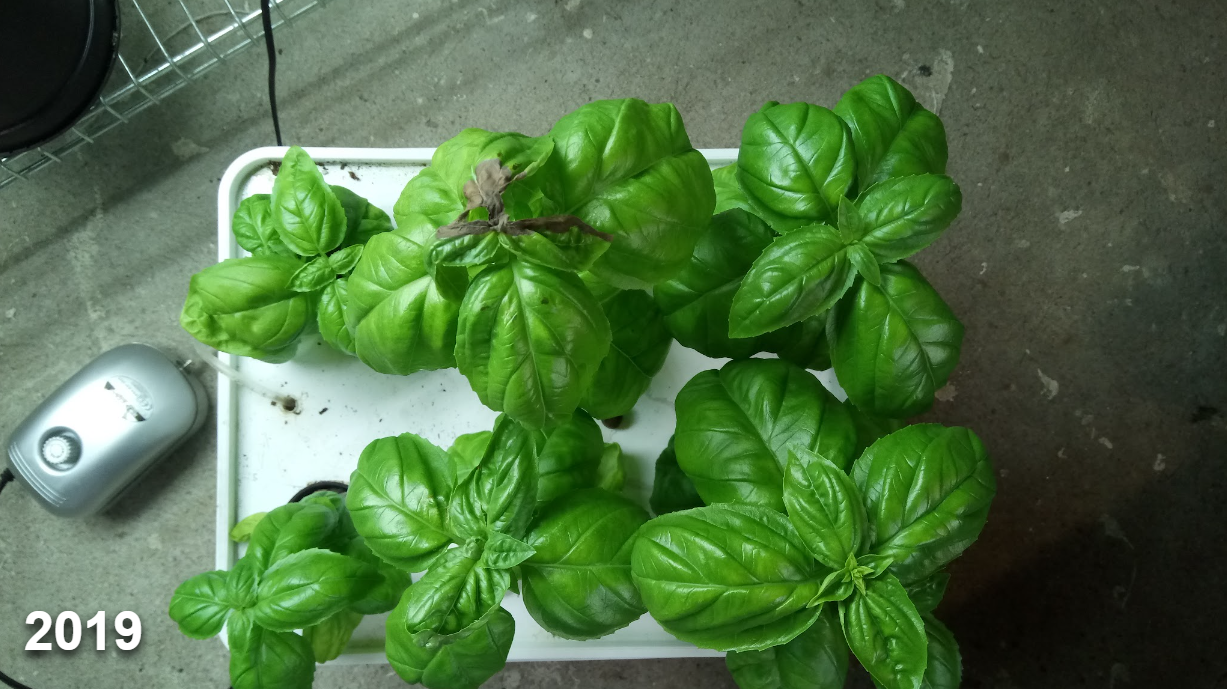
Bioponic basil in a simple DWC configuration, using dried & crushed vermicompost powder as the nutrient source, Henrique Sánchez 2019
Fuentes de nutrientes
- Lixiviado de vermicompost: El vermicompost, producido por la descomposición de materia orgánica a través de la acción de lombrices rojas, puede utilizarse para crear un lixiviado rico en nutrientes [3]. El extracto líquido del vermicompost contiene nutrientes esenciales para las plantas y microorganismos beneficiosos [4].
- Lixiviado de compost Bokashi: El Bokashi es un proceso de fermentación que utiliza una mezcla de microorganismos para descomponer la materia orgánica [5]. El lixiviado de compost resultante es rico en nutrientes y puede utilizarse como fertilizante líquido en sistemas de bioponía [6].
- Vermicompost seco y triturado: El vermicompost puede secarse y triturarse hasta obtener un polvo fino, que luego puede disolverse en agua para crear una solución nutritiva [7]. Este método permite un fácil almacenamiento y transporte del fertilizante orgánico.
- Lodo de biogás de residuos verdes: El biogás, producido mediante la digestión anaeróbica de residuos orgánicos, genera un lodo rico en nutrientes como subproducto [8]. Este lodo puede procesarse y utilizarse como fertilizante líquido en sistemas de bioponía [9].
- Té de compost: El té de compost se elabora remojando compost en agua, permitiendo que los microorganismos beneficiosos y los nutrientes se extraigan en el líquido [10]. Esta solución rica en nutrientes puede utilizarse para alimentar las plantas en sistemas de bioponía [11].
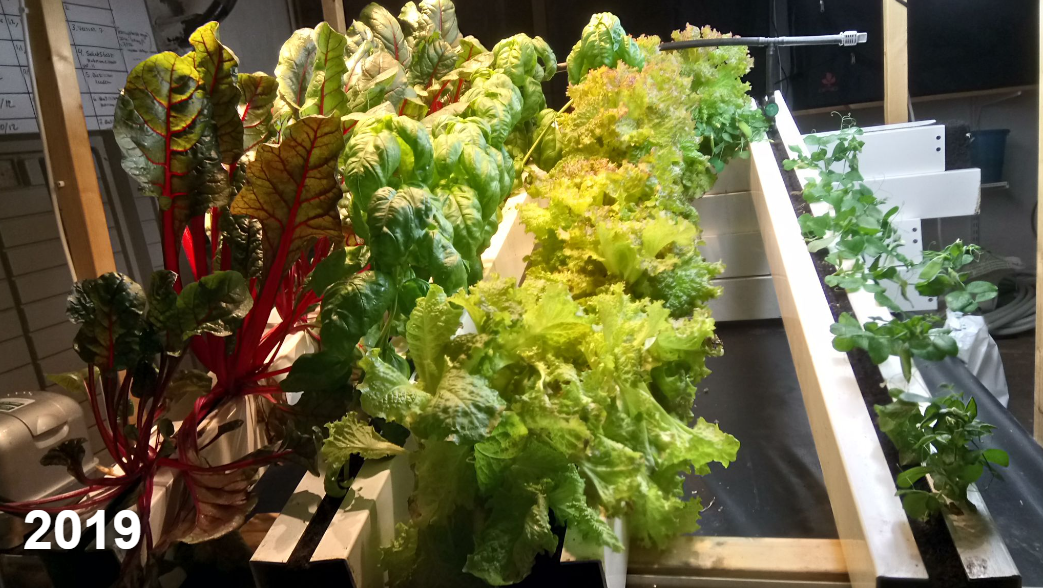
Bioponics NFT system powered by an MBBR, using green waste biogas slurry as the nutrient source, Henrique Sánchez 2019
Métodos de conversión
- Aireación y recirculación de agua: Para mantener niveles óptimos de nutrientes y evitar el estancamiento, los sistemas de bioponía suelen emplear técnicas de aireación y recirculación de agua [12]. Se utilizan bombas de aire y de agua para oxigenar la solución nutritiva y garantizar una distribución uniforme de los nutrientes a las plantas [13].
- Calentamiento: Algunos materiales orgánicos de desecho, como el compost bokashi, pueden requerir calentamiento para acelerar el proceso de descomposición y liberar los nutrientes en la solución líquida [14].
- Trituración y tamizado: El vermicompost seco u otros materiales orgánicos sólidos pueden triturarse y tamizarse para obtener un polvo fino, que puede disolverse fácilmente en agua para crear una solución nutritiva homogénea [15].
- Centrifugación: La centrifugación puede utilizarse para separar los componentes líquidos y sólidos de los lodos de residuos orgánicos, como el lodo de biogás [16]. Este proceso permite la extracción de la fracción líquida rica en nutrientes, que puede utilizarse como fertilizante en sistemas de bioponía [17].
La bioponía representa un enfoque sostenible y ecológico de la hidropónica orgánica, que utiliza diversas fuentes de nutrientes derivadas de los residuos alimentarios y de jardín [18]. Al emplear bacterias beneficiosas y métodos de conversión energéticamente eficientes, labioponía permite la creación de nutrientes disponibles para las plantas a partir de materiales orgánicos [19]. A medida que crece la demanda de producción de alimentos sostenible y orgánica, la bioponía ofrece una solución prometedora que minimiza los residuos y promueve una economía circular en la agricultura [20].
Referencias
- Schmautz, Z., et al. (2020). Bioponics: A review of the history, current trends, and future directions. Agronomy, 10(12), 1885.
- Goddek, S., et al. (2019). The role of organic fertilizers in bioponics: A review. Agronomy, 9(11), 726.
- Arancon, N. Q., et al. (2004). Effects of vermicomposts on growth and marketable fruits of field-grown tomatoes, peppers and strawberries. Pedobiologia, 47(5-6), 731-735.
- Pant, A. P., et al. (2009). Vermicompost leachate as a liquid fertilizer for marigold production. Bioresource Technology, 100(19), 4664-4671.
- Boechat, C. L., et al. (2019). Bokashi: A sustainable organic fertilizer for improving soil fertility and crop production. Journal of Cleaner Production, 234, 1328-1335.
- Kim, M. J., et al. (2016). Evaluation of bokashi as an organic fertilizer for organic farming of green chili pepper. Korean Journal of Organic Agriculture, 24(1), 51-60.
- Adhikary, S. (2012). Vermicompost, the story of organic gold: A review. Agricultural Sciences, 3(7), 905-917.
- Makádi, M., et al. (2012). Digestate: A new nutrient source – Review. In Biogas (pp. 295-310). InTech.
- Fuchs, J. G., et al. (2008). Effects of digestate on the environment and on plant production – results of a research project. Compost and digestate: sustainability, benefits, impacts for the environment and for plant production. Proceedings of the international congress CODIS 2008, 27-29 February 2008, Solothurn, Switzerland (pp. 101-110).
- Scheuerell, S., & Mahaffee, W. (2002). Compost tea: Principles and prospects for plant disease control. Compost Science & Utilization, 10(4), 313-338.
- Pant, A. P., et al. (2012). Vermicompost tea: A novel liquid compost extract for the suppression of plant pathogens and promotion of plant growth. In Microorganisms in Sustainable Agriculture and Biotechnology (pp. 183-199). Springer, Dordrecht.
- Goto, E., et al. (2005). Plant production in closed ecosystems: The basics and applications. In Plant Production in Closed Ecosystems (pp. 1-7). Springer, Dordrecht.
- Savvas, D., & Passam, H. (Eds.). (2002). Hydroponic production of vegetables and ornamentals. Embryo publications.
- Quiroz, M., et al. (2014). Bokashi as an amendment and source of nitrogen in sustainable agricultural systems: a review. Journal of Soil Science and Plant Nutrition, 14(2), 238-248.
- Álvarez, M. L., et al. (2018). Vermicompost and compost as growing media for potted plant production. In Organic Fertilizers-From Basic Concepts to Applied Outcomes. IntechOpen.
- Möller, K., & Müller, T. (2012). Effects of anaerobic digestion on digestate nutrient availability and crop growth: A review. Engineering in Life Sciences, 12(3), 242-257.
- Stoknes, K., et al. (2016). Liquid digestate from anaerobic treatment of source-separated household waste as fertilizer to barley. Waste Management & Research, 34(12), 1271-1276.
- Kawamura-Aoyama, C., et al. (2014). Study on the hydroponic culture of lettuce with microbially degraded solid food waste as a nitrate source. Japan Agricultural Research Quarterly: JARQ, 48(1), 71-76.
- Shinohara, M., et al. (2011). Microbial mineralization of organic nitrogen into nitrate to allow the use of organic fertilizer in hydroponics. Soil Science and Plant Nutrition, 57(2), 190-203.
- Liedl, B. E., et al. (2006). Liquid effluent from poultry waste bioremediation as a potential nutrient source for hydroponic tomato production. Acta Horticulturae, 742, 385-392.
Nota: La información anterior ha sido parcialmente asistida en su redacción y/o edición con herramientas LLM.