Anatomy of a hydroponic system: the design parameters
Contents
Standfirst: After reading this article you will be able to look at any hydroponic system, from a bottle on a windowsill to a commercial greenhouse, and say what it does for the roots, where it sits on four design axes, how much solution it holds per plant, and what will go wrong first. You will also be able to estimate how much water a small lettuce crop drinks and compare that with the buffer each kind of system gives you.
Before you read: What a plant needs, How roots take up nutrients, Dissolved oxygen in the root zone.
Six jobs every system does for the roots
A root system has three jobs of its own: it anchors the plant, it takes up water, and it takes up nutrients, and it must keep growing to do all three5. A hydroponic system is whatever surrounds those roots instead of soil. Resh puts its first three duties plainly: the nutrient solution must provide water, nutrients and oxygen to the plants1. Oxygen is on the list because roots respire, and a root in water with no dissolved oxygen suffocates; Dissolved oxygen in the root zone covers the physics.
The system also has to hold the plant up, since roots in water or a loose medium cannot anchor a heavy top on their own. For water culture, Resh lists three requirements: root aeration, root darkness and plant support1. Darkness matters because light on the solution grows algae, and algae compete with the crop for nutrients and, at night, for oxygen1. That is why Kratky’s bottles are covered or darkened2 and why rafts and channel covers are opaque1.
Two more jobs are easy to forget. The first is temperature: a polystyrene raft also acts as an insulating barrier against high temperatures1, and commercial raft tanks pass the solution through a refrigeration unit1. Root-zone temperature gives the targets. The second is keeping pathogens out. Commercial raft systems run the returning solution through an ultraviolet steriliser1, and closed substrate systems disinfect their drainage water by heat, ultraviolet light, filtration or chemicals7. When root disease does appear in a lettuce pond, the Cornell handbook’s advice is to drain it, sacrifice the crop and clean with a 2% bleach solution3.
Water, nutrients, oxygen, support, temperature, and exclusion of light and pathogens: every family of systems does all six, and they differ only in how.
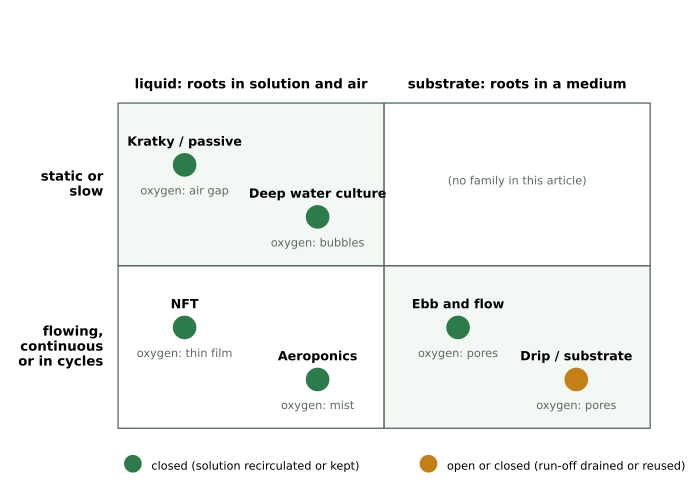
Four axes that place any system
Textbooks split hydroponics into two groups. In water culture the roots hang in the nutrient solution, which is aerated or allowed to meet air; in aggregate (substrate) culture the roots grow in a solid, inert material that holds moisture, drains the excess and provides anchorage6. Resh adds that because most methods use some medium the field is often called soilless culture, while “water culture alone would be true hydroponics”1. We use four axes, which together place every system you will meet.
Axis 1: liquid or substrate. The question is what touches the root: solution and air, or a medium whose pores hold both. The medium changes the oxygen story completely. In a well-drained medium the voids between particles should be filled with moist air, not water1, and Raviv and co-authors call such a medium “a passively buffered oxygen situation”: oxygen diffuses in and carbon dioxide out without any machine4. Water culture has no such buffer, so oxygen is forced in by bubbling air or spraying the solution4.
Axis 2: static or flowing. In a static system all the solution is put in before planting and nothing moves it; Kratky’s methods need no electricity, pumps or wicks2. In a flowing system a pump moves solution past the roots, continuously, as in NFT, which “must flow continuously to provide adequate water”1, or in cycles, as in ebb and flow and drip. Flow brings fresh solution and, with it, fresh oxygen.
Axis 3: how oxygen reaches the roots. There are five routes. An air gap: in a Kratky container the level falls as the plant drinks, and roots in the moist air space above it act as “oxygen roots”, while the oxygen content of the solution gets lower with depth2. Bubbles or splashing: an air pump through an airstone, or a return flow over baffles, in raft culture1. A thin film: the name “nutrient film” was coined to stress that the liquid flowing past the roots should be very shallow, so that enough oxygen reaches them1. Substrate pores: the moist air in the voids of a drained medium1. Mist: in aeroponics the roots hang in a closed dark chamber and jets of solution are sprayed over them periodically, so they take oxygen from the spray and from the air in the chamber1.
Axis 4: open or closed. Mason’s wording is “closed or open (i.e. the solution is recycled or drained through and lost)"6; open systems are also called drain-to-waste. The simplest closed system is a mixing tank into which fresh nutrient solution is added to the recirculated drainage before the next irrigation7. The water often decides: Castilla advises closed systems with good water, semi-closed systems, which flush the tank periodically, with medium-quality water, and open systems or reverse osmosis with poor water7. Managing a recirculating solution over time explains why salts build up in a closed loop.
The families, placed on the axes
Passive and Kratky systems are liquid, static, air-gap and closed in the sense that nothing leaves. A seedling in a net pot sits with its lower 3 cm in solution; as the plant drinks, the level drops and an enlarging moist air space forms under the cover, where the oxygen roots grow2. The crop is harvested before the solution runs out2. Kratky and other passive systems is the next article.
Deep water culture, or raft culture, is liquid, slowly flowing, bubble-aerated and closed. Lettuce sits on polystyrene boards floating on beds 15 to 20 cm deep that hold a large volume of solution, “fairly static”, circulated at 2 to 3 L/min and aerated with air stones or by circulation through a tank1. Deep water culture covers aeration and sizing.
Nutrient film technique is liquid, continuously flowing, film-aerated and closed. Roots sit in a small channel through which a thin film of solution passes1; the channel slopes to a catchment that returns the solution to a tank1. Nutrient film technique gives film depth, slope and channel-length limits.
Ebb and flow, or flood and drain, is substrate, cyclic, pore-aerated and closed. A watertight bed of gravel or another inert medium is flooded from a sump holding a volume equal to the bed and drains back by gravity; the solution is recirculated until it is no longer usable, then dumped8. Ebb and flow covers flood timing.
Drip and substrate culture is substrate, cyclic, pore-aerated, and either open or closed. Solution is dripped onto slabs or pots on a schedule set by the medium: coarse aggregates may need water every hour during the day, fine media such as coir and peat one or two irrigations a day1. Fine media need 20% to 30% run-off to flush salts1, and what happens to that run-off is the open-versus-closed choice. Drip irrigation and substrate culture covers leaching and scheduling.
Aeroponics is liquid, intermittently flowing, mist-aerated and closed. Roots hang in a dark chamber, high-pressure nozzles spray them from below, and the excess drains back to the tank1. Aeroponics and fogponics covers droplets, pressure and failure modes.
Design parameters common to every family
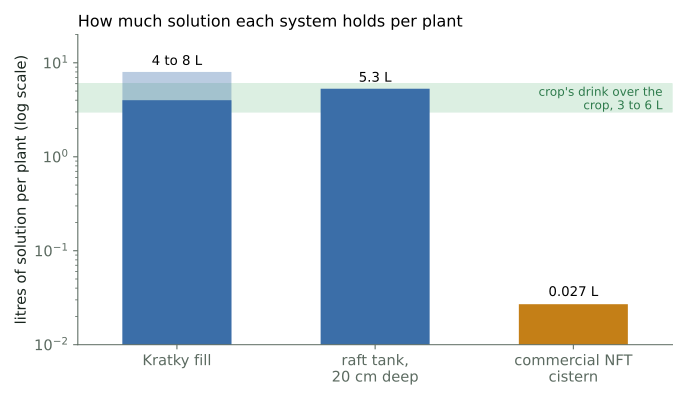
Solution per plant is the buffer. Raviv and co-authors make the central point: in soil some factors take weeks to change, but “every factor in soilless production has the capacity to change much more rapidly”, so where fast control is impossible the designer adds buffering to slow the change to a manageable level4. The simplest buffer is volume. A Kratky tank is filled with 4 to 8 L per plant before planting2. Resh’s small-greenhouse raft bed holds 11,355 L for 3,456 plants, which is 3.3 L per plant, our division of his two figures1. The commercial NFT system he describes pumps from a 1,890 L cistern to 70,000 plants, which is 0.027 L per plant by the same arithmetic, about one hundredth of the raft figure1. The NFT crop lives on continuous flow and continuous make-up; the Kratky crop lives on its initial volume alone.
Flow or turnover. Flowing systems are described by how often the solution is exchanged. Resh’s raft bed of 3,600 L at 2 to 3 L/min is exchanged about once in 24 h1, while his aeration rule for water culture is 1 to 2 complete changes per hour for a bed holding 10 to 15 cm of solution1. NFT flows all the time, because the film is the only water the roots have1.
Spacing. Spacing sets how many plants a tank serves and so the buffer per plant. The Cornell lettuce pond runs at 97 plants per m² from day 11 to day 21 and 38 plants per m² after re-spacing until harvest on day 353; Resh’s raft boards and NFT channels both use 15 cm × 15 cm1.
What happens when the pump stops. A Kratky system has no pump to stop2. In NFT, if the flow is interrupted, “only the plant root mat contains a small amount of residual moisture”1, so the crop has hours, this article’s inference from that passage and from the daily drink calculated below. In a raft tank the roots stay wet but the oxygen goes: the Cornell handbook states that if no oxygen is added to the pond the dissolved oxygen drops to nearly 0 ppm, and lettuce needs at least 4 ppm3. In substrate the medium itself is the reserve, and the irrigation interval is our guide to its size: hours for coarse aggregates, a day or so for coir and peat1.
Worked example: twelve lettuce for five weeks
Suppose you grow twelve heads of leaf lettuce on the Cornell schedule, which harvests 150 g heads on day 35 after 11 days in the nursery3. How much water will they drink, and how does that compare with what each system holds?
Input 1, water per plant. Kratky reports that growers aiming at 150 to 250 g heads see a nutrient solution consumption of typically 3 to 6 L per plant over a crop of about 6 to 7 weeks from seeding2. Our 35-day crop to a 150 g head is shorter and smaller, so 3 to 6 L is an upper bound, which this article keeps as a simplification of2,3.
Crop drink. 12 plants × 3 to 6 L = 36 to 72 L for the whole crop, our arithmetic from2. Spread over 35 days that is 1.0 to 2.1 L per day for the twelve, or 86 to 171 mL per plant per day on average, our estimate from2,3. The real rate is far from flat: water demand rises with leaf area as the plant grows1, so the last week takes much more than the first.
System 1, Kratky containers. Fill at 4 to 8 L per plant2: 12 × 4 to 8 L = 48 to 96 L in total, our arithmetic. That equals or exceeds the 36 to 72 L the crop drinks, which is why the method works with no top-up at all: the crop is harvested before the solution is exhausted2.
System 2, a raft tank. At Cornell’s final spacing of 38 plants per m²3, twelve plants need 12 ÷ 38 = 0.32 m² of raft. At Resh’s minimum depth of 20 cm1, the tank holds 0.32 m² × 0.20 m = 0.063 m³, about 63 L, or 5.3 L per plant, our arithmetic from1,3. The crop would drink 57% to 114% of that tank over five weeks, so it needs topping up; adding water once a week means 7 to 14 L each time, a ninth to a quarter of the tank, our estimate from1,2,3.
System 3, an NFT channel plus tank. At Resh’s commercial ratio of 0.027 L per plant1, twelve plants would be served by 0.32 L of solution in the cistern, which the crop drinks in 4 to 8 hours at the average rate, our arithmetic from1,2. Commercial NFT therefore runs with continuous make-up water. For a small rig you choose the tank; with a 20 L tank, our choice for the example and not a sourced figure, the 1.0 to 2.1 L daily drink empties it in 10 to 20 days, our arithmetic from2, so you top up weekly at least. The pump runs the whole time, and if it stops the roots have only the moisture in the root mat1.
Choosing a family
| Family | Buffer (solution per plant) | Power needed | What fails first | Suited crops in the sources |
|---|---|---|---|---|
| Passive and Kratky | 4 to 8 L at planting2 | none2 | solution exhausted; roots drowned if the level is raised2 | lettuce and other short-term crops needing under 4 L2 |
| Deep water culture, raft | 3.3 L in Resh’s bed (derived)1; 5.3 L in the example | air pump or circulation pump1 | dissolved oxygen falls toward 0 ppm when aeration stops3 | lettuce, basil1 |
| Nutrient film technique | 0.027 L at commercial scale (derived)1 | pump running continuously1 | only the root mat’s moisture when flow stops1 | lettuce at 15 cm × 15 cm spacing1 |
| Ebb and flow | sump equal in volume to the bed8 | electrical pump from a sump8 | root disease; medium replacement8 | tomatoes, lettuce8 |
| Drip and substrate | the medium’s water between irrigations1 | pump on a schedule1 | salt build-up without 20% to 30% run-off1 | see Drip irrigation and substrate culture |
| Aeroponics | the tank only; roots in air hold no reserve (this article’s inference from1) | high-pressure pump and nozzles1 | pump or nozzles stop and the roots dry (this article’s inference from1) | lettuce, herbs, root crops for extracts1 |
Key numbers
| Quantity | Typical value or range | Conditions | Source |
|---|---|---|---|
| Kratky fill per plant | 4 to 8 L | lettuce, filled before planting | 2 |
| Kratky consumption per plant | 3 to 6 L | 150 to 250 g heads, 6 to 7 weeks from seeding | 2 |
| Raft bed depth | 15 to 20 cm; minimum 20 cm for a built bed | commercial lettuce | 1 |
| Raft circulation | 2 to 3 L/min, one exchange per 24 h | 3,600 L bed | 1 |
| Water-culture aeration rule | 1 to 2 complete changes per hour | bed with 10 to 15 cm of solution | 1 |
| Raft solution per plant | 3.3 L | 11,355 L bed, 3,456 plants, our division | 1 |
| NFT solution per plant | 0.027 L | 1,890 L cistern, 70,000 plants, our division | 1 |
| Lettuce spacing | 97 then 38 plants per m² | Cornell pond, re-spaced on day 21 | 3 |
| Lettuce crop length | 35 days, harvested at 150 g | Cornell schedule, 11 days in nursery | 3 |
| Dissolved oxygen for lettuce | at least 4 ppm; held at 8 ppm | pond; drops to nearly 0 without aeration | 3 |
| Irrigation interval in substrate | hourly for coarse aggregates; 1 to 2 per day for coir and peat | daytime, greenhouse | 1 |
| Run-off for fine media | 20% to 30% | foam, rockwool, to flush salts | 1 |
Common mistakes
- Choosing a system by its name instead of its buffer. The volume of solution per plant, from 0.027 L in commercial NFT to 4 to 8 L in a Kratky tank, decides how many hours you have when something stops1,2.
- Letting light reach the solution. Algae compete with the crop for nutrients and, at night, for oxygen, so every family keeps the solution dark1.
- Topping up a Kratky container to the original level. The moist air space is where the oxygen roots live; raising the level over them drowns the plant2.
- Assuming a raft crop is safe because the roots stay wet when the pump fails. Without aeration the dissolved oxygen falls toward zero, and lettuce needs at least 4 ppm3.
Summary
Every hydroponic system must give the roots water, nutrients and oxygen, hold the plant up, keep the root zone at a workable temperature, and keep out light and pathogens. The families differ only in how they do each job, and four axes place any of them: liquid or substrate, static or flowing, the route oxygen takes, and open or closed. Because every root-zone factor can change fast in soilless culture, the main design parameter is the buffer, above all the solution per plant, with flow, spacing and the pump-failure mode after it. For twelve lettuce over five weeks, a crop that drinks 36 to 72 L, a Kratky set holds the whole crop’s water at planting, a raft tank of about 63 L needs a weekly top-up, and an NFT tank at commercial proportions holds a few hours’ worth1,2,3. Pick the family whose failure mode you can live with, then read its own article for the details.
Next in the series: Kratky and other passive systems.
References
- Resh, H. M. (2013). Hydroponic Food Production: A Definitive Guidebook for the Advanced Home Gardener and the Commercial Hydroponic Grower, 7th ed. CRC Press, Boca Raton. ISBN 978-1-4398-7869-9.
- Kratky, B. A. (2009). Three non-circulating hydroponic methods for growing lettuce. Acta Horticulturae, 843, 65–72.
- Brechner, M. and Both, A. J. (2013). Hydroponic Lettuce Handbook. Cornell University Controlled Environment Agriculture Program. https://cpb-us-e1.wpmucdn.com/blogs.cornell.edu/dist/8/8824/files/2019/06/Cornell-CEA-Lettuce-Handbook-.pdf
- Raviv, M., Lieth, J. H., Bar-Tal, A. and Silber, A. (2008). Growing plants in soilless culture: operational conclusions. In Raviv, M. and Lieth, J. H. (eds), Soilless Culture: Theory and Practice, chapter 13. Elsevier, Amsterdam. https://doi.org/10.1016/B978-0-444-52975-6.50015-0
- Kafkafi, U. (2008). Functions of the root system. In Raviv, M. and Lieth, J. H. (eds), Soilless Culture: Theory and Practice, chapter 2. Elsevier, Amsterdam. https://doi.org/10.1016/B978-0-444-52975-6.50004-6
- Mason, J. Commercial Hydroponics, 3rd ed. ACS Distance Education. Year not printed in the corpus copy.
- Castilla, N. (2013). Greenhouse Technology and Management, 2nd ed. CABI, Wallingford.
- Jones, J. B. Jr. (2005). Hydroponics: A Practical Guide for the Soilless Grower, 2nd ed. CRC Press, Boca Raton.
This article was drafted with the help of AI tools and reviewed and edited by PonicLabs. Sources are listed above; tell us if you find an error.