Dissolved oxygen in the root zone
Contents
Standfirst: After reading this article you will be able to read an oxygen solubility table, convert between mg/L, µmol/L and percent saturation, estimate how long the oxygen in a tank would last against a measured root respiration rate, explain what an air stone and water flow actually do, and compare your meter reading with the concentrations at which lettuce grows well and suffers.
Before you read: Photosynthesis and respiration for growers, How roots take up nutrients.
Roots breathe, and in water the oxygen must arrive dissolved
Roots have no light and no chlorophyll. They run on sugar sent down from the leaves and burn it with oxygen, and that respiration pays for growth and for the active uptake of ions described in How roots take up nutrients. In soil the oxygen comes from the air in the pores. In a hydroponic tank it has to come from the solution, which means it must first dissolve in water and then diffuse to the root surface.
Both steps are weak. Air is about 21% oxygen, but water in equilibrium with air at 25 °C holds only about 250 micromoles of oxygen per litre1. That small store also moves slowly: the diffusion coefficients of gases in air are about four orders of magnitude greater than in water6, and Marschner’s textbook puts the practical difference in soil at about 100 times faster through air-filled pores than through water4. Whole tissues respire more slowly once the gas around them falls below about 5% oxygen, although the enzyme that consumes oxygen is satisfied by well under 1 micromole per litre, which shows that diffusion through the watery phase of the tissue is the bottleneck1.
Root tips are the most demanding part. For a maize root tip in a well-stirred nutrient solution at 25 °C, respiration first slows when the oxygen partial pressure drops below about 0.20 atmosphere, almost the level in ordinary air; older parts of the root cope down to 0.1 to 0.05 atmosphere1. The tank’s concentration is only half of the story; the other half is how fast oxygen reaches the root surface.
How much oxygen water can hold
Henry’s law says that the amount of a gas that dissolves is proportional to its partial pressure above the water10. Air at normal pressure contains 20.946% oxygen2, which gives an oxygen partial pressure of 159 mm Hg, and water in equilibrium with that air is at 100% saturation; if the pressure is lower, as at altitude, so is the dissolved concentration10. Warmer water and saltier water both hold less2.
The reference values come from the equations of Benson and Krause, adopted by the United States Geological Survey in 2011 and cited by Standard Methods; they cover 0 to 40 °C, salinity 0 to 40 parts per thousand and pressures of 0.5 to 1.1 atmospheres3. For fresh water at one atmosphere the equation is3
DO₀ = exp(−139.34411 + 1.575701 × 10⁵ / T − 6.642308 × 10⁷ / T² + 1.243800 × 10¹⁰ / T³ − 8.621949 × 10¹¹ / T⁴),
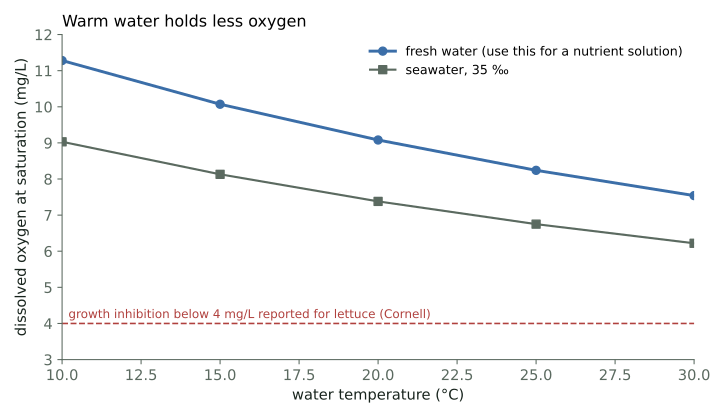
with T the water temperature in kelvin (°C + 273.15) and DO₀ in mg/L3. The table below, reproduced from Colt’s 1984 tables as printed in an aquaculture textbook, for moist air at one atmosphere2, agrees with the equation to within 0.02 mg/L at every row.
| Water temperature | Saturation, fresh water (0 ‰) | Saturation, 35 ‰ (seawater) | Source |
|---|---|---|---|
| 10 °C | 11.28 mg/L | 9.03 mg/L | 2 |
| 15 °C | 10.07 mg/L | 8.13 mg/L | 2 |
| 20 °C | 9.08 mg/L | 7.38 mg/L | 2 |
| 25 °C | 8.24 mg/L | 6.75 mg/L | 2 |
| 30 °C | 7.54 mg/L | 6.22 mg/L | 2 |
Two conversions make the table usable. Oxygen gas is O₂ with a molar mass of 32 g/mol, so 1 mg/L is 31.25 µmol/L, and 9.08 mg/L at 20 °C is 284 µmol/L, consistent with the 277 µmol/L that Taiz and Zeiger quote for 20 °C1. For pressure, the aquaculture text multiplies the table value by the measured barometric pressure divided by sea-level pressure; its example for fresh water at 28 °C and 900 hPa is 8.244 × 900 / 1013 = 7.32 mg/L2 (the book prints its pressures as kPa; they are hPa, 1013 hPa being 101.3 kPa or 760 mm Hg). For a nutrient solution use the fresh-water column.
Percent saturation is the measured concentration divided by the saturation concentration at the same temperature and pressure, times 100; surface fresh water at 25 °C containing 10 mg/L is at 121% saturation2. A meter that shows both numbers measures one of them and the temperature, then looks up the table for the other. Percent saturation tells you which way oxygen is moving: below 100%, from air into water; above it, out2.
Root demand: how fast a still tank would run down
The store is fixed by the table; the drain is set by the roots. Chun and Takakura built an airtight hydroponic box and measured how fast lettuce roots removed oxygen from the solution at 23 °C7. For dissolved oxygen between 190 and 230 µmol/L, the range they call usual in well-aerated beds, the roots of leaf lettuce 26 days after transplanting respired at 2.9 to 6.7 µmol of oxygen per hour per millilitre of roots7. The rate fell as the oxygen fell, and the decline levelled off at around 78 µmol/L, about 2.5 mg/L, which they call the minimum dissolved oxygen concentration for root respiration7. The root systems were small: their regression gives a root volume of 0.0698 × 1.1230^d millilitres at d days after transplanting, about 1.4 ml at 26 days and 4 ml at 35 days7.
At the other end of the scale, Marschner’s textbook, citing Cannell (1977), reports that under a dense crop stand in soil the oxygen consumption may be as high as 17 litres per square metre per day4. Taking those litres at standard temperature and pressure, oxygen gas has a density of 1.42905 mg per millilitre3, so that is about 24 g of oxygen per square metre per day, roughly 1 g per hour.
Worked example: a 100 L tank at 20 °C and at 30 °C
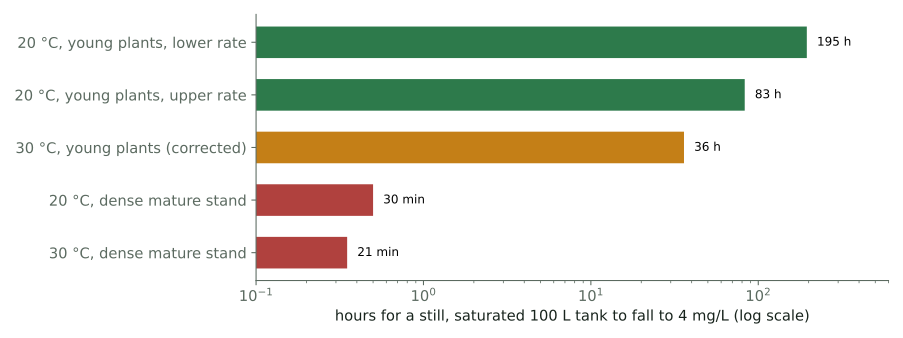
Take 100 L of fresh nutrient solution, saturated with air, with no aeration and no flow, and ask how long it takes to fall to the 4 mg/L below which Cornell’s lettuce programme reports growth inhibition9.
- Store. At 20 °C saturation is 9.08 mg/L, so the tank holds 908 mg of oxygen, of which 508 mg can be used before 4 mg/L; at 30 °C saturation is 7.54 mg/L, the tank holds 754 mg and 354 mg is usable2,9.
- Demand, young plants. Twenty leaf lettuce plants 26 days after transplanting, at about 1.4 ml of roots each (1.42 ml from the regression), make 28.5 ml of roots7. At the upper measured rate of 6.7 µmol per hour per millilitre that is 191 µmol/h, which at 32 mg per millimole is 6.1 mg of oxygen per hour; at the lower rate of 2.9 it is 2.6 mg/h7.
- Demand, dense stand. If a square metre of raft over the same tank carrying a dense, mature crop respired as much as Marschner’s field stand, it would draw up to about 1,010 mg/h3,4; no hydroponic measurement of that figure was found, so treat it as an upper bound.
Dividing the usable store by the demand gives the time to reach the Cornell floor9:
- 20 °C, young plants: 508 / 6.1 = 83 hours, about three and a half days, at the upper rate; 508 / 2.6 = 195 hours, about eight days, at the lower rate2,7,9.
- 20 °C, dense stand: 508 / 1,010 = 0.50 hours, about 30 minutes2,3,4,9.
- 30 °C, dense stand: 354 / 1,010 = 0.35 hours, about 21 minutes2,3,4,9.
For young plants at 30 °C the rate measured at 23 °C must be adjusted7. Between 0 and 30 °C respiration roughly doubles for each 10 °C rise1; over 7 °C that is a factor of 2^0.7 = 1.62, which takes 6.1 mg/h to 9.9 mg/h, and the usable 354 mg then lasts 354 / 9.9 = 36 hours1,2,7,9.
The spread is the lesson. Twenty small plants take days to run down a 100 L tank, which helps explain why a Kratky container with an air gap can work13; a full raft of mature roots could do it in half an hour, and warm water shortens both the store and the time. Your system sits somewhere between, and the only way to know where is to measure.
Why stillness hurts before the tank is empty
The calculation treats the tank as perfectly mixed, and it is not. Taiz and Zeiger note that dissolved oxygen diffuses so slowly in stagnant water that, in a waterlogged soil, only a few centimetres near the surface stay oxygenated, and that above 20 °C roots and microbes can strip the bulk water of oxygen in as little as 24 hours1. Kratky describes the same gradient in a non-circulating tank: roots in the moist air space above the solution act as oxygen roots, while the roots in the solution have limited elongation “because the oxygen content of the nutrient solution becomes progressively lower with depth”13. His rule follows: the level may stay the same or fall, but it must never be raised, because submerging the oxygen roots drowns the plant13.
Chun and Takakura give the second mechanism. A root mass growing as a lump blocks the flow of solution through itself, so the mass flow of dissolved oxygen is obstructed and the roots outside the flow suffer, even in nutrient film systems designed for aeration7. Immersing roots in unagitated water “drastically reduces the diffusion of gases to the roots”7. Flow brings oxygen to the root surface the way it brings ions, and with oxygen the stakes are higher because the store is so small.
Roots respond fast: Kafkafi cites an experiment in which cotton roots stopped growing immediately when the soil oxygen was replaced with nitrogen gas5. In a growing medium the same question is asked of the air-filled pores, and Growing media I takes that up.
Aeration: how oxygen gets back in
Oxygen crosses from air to water only at a surface, and the rate depends on how far the water is from saturation and on how much surface there is. Colt writes the standard two-film model for slightly soluble gases as12
ln[(C* − C_in) / (C* − C_out)] = K_L a × t,
where C* is the saturation concentration at the local temperature and pressure, C_in and C_out the concentrations before and after, K_L the liquid-side transfer coefficient, a the interfacial area per cubic metre of water, and t the contact time; the concentration approaches C* but needs infinite time to reach it12. Every aeration method acts on one of those terms: more surface, more renewal of the surface, more contact time.
When water is below saturation, oxygen diffuses in through the surface; waves add surface area, and mixing the surface layer with deeper water keeps re-establishing a fresh surface so that it does not saturate faster than oxygen can move into the water below2.
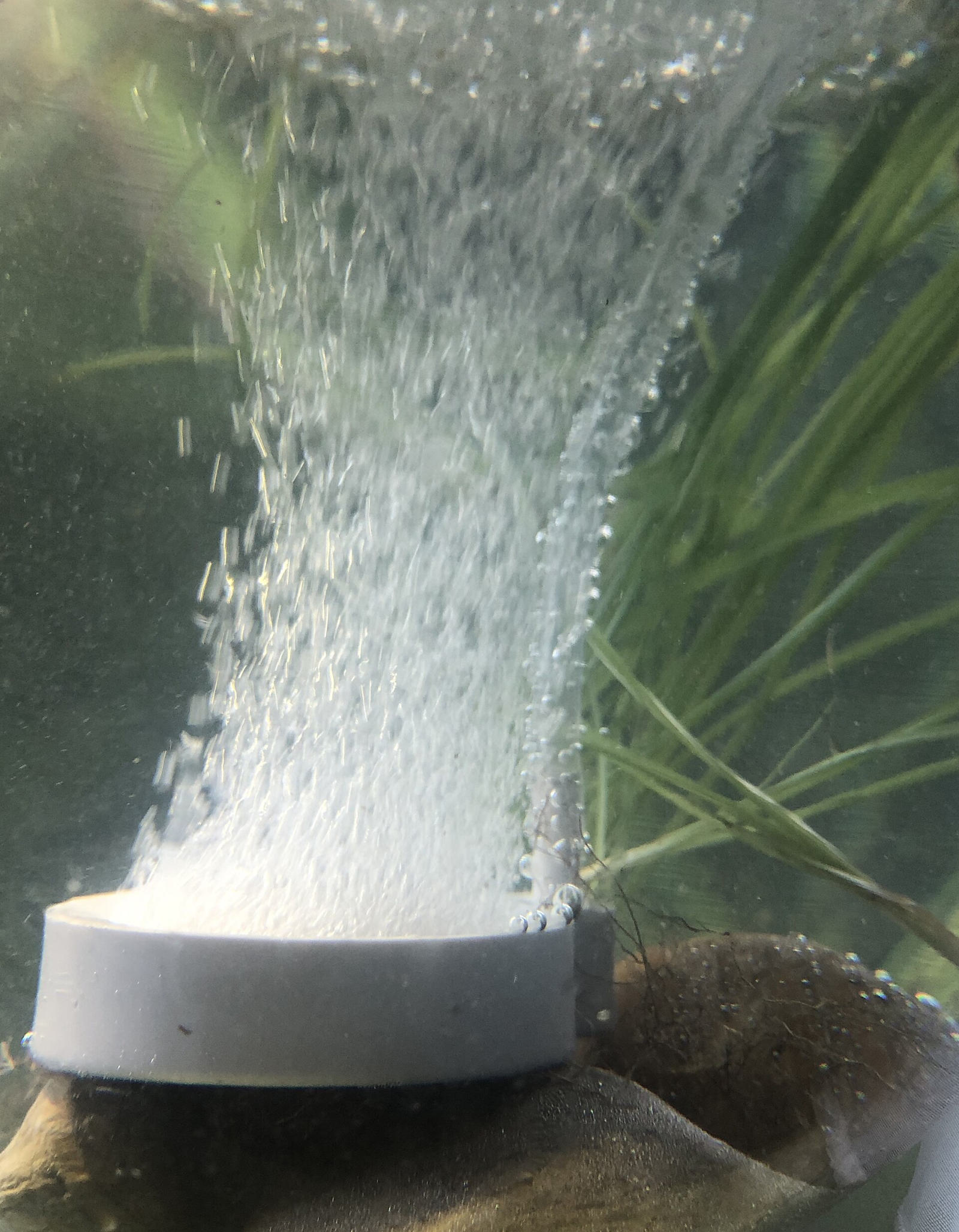
An air stone probably works largely the same way, less through its bubbles than people assume; the sources below give the bubble side of the account, and the surface side is this article’s inference. Fine-pore diffusers with pores of 0.1 to 0.3 mm make bubbles of 1.5 to 3.0 mm, while non-porous diffusers with openings of 5 to 25 mm make bubbles of 20 to 40 mm11. A bubble’s surface-area-to-volume ratio falls as it grows, and small bubbles rise more slowly, so their contact time is longer10,11. Pushing more air through the same stone makes the bubbles larger and faster, so the transfer per litre of air falls as the flow rises11.
The industry rates diffusers by the standard oxygen transfer efficiency, SOTE, the fraction of the oxygen supplied that actually dissolves11. Fine-pore diffusers 3.7 to 4.3 m under the surface reach 26 to 32% in clean water, and one clean-water test series of fine-pore diffusers in grids gives a depth-corrected 5.7 to 6.0% per metre of submergence11. A hydroponic tub is far shallower; at 0.3 m, if the per-metre figure held, an air stone would dissolve roughly 1.7 to 1.8% of the oxygen it is fed11. The rest leaves at the surface, having lifted water, stirred the tank and renewed the surface on the way, which is where the mechanism in2 takes over.
That lets you translate a pump rating. One litre of air contains 20.946% oxygen by volume2 and oxygen has a density of 1.42905 mg/mL at standard temperature and pressure3, so one litre of air carries about 0.30 g of oxygen. A pump rated at 1 L/min delivers about 18 g of oxygen per hour to the stone, of which, at 1 to 2% transfer in a shallow tub, something like 0.2 to 0.4 g/h dissolves, and an aquarium stone pushed hard is likely to do worse, since transfer falls as the air per diffuser rises2,3,11. That is far more than twenty young lettuce plants need and a fifth to two-fifths of a dense mature square metre at its peak4,7. Cornell’s handbook agrees in words: for sufficiently small systems an air pump and aquarium air stone are enough, though the level will not match pure oxygen9. These transfer figures come from wastewater diffusers at several metres’ depth and are an order-of-magnitude guide, not a specification for an aquarium stone; Deep water culture and Build: a deep water culture tub size pumps for real systems.
Targets, and the warm-water problem
Three sources, two of them from the same Cornell group, give a consistent picture of what is adequate and a less consistent one of where damage starts. Cornell’s deep-flow programme reports that lettuce grows satisfactorily at a dissolved oxygen level of at least 4 ppm, that visible stress appears at 3 ppm, that with no oxygen added the level drops to nearly zero and the plant dies, and that they keep their ponds at 8 ppm, within 7 to 10, with no advantage at 20 ppm9. Goto and co-workers grew lettuce for 24 days in floating culture at 2.1, 4.2, 8.4 and 16.8 mg/L at 24 °C, that is at 25% to 200% of saturation, and found no significant difference in fresh weight or in shoot and root dry weight, and no root damage; they put the critical level for vigorous growth below 2.1 mg/L8. Chun and Takakura’s measured minimum for root respiration, about 2.5 mg/L, sits in the same region7.
Read together: for lettuce anything from about 4 mg/L up to saturation is adequate, and supersaturation buys nothing measurable8,9. Where damage begins is less settled: Cornell reports visible stress at 3 ppm and, in its set-point table, crop failure below it9, while Goto and co-workers saw no loss of growth and no root damage after 24 days at 2.1 mg/L8; Chun and Takakura’s respiration floor of about 2.5 mg/L sits between the two7. Other crops have been studied less; treat the lettuce figures as a floor, not a universal target.
The margin shrinks in warm water from both sides at once. Saturation at 30 °C is 7.54 mg/L against 9.08 mg/L at 20 °C, a 17% smaller store2, and respiration roughly doubles for each 10 °C between 0 and 30 °C1, so a root system that used 6 mg/h at 20 °C uses about 12 mg/h at 30 °C and empties a smaller store in well under half the time. Cornell sets its pond water at no higher than 25 °C9, and Chun and Takakura call the range between saturation and the respiration minimum at 23 °C “very narrow”7. Root-zone temperature covers solution temperature and its control. Here the rule is simple: if the solution is warm, measure oxygen more often, aerate more, and expect trouble first in the thickest root masses.
Key numbers
| Quantity | Typical value or range | Conditions | Source |
|---|---|---|---|
| Oxygen in air | 20.946% by volume | dry atmosphere | 2 |
| Oxygen saturation, fresh water | 11.28, 10.07, 9.08, 8.24, 7.54 mg/L | 10, 15, 20, 25, 30 °C, moist air at 1 atm | 2 |
| Oxygen saturation, 35 ‰ | 9.03 to 6.22 mg/L | 10 to 30 °C, 1 atm | 2 |
| Air-saturated water | about 250 µmol/L at 25 °C; 277 µmol/L at 20 °C | textbook values | 1 |
| Pressure correction | table value × barometric pressure / 1013 hPa | example: 8.244 × 900/1013 = 7.32 mg/L at 28 °C | 2 |
| Molar mass of O₂ | 32 g/mol, so 1 mg/L = 31.25 µmol/L | derived | 1 |
| Density of oxygen gas | 1.42905 mg/mL | real gas at standard temperature and pressure | 3 |
| Lettuce root respiration | 2.9 to 6.7 µmol O₂ per hour per ml of roots | 23 °C, 190 to 230 µmol/L DO, 26 days after transplanting | 7 |
| Lettuce root volume | 0.0698 × 1.1230^d ml; about 1.4 ml at 26 days | leaf lettuce in deep-flow beds, d days after transplanting | 7 |
| Minimum DO for root respiration | about 78 µmol/L (about 2.5 mg/L) | lettuce, 26 days after transplanting | 7 |
| Dense crop stand oxygen use | up to 17 L m⁻² d⁻¹, about 24 g m⁻² d⁻¹ | field crop stand in soil, Cannell 1977 via Marschner; litres taken at STP | 3,4 |
| Critical oxygen pressure, root tip | about 0.20 atm; 0.1 to 0.05 atm in older zones | maize, stirred solution, 25 °C | 1 |
| Respiration temperature response | about doubles per 10 °C | 0 to 30 °C | 1 |
| Lettuce DO, adequate | at least 4 ppm; ponds held at 8 (7 to 10) ppm | Cornell deep-flow system | 9 |
| Lettuce DO, stress visible | 3 ppm | Cornell | 9 |
| Lettuce growth, no difference | 2.1 to 16.8 mg/L | 24 days, 24 °C, floating culture | 8 |
| Fine-pore diffuser bubbles | 1.5 to 3.0 mm; coarse 20 to 40 mm | clean-water tests | 11 |
| Fine-pore SOTE | 26 to 32% at 3.7 to 4.3 m; 5.7 to 6.0% per metre | clean water, grid layouts | 11 |
| Oxygen carried by air | about 0.30 g per litre of air | standard conditions, derived | 2,3 |
| 100 L tank, usable store to 4 mg/L | 508 mg at 20 °C; 354 mg at 30 °C | derived | 2,9 |
Common mistakes
- Reading 100% saturation as “plenty”. The store at saturation is under 10 mg/L and a dense root mass can use it in under an hour, so what matters is how fast oxygen is replaced2,4.
- Judging the whole tank by a reading at the surface. Oxygen falls with depth and inside root lumps in still water, so the roots at the bottom of a thick mass can be short while the meter at the top reads well1,7,13.
- Buying a bigger air pump instead of a better one. Transfer per litre of air falls as flow rises because the bubbles get larger and faster; more stones, finer pores and better mixing do more than more air through one stone11.
- Topping up a Kratky container to its original level. The roots in the air space are the plant’s oxygen roots, and submerging them drowns the plant13.
- Ignoring solution temperature when the oxygen reading looks fine. At 30 °C the saturated store is 17% smaller than at 20 °C and respiration is about twice as fast, so the time to a damaging level is far shorter1,2.
Summary
Roots respire, and in a hydroponic tank their oxygen must first dissolve in water, which holds very little of it, and then diffuse to the root, which it does slowly. Saturation at one atmosphere falls from about 11 mg/L at 10 °C to 7.5 mg/L at 30 °C, and percent saturation is the reading divided by that table value2. Measured lettuce roots use 2.9 to 6.7 µmol of oxygen per hour per millilitre at 23 °C, so twenty young plants take days to run a still 100 L tank down to 4 mg/L, while a dense mature stand drawing about a gram per hour per square metre could do it in half an hour, faster still at 30 °C2,4,7,9. Stillness hurts before the tank is empty, because oxygen falls with depth and inside root lumps, which is why flow and the Kratky air gap matter. An air stone’s bubbles dissolve only a few percent of the oxygen in its air in a shallow tub; much of its effect is likely to come from stirring and renewing the surface. Only a few percent of the oxygen in its air dissolves in a shallow tub. For lettuce, 4 mg/L is adequate, 3 mg/L shows stress, 8 mg/L is a comfortable set-point, and supersaturation adds nothing8,9. Warm water shrinks the store and doubles the demand at once.
Next in the series: Root-zone temperature.
References
- Taiz, L. and Zeiger, E. (2002). Plant Physiology, 3rd ed. Sinauer Associates, Sunderland, MA. Chapters 11 and 25.
- Lucas, J. S. and Southgate, P. C. (eds) (2012). Aquaculture: Farming Aquatic Animals and Plants, 2nd ed. Chapter 3, Water quality. Wiley-Blackwell, Oxford. Table 3.2 reproduced from Colt, J. (1984), Computation of Dissolved Gas Concentrations in Water as Functions of Temperature, Salinity, and Pressure, American Fisheries Society Special Publication 14.
- U.S. Geological Survey, Office of Water Quality (2011). Change to solubility equations for oxygen in water. Technical Memorandum 2011.03, with attachment "Analysis to support the replacement of Weiss (1970) equations by Benson and Krause (1980, 1984) equations for USGS computation of solubility of dissolved oxygen in water". https://water.usgs.gov/admin/memo/QW/qw11.03.pdf The underlying paper is Benson, B. B. and Krause, D. Jr. (1984). The concentration and isotopic fractionation of oxygen dissolved in freshwater and seawater in equilibrium with the atmosphere. Limnology and Oceanography, 29(3), 620–632. https://doi.org/10.4319/lo.1984.29.3.0620
- Marschner, P. (ed.) (2012). Marschner's Mineral Nutrition of Higher Plants, 3rd ed., Chapter 13, Effect of internal and external factors on root growth and development, section 13.4.3 Aeration. Academic Press, London. ISBN 978-0-12-384905-2.
- Kafkafi, U. (2008). Functions of the root system. In: Raviv, M. and Lieth, J. H. (eds.), Soilless Culture: Theory and Practice, Chapter 2. Elsevier, Amsterdam. PII B978-0-444-52975-6.50004-6.
- Wallach, R. (2008). Physical characteristics of soilless media. In: Raviv, M. and Lieth, J. H. (eds.), Soilless Culture: Theory and Practice, Chapter 3. Elsevier, Amsterdam. PII B978-0-444-52975-6.50005-8.
- Chun, C. and Takakura, T. (1994). Rate of root respiration of lettuce under various dissolved oxygen concentrations in hydroponics. Environment Control in Biology, 32(2), 125–135. https://doi.org/10.2525/ecb1963.32.125
- Goto, E., Both, A. J., Albright, L. D., Langhans, R. W. and Leed, A. R. (1996). Effect of dissolved oxygen concentration on lettuce growth in floating hydroponics. Acta Horticulturae, 440, 205–210. https://doi.org/10.17660/ActaHortic.1996.440.36
- Brechner, M., Both, A. J. and CEA Staff (2013). Hydroponic Lettuce Handbook. Cornell University Controlled Environment Agriculture Program, Ithaca, NY. https://cpb-us-e1.wpmucdn.com/blogs.cornell.edu/dist/8/8824/files/2019/06/Cornell-CEA-Lettuce-Handbook-.pdf
- Lekang, O.-I. (2013). Aquaculture Engineering, 2nd ed. Chapter 12, Aeration and oxygenation. Wiley-Blackwell, Chichester.
- Mueller, J. A., Boyle, W. C. and Pöpel, H. J. (2002). Aeration: Principles and Practice. Water Quality Management Library, Volume 11. CRC Press, Boca Raton.
- Colt, J. (2000). Degassing systems. In: Stickney, R. R. (ed.), Encyclopedia of Aquaculture. John Wiley & Sons, New York.
- Kratky, B. A. (2009). Three non-circulating hydroponic methods for growing lettuce. Proceedings of the International Symposium on Soilless Culture and Hydroponics, Acta Horticulturae, 843, 65–72.
This article was drafted with the help of AI tools and reviewed and edited by PonicLabs. Sources are listed above; tell us if you find an error.