What plants are made of: the essential elements
Contents
Standfirst: After reading this article you will be able to name the chemical elements a plant cannot complete its life without, explain the test that puts an element on that list, read a table of typical tissue concentrations, and estimate how many grams of nitrogen and potassium a head of lettuce contains. You will also know why a shortage of some elements shows first on old leaves and a shortage of others on young ones.
Before you read: What a plant needs, Photosynthesis and respiration for growers, Water in the plant.
Most of a plant is water, and most of the rest comes from air
Fresh plant matter is about 80% to 95% water, and the exact share changes with the species, the time of day, the temperature and the wind1. Because the water content moves so much, laboratories do not report composition per kilogram of fresh plant. They dry the sample at 70 °C for 24 to 48 hours and report everything per kilogram of dry matter, which is roughly 10% to 20% of the original fresh weight1.
Within that dry matter, over 90% of the mass of most plant material is only three elements: carbon, oxygen and hydrogen1. None of them comes from fertiliser. Carbon and part of the oxygen enter the leaf as carbon dioxide from the air; hydrogen and the rest of the oxygen come from water1. Photosynthesis joins them into sugars, and the sugars become everything else.
Take a plant whose dry matter is 15% of its fresh weight, with 90% of that dry matter made of carbon, hydrogen and oxygen; all the other elements together are then 0.15 × 0.10 = 0.015, about 1.5% of the fresh weight1. That small fraction is what this article is about, and it is the only part a hydroponic grower supplies as dissolved salts.
What “essential” means
Plants absorb more than they need. Roots take up, to some degree, any element dissolved in the water around them, and about 60 of the natural elements have been found inside plants1. To decide which elements a plant truly requires, plant scientists use a definition published in 1939 by Daniel Arnon and Perry Stout at the University of California1,2,4.
Their definition has three tests, and an element must pass all three to be called essential1,2:
- Without the element, the plant cannot complete its life cycle, from seed to seed1,2,5.
- The element’s job is specific. No other element can fully take its place1,2.
- The element acts directly in the plant’s nutrition, for example as part of an essential molecule or as a requirement for an essential enzyme. It does not count if the element only makes another element easier to take up, or only cancels a toxic effect1,2,5.
The test is hard to run. You have to grow a plant in a medium from which only that element is absent, which is almost impossible in soil, so the question was settled by growing plants in water solutions of pure salts; this is where hydroponics began as a research method3. Even then, impurities can hide a requirement: early solutions seemed complete, but they contained boron and molybdenum as contaminants, and both turned out to be essential3.
Later authors loosened the definition. Epstein proposed that an element also counts as essential if it has a clear physiological role in the plant, even where a life-cycle test is impractical3. A 2022 review by Brown, Zhao and Dobermann sums up current practice: “for practical purposes 17 elements are commonly classified as ’essential’ for plant growth”5.
Nickel is the most recent arrival. In 1987 Brown, Welch and Cary grew barley with and without nickel and found that “Under Ni-deficient conditions, barley plants fail to produce viable grain”6. That is a failure to complete the life cycle, the first Arnon and Stout test, and the authors concluded that nickel “should be added to the list of micronutrients essential for all higher plant growth”6. Nickel’s known role is as part of the enzyme urease1,3. Older textbooks still count 16 essential elements1,2; the difference is nickel.
The seventeen essential elements
The table lists each element, the chemical form in which roots take it up, a typical concentration in dry tissue, and its main job. The concentrations come from a table compiled by Epstein in 1972 of levels “sufficient for adequate growth”, reproduced in Jones2 and in Taiz and Zeiger3; Resh prints the same values from a 1961 source by Stout1. They are typical adequate levels, not targets for any one crop. Real values vary by species, organ and age, and the lettuce example below sits well above them for nitrogen and potassium.
| Element | Symbol | Form taken up | Typical concentration in dry tissue | Main role |
|---|---|---|---|---|
| From air and water | ||||
| Carbon | C | CO₂ | 45%1,3 | every organic molecule |
| Oxygen | O | CO₂, H₂O, O₂ | 45%1,3 | organic molecules, respiration |
| Hydrogen | H | H₂O | 6%1,3 | organic molecules, water |
| Mineral macronutrients | ||||
| Nitrogen | N | NO₃⁻, NH₄⁺1 | 1.5%1,2,3 | amino acids, proteins, nucleic acids3 |
| Potassium | K | K⁺1 | 1.0%1,2,3 | cofactor for over 40 enzymes; main ion keeping cells turgid3 |
| Calcium | Ca | Ca²⁺1 | 0.5%1,2,3 | middle lamella between cell walls; signalling3 |
| Magnesium | Mg | Mg²⁺1 | 0.2%1,2,3 | centre of the chlorophyll molecule3 |
| Phosphorus | P | H₂PO₄⁻, HPO₄²⁻1 | 0.2%1,2,3 | sugar phosphates, nucleic acids, ATP, membranes3 |
| Sulfur | S | SO₄²⁻1 | 0.1%1,2,3 | amino acids cysteine and methionine3 |
| Micronutrients | ||||
| Chlorine | Cl | Cl⁻1 | 100 mg/kg1,2,3 | oxygen-releasing step of photosynthesis3 |
| Iron | Fe | Fe³⁺, Fe²⁺1 | 100 mg/kg1,2,3 | electron carriers (cytochromes)3 |
| Manganese | Mn | Mn²⁺1 | 50 mg/kg1,2,3 | enzymes; oxygen release in photosynthesis3 |
| Boron | B | H₃BO₃ (boric acid)2,3 | 20 mg/kg1,2,3 | cell-wall complexes; cell elongation3 |
| Zinc | Zn | Zn²⁺1 | 20 mg/kg1,2,3 | several enzymes, including carbonic anhydrase3 |
| Copper | Cu | Cu²⁺, Cu⁺1 | 6 mg/kg1,2,3 | plastocyanin, cytochrome oxidase3 |
| Nickel | Ni | Ni²⁺ (supplied as nickel sulfate in research solutions3) | 0.1 mg/kg3 | urease1,3 |
| Molybdenum | Mo | MoO₄²⁻1 | 0.1 mg/kg1,2,3 | nitrate reductase, nitrogenase3 |
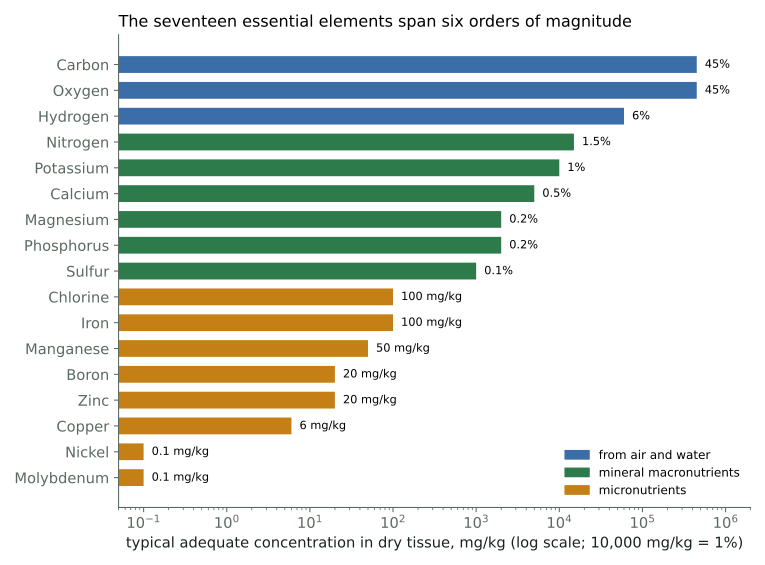
A note on units. Macronutrients are given in percent of dry matter and micronutrients in milligrams per kilogram of dry matter, also written as parts per million (ppm). One percent is 10,000 mg/kg, so nitrogen at 1.5% is 15,000 mg/kg1,2.
“Macro” and “micro” describe quantity, not importance
The split into macronutrients and micronutrients is made on tissue concentration alone3. Counted in atoms, a plant with the composition above holds about one million atoms of nitrogen for every atom of molybdenum2,3. Yet the Arnon and Stout tests make no distinction. A plant without molybdenum cannot reduce nitrate, because the enzyme that does it, nitrate reductase, contains molybdenum3. Without that one atom in a million, the million nitrogen atoms taken up as nitrate cannot be used.
The boundary is also less sharp than the table suggests. Some tissues, such as the green mesophyll of a leaf, contain almost as much iron or manganese as they do sulfur or magnesium3. For that reason some authors group the elements by function instead: nitrogen and sulfur form the plant’s carbon compounds; phosphorus, boron and silicon serve energy storage and structure; potassium, calcium, magnesium, chlorine, manganese and sodium stay as free ions that activate enzymes and set the osmotic pressure of cells; and iron, zinc, copper, nickel and molybdenum take part in electron-transfer reactions3. The metals of that last group are the ones most often locked into insoluble forms in a solution, a problem that Micronutrients and chelates covers.
Beneficial elements: useful to some plants, essential to none
Some elements fail the Arnon and Stout tests but still improve growth in some species; textbooks call them beneficial elements2. Taiz and Zeiger list two of them alongside the essentials, silicon at 0.1% and sodium at 10 mg/kg, under the heading “elements that may be required by plants”3.
Silicon is deposited as amorphous silica in cell walls and stiffens them3. Resh reports that in cucumber production it is now common practice to add 100 ppm of silicon to the solution as potassium silicate, for stronger tissue and better resistance to fungal infection1. Sodium can replace potassium in some functions and takes part in a step of photosynthesis in plants with the C4 and CAM pathways3. Cobalt is part of vitamin B12, which nitrogen-fixing bacteria need, so legumes that rely on root nodules need it, but plants fed with nitrate or ammonium do not1,3. A solution built from the seventeen essential elements is therefore complete by definition; anything beyond that is a crop-specific option.
Composition sets demand: a worked example with a head of lettuce
If you know what a plant is made of, you know what it had to take up to get there. A nutrient solution has no purpose other than to deliver, over the life of the crop, the elements that end up in the plant. Lettuce makes this concrete. Each input has a source, and you can redo the calculation with a calculator.
- Fresh mass of one head. Resh reports a commercial hydroponic lettuce operation that produces heads of 200 grams, so we use 200 g1.
- Dry-matter fraction. Dediu and co-workers, citing Seginer et al. (2004), give the normal range of dry matter content of lettuce as 4 to 6%, so we use 5%7. This is well below the 10% to 20% that Resh gives for plants in general1.
- Nitrogen and potassium in the dry matter. The University of Florida extension guide to tissue analysis gives adequate ranges for the wrapper leaf of lettuce when heads are half grown: 2.5 to 4.0% nitrogen and 4.5 to 8.0% potassium, on a dry-weight basis, so we use 3% N and 6% K, inside both ranges8.
The calculation, with inputs from1,7,8:
- Dry mass of the head: 200 g × 0.05 = 10 g1,7.
- Nitrogen: 10 g × 0.03 = 0.30 g of N8.
- Potassium: 10 g × 0.06 = 0.60 g of K8.
Using the ends of the Florida ranges instead of the middle values, at 5% dry matter, the head contains 0.25 to 0.40 g of nitrogen and 0.45 to 0.80 g of potassium7,8.
Two things stand out. The amounts are small: one head leaves the system with well under a gram of each of its two most abundant mineral elements. And lettuce leaves hold far more potassium than the generic table, 6% against 1.0%, several times more across the Florida sampling stages3,8. This is why recipes are built from crop data rather than from the generic table; Reading a formulation shows how.
Two cautions keep the example honest. The Florida values describe one leaf at one growth stage, not the whole head, so the result is an estimate8. And a plant takes up more than it keeps, because some of what enters is lost again or stays in roots and unharvested tissue; Managing a recirculating solution over time returns to this.
Mobile and immobile elements: where a shortage shows first
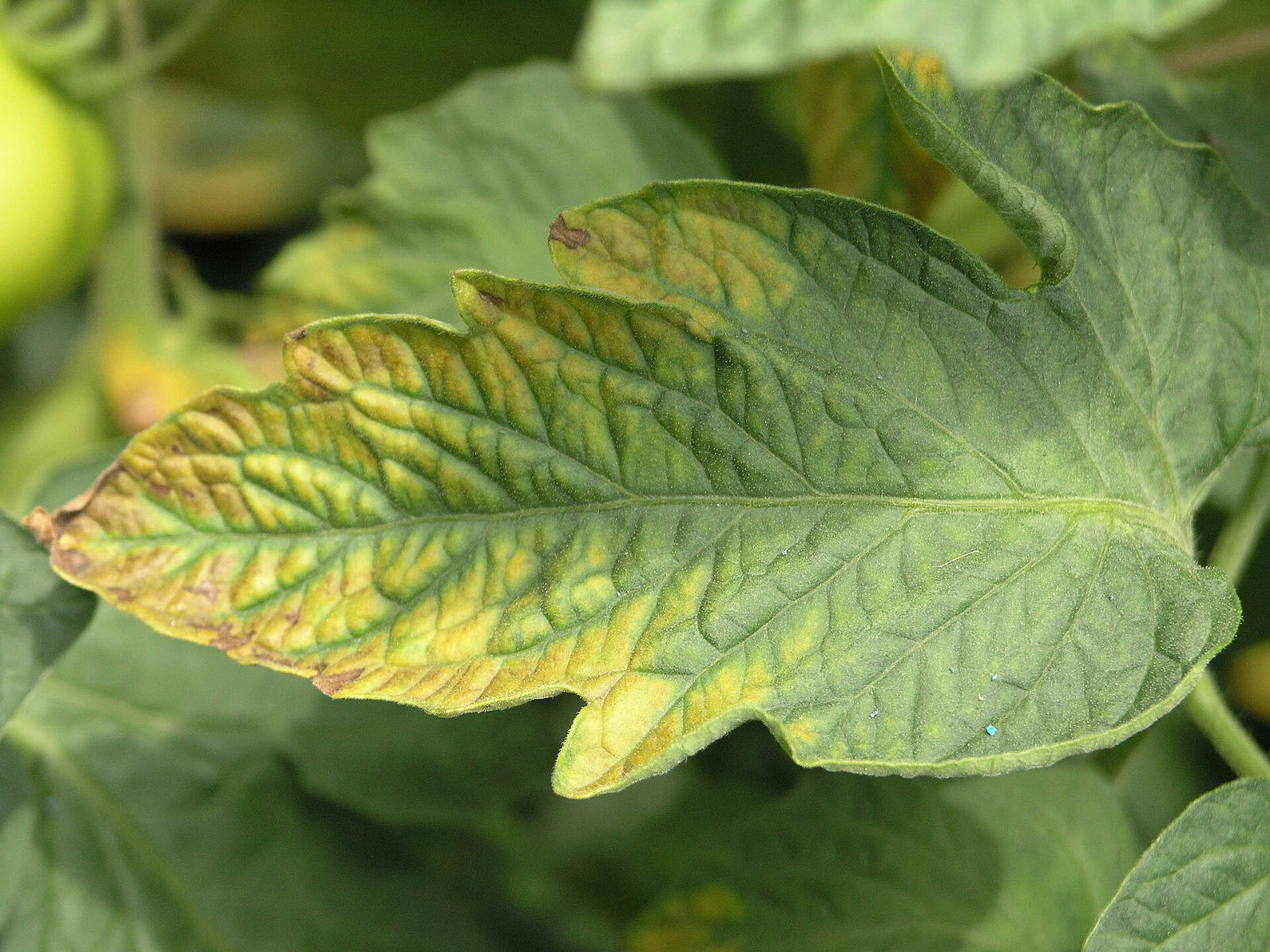
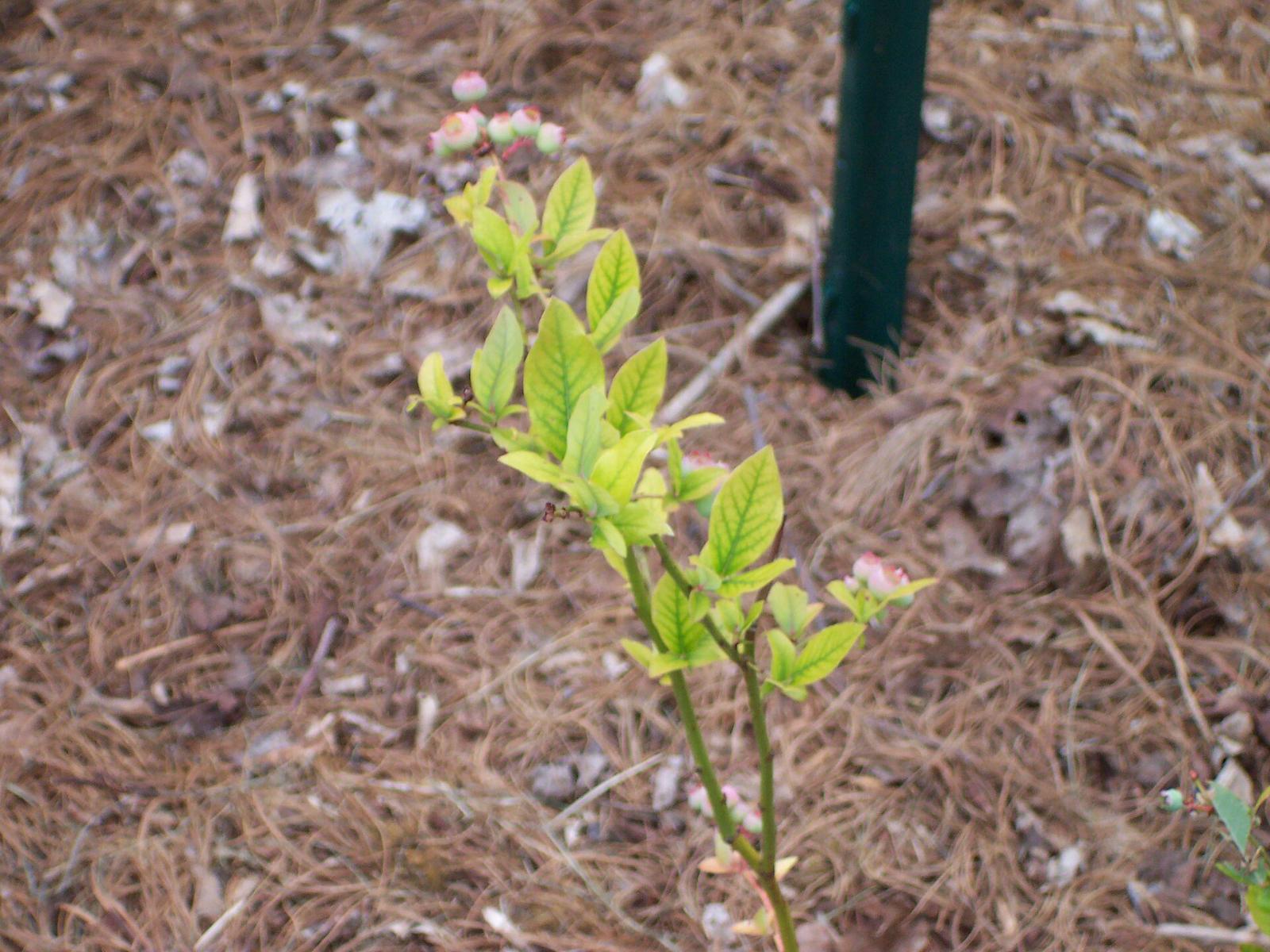
A plant that runs short of an element does not starve evenly. Some elements can be taken out of old leaves and moved through the phloem, the plant’s sugar-transport tissue, to the young leaves and growing points that need them most. These are the mobile elements, and when one is short the old leaves at the bottom of the plant are stripped first, so symptoms appear there first1,3. Other elements, once built into a leaf, stay there. These are the immobile elements: the plant cannot rob old leaves to feed new ones, so symptoms appear first on the young leaves at the top1,3.
| Element | Mobility | Symptoms of a shortage appear first on | Source |
|---|---|---|---|
| Nitrogen, phosphorus, potassium, magnesium, zinc | mobile | older, lower leaves | 1,3 |
| Chlorine, sodium, molybdenum | mobile | older, lower leaves | 3 |
| Calcium, boron | immobile | younger, upper leaves and growing tips | 1,3 |
| Sulfur, iron, copper | immobile | younger, upper leaves | 1,3 |
| Manganese | immobile | younger, upper leaves | 1 |
The two sources agree on every element both classify; the rows with a single source are elements the other book does not list1,3. Resh also notes that mobility is a gradient, with some elements only partly mobile1.
This old-leaf, young-leaf rule is the first question in any diagnosis, and Diagnosing nutrient deficiencies and toxicities builds a key from it. The rule has a limit: once a deficiency is severe, symptoms spread over the whole plant, two or more elements are often short at once, and the pattern no longer identifies the cause1.
From the plant to the nutrient solution
A nutrient solution is the fourteen mineral elements, dissolved in water as the ions in the table above, in proportions that roughly match what the crop will build into its tissue. The next article, How roots take up nutrients, explains how those ions cross from the water into the root, why uptake is selective, and why it moves the pH of the solution. Part B then builds the solution itself.
Key numbers
| Quantity | Typical value or range | Conditions | Source |
|---|---|---|---|
| Water in fresh plant matter | 80% to 95% | varies with species and turgor | 1 |
| Dry matter as share of fresh weight | 10% to 20% | plants in general, dried at 70 °C | 1 |
| Carbon, hydrogen and oxygen in dry matter | over 90% | most plant matter | 1 |
| Essential elements | 17 (16 in older textbooks) | nickel added after 1987 | 1,2,5,6 |
| N, K, Ca, Mg, P, S in dry tissue | 1.5%, 1.0%, 0.5%, 0.2%, 0.2%, 0.1% | generic adequate levels (Epstein 1972) | 1,2,3 |
| Cl, Fe, Mn, B, Zn, Cu, Mo in dry tissue | 100, 100, 50, 20, 20, 6, 0.1 mg/kg | generic adequate levels | 1,2,3 |
| Nickel in dry tissue | 0.1 mg/kg | generic adequate level | 3 |
| Dry matter of lettuce | 4% to 6% | normal, unstressed plants | 7 |
| Lettuce wrapper leaf, heads half grown | N 2.5% to 4.0%, K 4.5% to 8.0% of dry weight | adequate range | 8 |
| N and K in a 200 g lettuce head (derived) | about 0.3 g N and 0.6 g K | 200 g head, 5% dry matter, 3% N, 6% K | 1,7,8 |
Common mistakes
- Treating micronutrients as optional because the quantities are tiny. A plant short of molybdenum cannot use the nitrate it absorbs, because nitrate reductase contains molybdenum3.
- Reading the generic tissue table as a target for your crop. Adequate lettuce leaves hold several times the potassium of the generic figure, and only crop-specific data tell you that3,8.
- Looking for a deficiency on the wrong leaves. A shortage of a mobile element such as nitrogen shows on old leaves first; a shortage of an immobile element such as calcium or iron shows on young leaves first1,3.
- Assuming that an element found in plant tissue must be needed. About 60 elements have been found in plants, and only 17 pass the essentiality tests1,5.
Summary
A fresh plant is mostly water, and most of its dry matter is carbon, hydrogen and oxygen taken from air and water. The remaining one or two percent of the fresh weight is the mineral elements, and those are what a hydroponic grower supplies. An element is essential when the plant cannot complete its life cycle without it, when nothing else can replace it, and when it acts directly in metabolism; seventeen elements pass, with nickel the most recent addition. Macronutrients and micronutrients differ in quantity, by up to a million atoms to one, not in importance. Because a plant’s composition is what it had to take up, tissue concentrations let you estimate demand, and a 200 g head of lettuce holds on the order of 0.3 g of nitrogen and 0.6 g of potassium1,7,8. Mobile elements are pulled out of old leaves when short, so their symptoms start low on the plant; immobile elements such as calcium and iron show first on new growth.
Next in the series: How roots take up nutrients.
References
- Resh, H. M. (2013). Hydroponic Food Production: A Definitive Guidebook for the Advanced Home Gardener and the Commercial Hydroponic Grower, 7th ed. CRC Press, Boca Raton. ISBN 978-1-4398-7869-9.
- Jones, J. B. Jr. (2005). Hydroponics: A Practical Guide for the Soilless Grower, 2nd ed. CRC Press, Boca Raton.
- Taiz, L. and Zeiger, E. (2002). Plant Physiology, 3rd ed. Sinauer Associates, Sunderland, MA. Chapter 5, Mineral Nutrition.
- Arnon, D. I. and Stout, P. R. (1939). The essentiality of certain elements in minute quantity for plants with special reference to copper. Plant Physiology, 14(2), 371–375. https://doi.org/10.1104/pp.14.2.371
- Brown, P. H., Zhao, F.-J. and Dobermann, A. (2022). What is a plant nutrient? Changing definitions to advance science and innovation in plant nutrition. Plant and Soil, 476, 11–23. https://doi.org/10.1007/s11104-021-05171-w
- Brown, P. H., Welch, R. M. and Cary, E. E. (1987). Nickel: a micronutrient essential for higher plants. Plant Physiology, 85(3), 801–803. https://doi.org/10.1104/pp.85.3.801
- Dediu, L., Cristea, V. and Zhang, X. (2012). Waste production and valorization in an integrated aquaponic system with bester and lettuce. African Journal of Biotechnology, 11(9), 2349–2358. https://doi.org/10.5897/AJB11.2829
- Hochmuth, G. and Hanlon, E. Plant Tissue Analysis and Interpretation for Vegetable Crops in Florida. University of Florida IFAS Extension, publication HS964. https://edis.ifas.ufl.edu/publication/EP081
This article was drafted with the help of AI tools and reviewed and edited by PonicLabs. Sources are listed above; tell us if you find an error.