Fertiliser salts: purity, solubility and compatibility
Contents
Standfirst: After reading this article you will be able to name the salt that supplies each element of a nutrient solution, calculate the element content of a salt from its formula and check it against the bag label, read a purity grade, use a solubility limit to size a stock tank, and explain from the chemistry why calcium nitrate is never concentrated together with sulfates or phosphates.
Before you read: What plants are made of: the essential elements, EC and concentration.
A salt is a package of ions
A fertiliser salt is a solid made of positive ions (cations) and negative ions (anions) held in a crystal. When the crystal dissolves, the ions separate and move freely in the water, and from that moment the plant sees ions, not salts. One molecule of potassium nitrate (KNO₃) releases one potassium ion (K⁺) and one nitrate ion (NO₃⁻); one molecule of calcium nitrate (Ca(NO₃)₂) releases one calcium ion (Ca²⁺) and two nitrate ions1.
The consequence shapes everything else here: you cannot buy an element on its own. Every salt delivers two things at once, and a recipe is a set of pairs chosen so that the totals come out right. Resh’s example is nitrate: where a formulation needs plenty of nitrate but few cations, calcium nitrate is the better carrier, because half as much of it satisfies the same nitrate requirement1. Solving that puzzle for a whole recipe is the subject of Reading a formulation.
Which salt supplies which element
The table lists the salts hydroponic growers use most, with the element content calculated from the chemical formula and the atomic weights in Resh’s Table 3.5 (Ca 40.08, N 14.01, O 16.00, K 39.10, P 30.97, S 32.06, Mg 24.31, H 1.008)1. The method is the same for every salt: add the atomic weights to get the molecular weight, then divide the weight of the element you want by that total. For calcium nitrate, Ca(NO₃)₂, the molecular weight is 40.08 + 2 × 14.01 + 6 × 16.00 = 164.1, so calcium is 40.08 / 164.1 = 24.4% of the salt and nitrogen is 28.02 / 164.1 = 17.1%1. Resh’s Table 3.2 prints these fractions as conversion factors, 0.244 for calcium and 0.171 for nitrogen1, and Jones’s table of reagent-grade compounds gives the matching percentages for the hydrated forms2.
| Salt | Formula | Molecular weight | Element content (from formula) | Notes |
|---|---|---|---|---|
| Calcium nitrate, anhydrous | Ca(NO₃)₂ | 164.11 | Ca 24.4%, N 17.1%1 | the formula Resh uses for calculation1 |
| Calcium nitrate tetrahydrate | Ca(NO₃)₂·4H₂O | 236.22 | Ca 17.0%, N 11.9%2 | the reagent-grade crystal2 |
| Calcium nitrate, greenhouse grade | calcium nitrate with some ammonium nitrate (from the label analysis; see text) | not a single formula | Ca 19%, N 15.5% (14.4% nitrate, 1.1% ammonium)7 | manufacturer’s analysis7 |
| Potassium nitrate | KNO₃ | 101.11 | K 38.7%, N 13.9%1 (Jones rounds N to 13.82) | sold as 13-0-441 |
| Monopotassium phosphate | KH₂PO₄ | 136.11 | K 28.7%, P 22.8%1,2 | highly soluble and pure, but costly1 |
| Potassium sulfate | K₂SO₄ | 174.31 | K 44.9%, S 18.4%1,2 | low solubility1 |
| Magnesium sulfate heptahydrate | MgSO₄·7H₂O | 246.51 | Mg 9.9%, S 13.0%1,2 | Epsom salts1 |
| Ammonium nitrate | NH₄NO₃ | 80.051 | N 35.0%1,2 | half as ammonium, half as nitrate1 |
| Mono-ammonium phosphate | NH₄H₂PO₄ | 115.01 | N 12.2%, P 26.9%2 | Jones’s second table prints N 11.8, a misprint2 |
| Iron chelate | FeEDTA, FeDTPA | 382.1, 468.21 | Fe 10% to 10.5% as labelled1 | dissolve in hot water1 |
| Manganese sulfate monohydrate | MnSO₄·H₂O | 169.02 | Mn 32.5%2 | |
| Zinc sulfate heptahydrate | ZnSO₄·7H₂O | 287.61 | Zn 22.7%1,2 | |
| Copper sulfate pentahydrate | CuSO₄·5H₂O | 249.71 | Cu 25.4%1,2 | “bluestone”1 |
| Boric acid | H₃BO₃ | 61.81 | B 17.5%1,2 | best boron source; dissolve in hot water1 |
| Sodium molybdate dihydrate | Na₂MoO₄·2H₂O | 241.92 | Mo 39.6%2 | |
| Ammonium molybdate | (NH₄)₆Mo₇O₂₄·4H₂O | 12362 | Mo 53% as tabulated by Jones2 (54% from the formula) |
Three rows in the table are all called “calcium nitrate”, and they hold 24.4%, 17.0% and 19% calcium1,2,7. The difference is water. The reagent crystal carries four water molecules per formula unit, and that water counts in the weight on the scale; Resh is explicit that water of crystallisation is not an impurity but is accounted for in his conversion factors1. The greenhouse product’s label shows 1.1% ammonium nitrogen7, so it is not pure calcium nitrate but carries some ammonium nitrate as well; its analysis is consistent with a calcium ammonium nitrate double salt, which is our reading of the label, not a statement on the manufacturer’s page. So calculate from the analysis printed on the bag you hold, not from a textbook formula.
A bag label also uses an old convention. Nitrogen, phosphorus and potassium are declared as N, phosphoric anhydride (P₂O₅) and potassium oxide (K₂O), so potassium nitrate is labelled 13-0-44, meaning 13% N and 44% K₂O1. Hydroponic recipes are written as N, P and K, so the oxide figures must be converted: multiply P₂O₅ by 0.436 to get P, and K₂O by 0.830 to get K1. On that basis 44% K₂O is 36.5% K, a little below the 38.7% of the pure formula1; the gap between the two numbers is what purity is about.
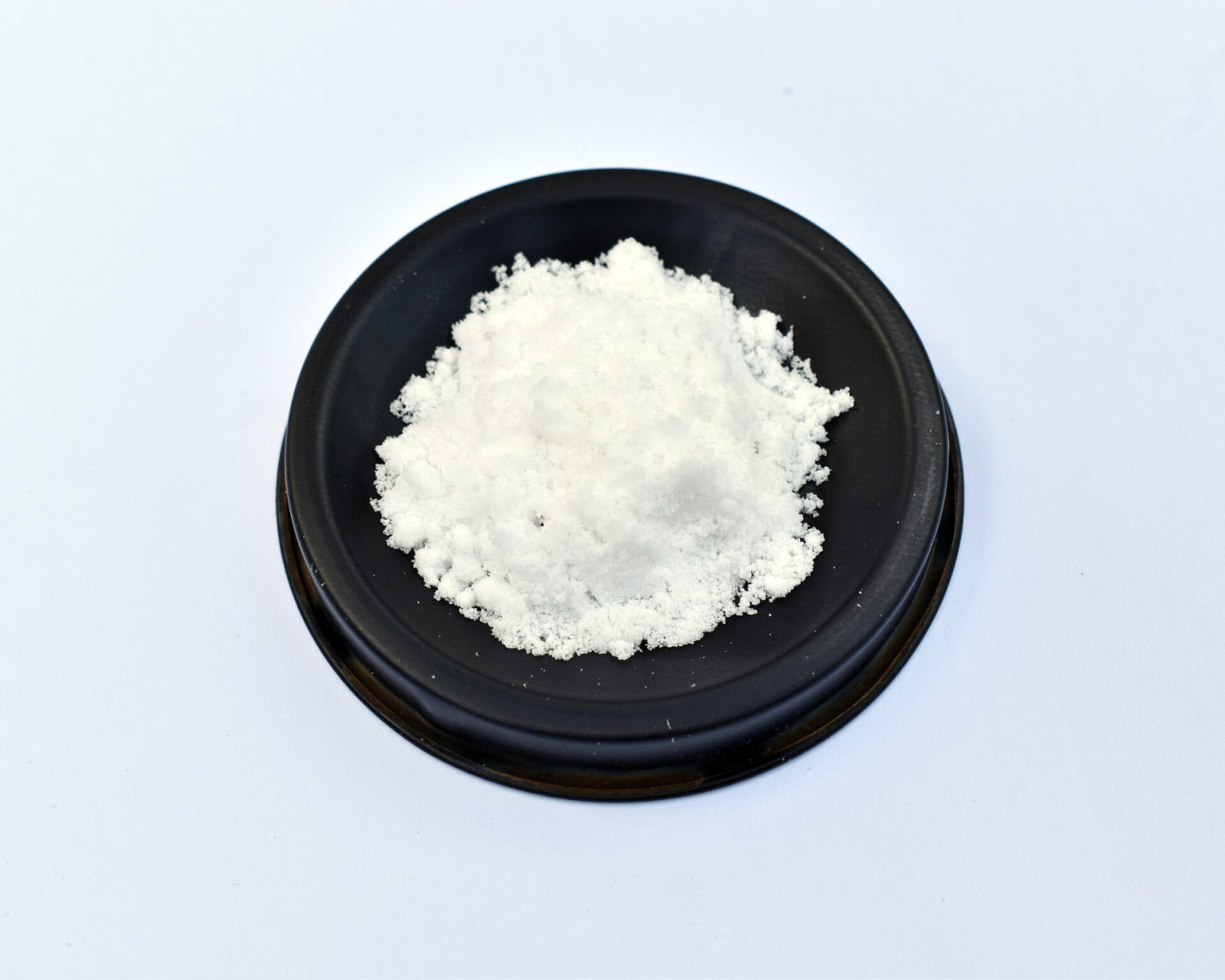
Purity and grades
Most fertiliser salts are not 100% pure1. They carry inert material such as clay, silt and sand, which supplies no ions, so the bag states a percentage purity or a guaranteed analysis1. Resh lists typical purities of commercial fertilisers: 90% for calcium nitrate, 95% for potassium nitrate, 90% for potassium sulfate, 98% for monopotassium phosphate, 98% for magnesium sulfate and 98% for ammonium nitrate, and he adds that purity varies between manufacturers, so the bag is the authority1. Purity enters every calculation as a division: if you need 614 mg of pure calcium nitrate per litre and the salt is 90% pure, you weigh 614 / 0.90 = 682 mg1.
Purity has a second meaning that matters more in water culture than in soil, because a contaminant in the bag reaches the roots undiluted. Hoagland and Arnon warned in 1950 that some commercial salts contain impurities, fluorine in phosphate fertilisers being their example, which may be toxic to plants under water-culture conditions6. The effect can also run the other way: the classic nineteenth-century solutions appeared complete only because their chemicals were contaminated with boron and molybdenum, elements later shown to be essential3. The grade names describe where a salt sits on this scale. Hoagland and Arnon separated “chemically pure” salts, used for scientific experiments but too expensive for commercial practice, from the “technical” and “fertilizer” grades they recommended to growers: fertiliser-grade potassium nitrate and calcium nitrate, technical-grade potassium phosphate, ammonium phosphate and magnesium sulfate6. Today the term that matters is greenhouse grade. Resh advises that a greenhouse grade should be used in general: it costs somewhat more than a standard grade, but its purity and solubility are greater, whereas a poor grade contains a large amount of inert carriers that can tie up nutrients and plug feeder lines1. A manufacturer’s page for one greenhouse-grade calcium nitrate states that it dissolves without residues and is free of chlorine and sodium and virtually free of heavy metals7.
Solubility: how much a stock tank can hold
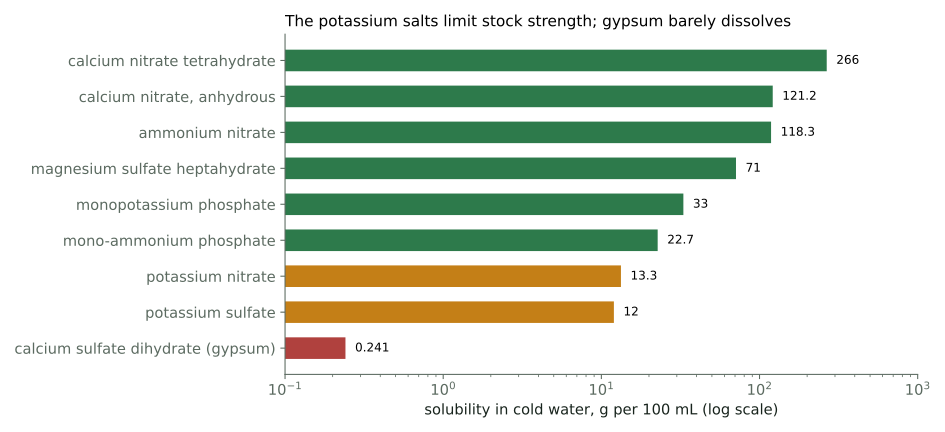
Solubility is the concentration of a salt that stays dissolved in water; a salt of low solubility dissolves only in small amounts, and because ions must be in solution to reach the plant, hydroponics uses salts of high solubility1. Handbooks give solubility in grams of salt per 100 mL of cold or hot water, and since a stock tank is not heated, the cold-water value is the one to use1.
| Salt | Solubility, g per 100 mL cold water1 | Solubility, g/L, at 1 °C and 20 °C4 |
|---|---|---|
| Calcium nitrate, anhydrous | 121.2 | 1,020 and 3,410 |
| Calcium nitrate tetrahydrate | 266 | (Jones: 2,660 g/L)2 |
| Ammonium nitrate | 118.3 | 1,183 and 1,950 |
| Magnesium sulfate heptahydrate | 71 | (Jones: 710 g/L)2 |
| Monopotassium phosphate | 33 | 330 at 20 °C |
| Mono-ammonium phosphate | 22.7 | 227 and 282 |
| Potassium nitrate | 13.3 | 133 and 316 |
| Potassium sulfate | 12 | 69 and 110 |
| Calcium sulfate (anhydrous; dihydrate) | 0.209; 0.241 | (Jones: 2.41 g/L)2 |
| Boric acid | 6.35 | |
| Copper sulfate pentahydrate | 31.6 | |
| Manganese sulfate tetrahydrate | 105.3 | |
| Zinc sulfate heptahydrate | 96.5 |
Resh’s appendix does not state the temperature of “cold water”1. Several of the same numbers appear in Jones’s table labelled 15 °C2 and in Bar-Yosef’s table, drawn from two editions of the CRC Handbook, labelled 1 °C4, though not all (potassium sulfate is 120 g/L in the first two and 69 g/L in the third); 133 g/L for potassium nitrate and 1,183 g/L for ammonium nitrate are identical in all three1,2,4. Bar-Yosef adds that most common fertilisers are about 30% more soluble at 20 °C than at 1 °C, that potassium sulfate dissolves at 69, 110 and 170 g/L at 1, 20 and 50 °C, and that stocks should be prepared from the 20 °C data even in summer, to allow for cooler nights4.
The sources disagree on one value. For anhydrous calcium nitrate at 20 °C, Bar-Yosef’s table gives 3,410 g/L4, while the manufacturer of a greenhouse-grade product states 1,200 g/L at 20 °C7, close to Resh’s cold-water figure of 121.2 g per 100 mL1. Part of the gap is the hydrate: the tetrahydrate dissolves at 266 g per 100 mL against 121.2 for the anhydrous salt1, and the greenhouse product is a third form7. Use the figure for the product you own, and when in doubt the lower one.
Two consequences follow. First, calcium sulfate (gypsum) is out: at about 0.2 g per 100 mL it cannot supply calcium, and Resh has calcium nitrate carry the entire calcium requirement even though gypsum is cheaper1; Jones allows it only as a supplementary source2. Second, the potassium salts set the ceiling on stock-tank strength. Resh marks potassium nitrate at 13.3 and potassium sulfate at 12.0 g per 100 mL as the least soluble compounds and possibly the limiting ones1, and Bar-Yosef agrees: potassium is limited by potassium sulfate, and nitrate solubility is lowest as potassium nitrate and highest as ammonium nitrate4. The ceiling is set by the salt you need most of relative to its solubility, so the worked example checks every salt.
Compatibility: why calcium gets its own tank
Precipitation is solubility in reverse. Two ions that coexist at working strength can exceed the solubility of the solid they form together once both are concentrated. In a stock tank at 100 times strength1, every ion is 100 times higher, and a solid that was far from saturation becomes supersaturated; the least soluble solid in the whole mixture decides. Saturated calcium sulfate holds about 2.1 g of salt per litre1, which is about 0.6 g of calcium per litre; a 100× stock built to deliver 150 mg/L of calcium holds 15 g of calcium per litre, 25 times more1, so if sulfate is present in comparable amounts gypsum must come out of solution. Jones names the three solids: in stock solutions with high calcium, calcium can precipitate as calcium phosphate or calcium sulfate, and under high pH as calcium carbonate, and the remedy is to keep phosphorus and sulfur out of the calcium stock and keep it acid2.
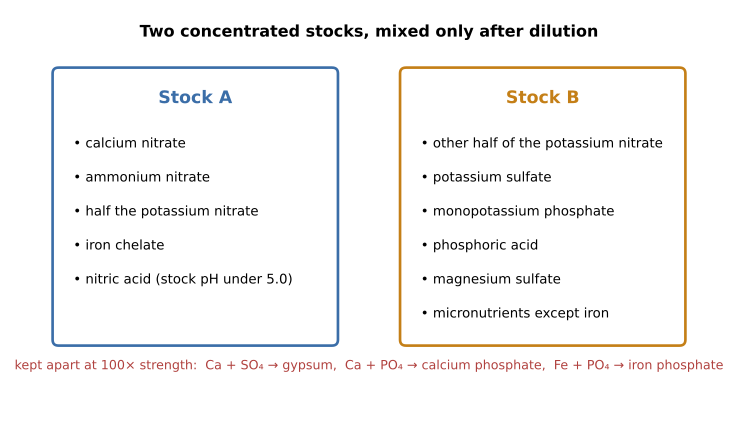
Resh describes the standard layout. Stock solutions are prepared at 50, 100 or 200 times normal strength, depending on the injector, and two separate stocks plus an acid are kept in individual tanks because precipitation will occur among the sulfates and nitrates of some compounds at high concentration1; his example is the sulfates of potassium sulfate or magnesium sulfate precipitating with calcium from calcium nitrate1. Stock A holds all the calcium nitrate, ammonium nitrate, half the potassium nitrate, the iron chelate and nitric acid to bring the stock pH under 5.01; stock B holds the other half of the potassium nitrate, potassium sulfate, monopotassium phosphate, phosphoric acid, magnesium sulfate and the micronutrients apart from iron1. Potassium nitrate is split for a solubility reason, not a compatibility one: it keeps each tank under the 13.3 g per 100 mL limit1. Penn State Extension gives the general guideline that calcium should be in a different tank from phosphates and sulfates9, and the e-GRO alert on fertiliser compatibility lists the common incompatibilities as sulfates with calcium, phosphates with calcium, and phosphates with iron, calling the mixing of Epsom salt with calcium nitrate the most common mistake8.
The price of getting it wrong is not only lost nutrient. Mason describes calcium phosphate settling as a sludge in which most of the calcium and phosphate becomes unavailable, and which can block irrigation lines and nozzles5. At working strength the ions are back below the solubility of the solids and the two stocks are compatible again, which is why they are diluted into the raw water separately before they meet1.
Before trusting a new combination, the e-GRO authors recommend a jar test: dissolve the salts at the intended stock concentration in a clear jar, cap it, leave it 12 to 24 hours, and look for cloudiness or solids8.
Iron goes with calcium, not with phosphate
Iron is the exception to the “micronutrients in tank B” rule. Supplied as an inorganic salt such as ferrous sulfate or ferric nitrate, iron precipitates as iron hydroxide, and if phosphate is present, insoluble iron phosphate forms as well3. Hoagland and Arnon dealt with this by adding iron, as iron tartrate solution, at frequent intervals, perhaps as often as twice a week6. The modern answer is a chelate: a molecule such as EDTA or DTPA that wraps the iron ion in a soluble complex and keeps it from reacting3. Resh lists FeDTPA at 10% iron as the best source and FeEDTA at 10.5% iron as a good one, both to be dissolved in hot water1.
Because the chelate’s purpose is to keep iron away from phosphate, it belongs in the calcium tank: Resh puts the iron chelate in stock A and the other micronutrients in stock B1, and the modified Hoagland solution in Taiz and Zeiger keeps a combined micronutrient stock “except iron”, with iron added separately as NaFeDTPA3. Which chelate holds iron at which pH is the subject of Micronutrients and chelates.
Hygroscopic salts and storage
Some salts attract water from the air. Resh notes that calcium nitrate is hygroscopic, and that regular-grade calcium nitrate shipped in bulk is coated with a greasy plasticiser to stop it taking up water; in a nutrient solution that coating forms a scum that floats on the surface, plugs irrigation lines and makes tanks hard to clean, which is why the greenhouse grade, sold without it, is the one to buy1. A salt that has absorbed water also weighs more per unit of nutrient than its label says, so an opened bag in a humid room slowly drifts from its analysis. Keep opened bags sealed and dry. Chelates and boric acid dissolve slowly and go into hot water first1.
Worked example: a 100× calcium nitrate stock for a 1,000 L tank
The target is 150 mg/L of calcium, a little below the 200 mg/L that Jones calls typical of most formulas2, in a 1,000 L working tank fed from a 100× stock in a 10 L container at 20 °C1. We do it twice, once from the formula and once from a bag analysis, because that is the choice every grower faces.
Route A, from the formula. Resh’s factor for calcium to calcium nitrate is 4.094, the reciprocal of the 24.4% calcium content, and his typical purity for calcium nitrate is 90%1.
- Pure salt needed: 150 mg/L × 4.094 = 614 mg/L1.
- Adjusted for 90% purity: 614 / 0.90 = 682 mg/L1.
- For 1,000 L of working solution: 682 mg/L × 1,000 L = 682 g of salt1.
- As a 100× stock in 10 L: all 682 g go into 10 L, which is 68.2 g/L, or 6.8 g per 100 mL1.
- Solubility check: 6.8 g per 100 mL against 121.2 g per 100 mL cold water1. It dissolves with a wide margin.
- Nitrogen that comes with it: 614 mg/L × 0.171 = 105 mg/L of nitrate nitrogen1, which the recipe must count.
Route B, from the bag. A greenhouse-grade calcium nitrate is declared at 19% calcium and 15.5% nitrogen, with solubility 1,200 g/L at 20 °C7.
- Product needed: 150 / 0.19 = 789 mg/L, so 789 g for 1,000 L7.
- Stock: 789 g in 10 L is 78.9 g/L, against 1,200 g/L7. It dissolves; the stock could be about 15 times stronger before saturating7.
- Nitrogen that comes with it: 789 mg/L × 0.155 = 122 mg/L of N7.
The two routes differ by 107 g of salt and 17 mg/L of nitrogen1,7, the difference between a generic purity assumption and the analysis of the bag you own.
Where the ceiling really is. Calcium nitrate is never the limiting salt. In Resh’s own 200× example, potassium nitrate at 464 mg/L of working solution becomes 92.8 g/L, or 9.28 g per 100 mL, against its limit of 13.31, which is why he puts half in each tank; the potassium sulfate in the same recipe reaches 3.32 g per 100 mL against 12.0, and the monopotassium phosphate 4.5 against 33.01. Divide the solubility by the working-strength dose for every salt and the smallest ratio is your maximum concentration factor; for that recipe it is potassium nitrate at about 287×1.
Key numbers
| Quantity | Typical value or range | Conditions | Source |
|---|---|---|---|
| Calcium in calcium nitrate | 24.4% (anhydrous), 17.0% (tetrahydrate), 19% (greenhouse grade) | from formula; from label | 1,2,7 |
| Nitrogen in calcium nitrate | 17.1%, 11.9%, 15.5% | same three forms | 1,2,7 |
| K and N in potassium nitrate | 38.7% K, 13.9% N | from formula; labelled 13-0-44 | 1,2 |
| Oxide to element | P₂O₅ × 0.436 = P; K₂O × 0.830 = K | label conversion | 1 |
| Typical purity, commercial salts | Ca nitrate 90%, K nitrate 95%, K sulfate 90%, MKP 98%, Mg sulfate 98% | varies by manufacturer; read the bag | 1 |
| Solubility, cold water | KNO₃ 13.3, K₂SO₄ 12, KH₂PO₄ 33, MgSO₄·7H₂O 71, Ca(NO₃)₂ 121.2 g/100 mL | temperature unstated; KNO₃ and NH₄NO₃ values identical in tables labelled 1 °C and 15 °C elsewhere, K₂SO₄ not | 1,2,4 |
| Potassium sulfate solubility | 69, 110, 170 g/L | 1, 20, 50 °C | 4 |
| Temperature effect | about 30% more soluble at 20 °C than at 1 °C | most common fertilisers | 4 |
| Calcium sulfate solubility | 0.209 g/100 mL (anhydrous); 0.241 (dihydrate) | cold water | 1 |
| Stock concentration factors | 50×, 100×, 200× | set by injector and least soluble salt | 1,9 |
| Stock A pH | under 5.0 | nitric acid added to the calcium stock | 1 |
| Jar test | 12 to 24 hours standing | clear jar at stock concentration | 8 |
| Worked example | 682 g (Route A) or 789 g (Route B) per 1,000 L for 150 mg/L Ca | 100× stock in 10 L dissolves in both cases | 1,7 |
Common mistakes
- Calculating from a textbook formula instead of the bag. Three products called calcium nitrate hold 24.4%, 17.0% and 19% calcium, because hydrate water and a second salt change the weight that carries each gram of calcium1,2,7.
- Putting magnesium sulfate or monopotassium phosphate in the calcium tank. At 100× every ion is 100 times more concentrated, and calcium sulfate and calcium phosphate, far from saturation at working strength, precipitate as sludge1,2,5,8.
- Putting the iron chelate in tank B with the other micronutrients. The chelate exists to keep iron away from phosphate and hydroxide, so it goes in the calcium tank1,3.
- Buying a standard-grade salt because it is cheaper. Its inert carriers plug lines, its contaminants reach the roots undiluted, and the plasticiser on bulk calcium nitrate forms a scum on the tank1,6.
- Mixing stocks on a warm afternoon and storing them in a cold shed. Solubility falls by roughly a quarter to a third between 20 °C and 1 °C (Bar-Yosef’s 30% figure, and 37% for potassium sulfate), so a stock near its limit precipitates overnight4.
Summary
A fertiliser salt is a pair of ions, and each salt delivers two elements whose shares you can calculate from the formula and the atomic weights, or read from the label after converting the oxide figures. Hydrate water and double salts mean that products with the same name carry different amounts of the element, so the bag analysis is the number to use. Purity is both a fraction to divide by and a question of what else is in the bag; in water culture the contaminants reach the roots undiluted, which is why greenhouse grade is worth its price. Solubility, read at the lowest temperature the stock will meet, sets how strong a stock tank can be, and the potassium salts usually set that limit. Calcium is concentrated in its own tank because calcium sulfate and calcium phosphate, soluble enough at working strength, precipitate once every ion is concentrated together1,2, and the iron chelate goes with the calcium. A 100× stock of calcium nitrate for 150 mg/L of calcium needs about 680 to 790 g per 1,000 L, depending on the product, and dissolves easily in 10 L of water1,7.
Next in the series: Reading a formulation.
References
- Resh, H. M. (2013). Hydroponic Food Production: A Definitive Guidebook for the Advanced Home Gardener and the Commercial Hydroponic Grower, 7th ed. CRC Press, Boca Raton. ISBN 978-1-4398-7869-9.
- Jones, J. B. Jr. (2005). Hydroponics: A Practical Guide for the Soilless Grower, 2nd ed. CRC Press, Boca Raton.
- Taiz, L. and Zeiger, E. (2002). Plant Physiology, 3rd ed. Sinauer Associates, Sunderland, MA. Chapter 5, Mineral Nutrition.
- Bar-Yosef, B. (2008). Fertigation management and crops response to solution recycling in semi-closed greenhouses. In: Raviv, M. and Lieth, J. H. (eds), Soilless Culture: Theory and Practice. Elsevier, Amsterdam, pp. 341–424. https://doi.org/10.1016/B978-044452975-6.50011-3
- Mason, J. (n.d.). Commercial Hydroponics, 3rd ed. ACS Distance Education. ISBN 978-0-9871022-2-5.
- Hoagland, D. R. and Arnon, D. I. (1950). The Water-Culture Method for Growing Plants without Soil. California Agricultural Experiment Station Circular 347 (revised). University of California, Berkeley. Full text: https://archive.org/details/watercultureme3450hoag (pp. 29–31)
- Yara UK (n.d.). YaraTera CALCINIT, product page. https://int.yara.co.uk/crop-nutrition/fertiliser/soluble/yaratera-calcinit/ (accessed 2026-10-19)
- Owen, W. G. and Whipker, B. E. (2022). Jar Test: Determining Fertilizer Solubility and Compatibility. e-GRO Alert 11(8), February 2022. https://greenhousehort.ca.uky.edu/sites/greenhousehort.ca.uky.edu/files/2022-03/Jar%20Test%20-%20Determining%20Fertilizer%20Solubility%20and%20Compatibility.pdf
- Sánchez, E., Di Gioia, F., Ford, T., Berghage, R. and Flax, N. (2024). Hydroponics Systems: Nutrient Solution Programs and Recipes. Penn State Extension, updated 18 March 2024. https://extension.psu.edu/hydroponics-systems-nutrient-solution-programs-and-recipes
This article was drafted with the help of AI tools and reviewed and edited by PonicLabs. Sources are listed above; tell us if you find an error.