How roots take up nutrients
Contents
Standfirst: After reading this article you will be able to explain what a root actually absorbs, how each ion reaches the root surface and crosses the root’s membrane, why that needs oxygen, why solution and plant end up with different compositions, and why nitrate feeding pushes pH one way and ammonium feeding the other. A worked example turns one head of lettuce into millimoles of charge.
Before you read: What plants are made of: the essential elements, Water in the plant.
A root does not take up fertiliser; it takes up ions
When a fertiliser salt dissolves, it stops existing as a salt. Potassium nitrate becomes a potassium ion, K⁺, and a nitrate ion, NO₃⁻, each moving on its own in the water. The root never sees “potassium nitrate”; it sees two ions, and it can take them up at different rates. Resh lists the form in which each essential element is available to roots, and each is an ion: nitrogen as NO₃⁻ or NH₄⁺, potassium as K⁺, calcium as Ca²⁺, magnesium as Mg²⁺, phosphorus as H₂PO₄⁻ or HPO₄²⁻, sulfur as SO₄²⁻11.
A cation is an ion with positive charge (K⁺, Ca²⁺, Mg²⁺, NH₄⁺); an anion has negative charge (NO₃⁻, H₂PO₄⁻, SO₄²⁻, Cl⁻). Some ions carry two charges, so when we count charges rather than ions, one millimole of Ca²⁺ counts as two millimoles of positive charge. We use “mmol of charge” in that sense throughout.
Reaching the root surface: mass flow, diffusion and depletion zones
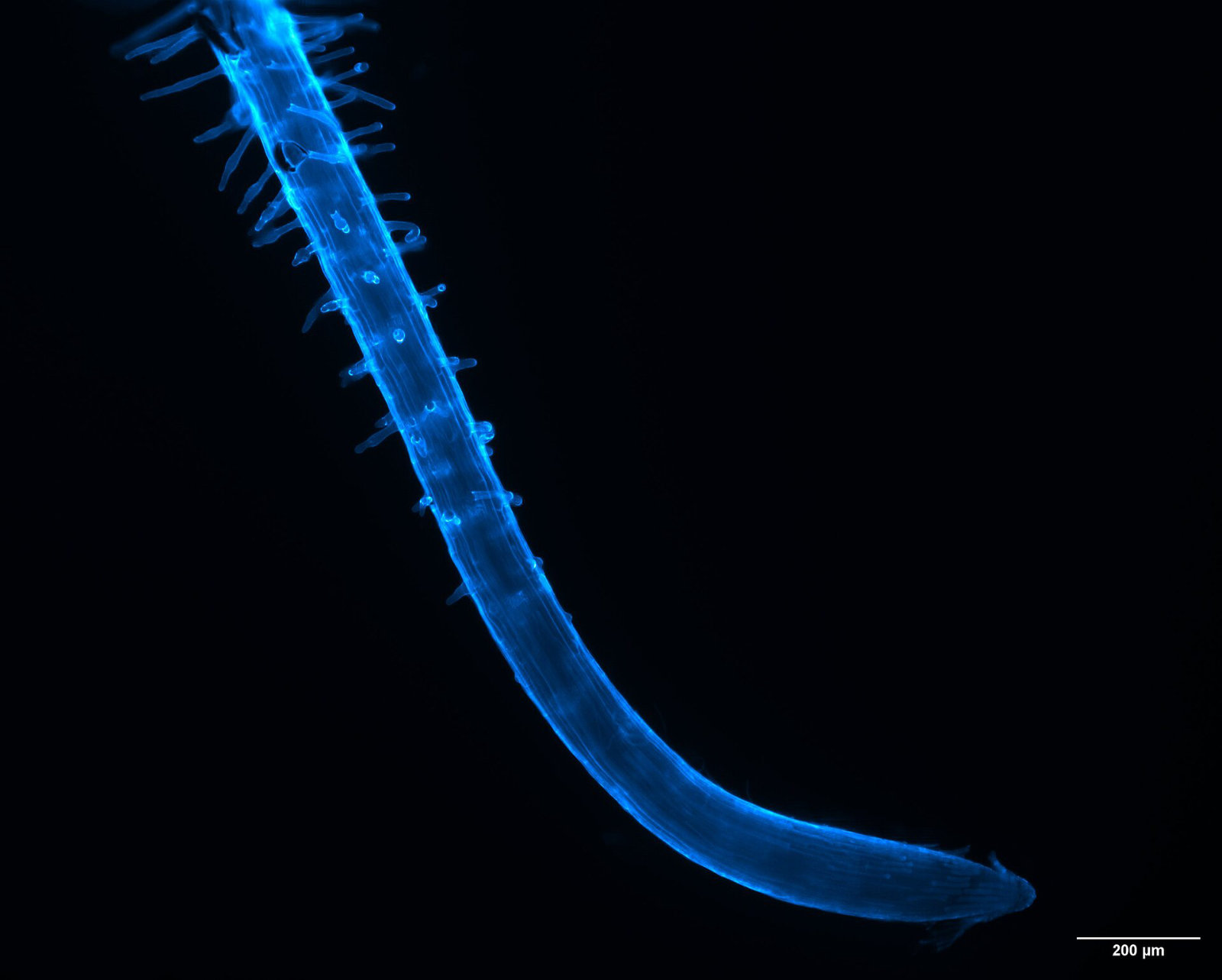
An ion has only two ways to reach the root surface. In mass flow (also called bulk flow or convection), it is carried along by water moving towards the root, and that water moves because the leaves are transpiring; how much arrives depends on the water flow and on the ion’s concentration in the water1,4. In diffusion, an ion moves on its own from where it is more concentrated to where it is less concentrated; uptake lowers the concentration at the root surface, which creates the gradient that pulls more ions in1.
Which route matters depends on the ion. Marschner reproduces Barber’s estimate for a maize crop in soil4:
| Nutrient | Crop demand (kg/ha) | Supplied by mass flow | Supplied by diffusion | Source |
|---|---|---|---|---|
| Potassium | 195 | 35 | 156 | 4 |
| Nitrogen | 190 | 150 | 38 | 4 |
| Phosphorus | 40 | 2 | 37 | 4 |
| Magnesium | 45 | 100 | 0 | 4 |
Nitrogen and magnesium arrive mainly with the water, and magnesium arrives faster than it is used; potassium and phosphate, which mass flow cannot supply fast enough (soil-solution phosphate in particular is extremely dilute), have to diffuse4.
When the flux of uptake exceeds the rate at which diffusion and convection bring an element from the bulk solution, the concentration right at the root surface falls below the concentration further away10. This region is a depletion zone; in soil it extends about 0.2 to 2.0 mm from the root, depending on how mobile the nutrient is, and plants deal with it by growing root tips and root hairs into fresh soil1.
A hydroponic solution changes the arithmetic without changing the physics. All the phosphate and potassium a plant will get is already dissolved, at concentrations far above a soil solution, so mass flow delivers far more of them. Silber and Bar-Tal make this point for substrate culture: frequent irrigation with fresh solution shrinks the depletion zone, reduces the gradient, and makes convection rather than diffusion the main route to the root9.
A plant in a container cannot grow its way out of a depletion zone, so the alternative is to move the solution. At a higher fertigation frequency “the nutrient depletion zones around roots are more often replenished by fresh solution”, so the average concentration the root experiences rises10. This is a reason recirculating, stirred and aerated systems work: the pump or air stone keeps replacing the thin layer of solution against the root, so the concentration there stays close to what you measure in the tank, whereas a static system relies on diffusion through that layer and on root growth1,10, a design limit discussed in Kratky and other passive systems.
Crossing the membrane: channels, carriers and pumps
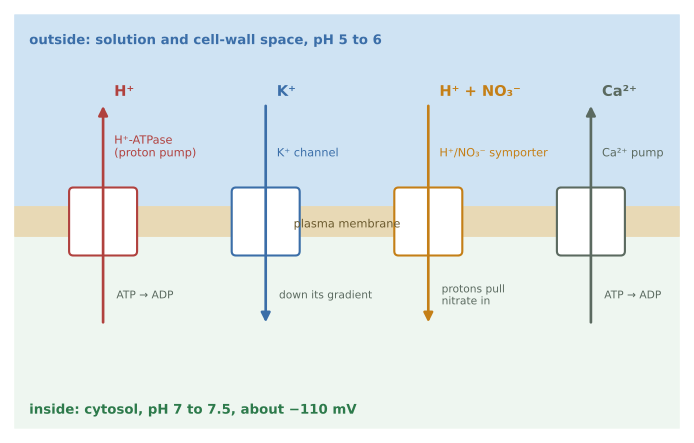
Each root cell is wrapped in a membrane, and Jones puts the consequence plainly: the cell membranes “form an effective barrier to the passage of most ions into the root”, so water can enter while the ions it carried are left behind7. Ions cross only through transport proteins, which Taiz and Zeiger group into three classes1. Channels are selective pores: an ion that fits diffuses through, always down its own gradient and never against it, at about 10⁸ ions per second per channel, and gates open and close the pore in response to signals such as voltage1. Carriers bind the ion on one side, change shape, and release it on the other; binding makes them selective and slow, about 100 to 1,000 ions per second, and they can work down the gradient or against it1. Pumps use energy directly, usually from ATP, to move an ion against its gradient1.
The pump that matters most in a root is the proton pump, a plasma-membrane H⁺-ATPase that spends ATP to push protons (H⁺) out of the cell1,5. Two things result. The outside becomes acidic relative to the inside, with the cytosol at pH 7 to 7.5 and the cell-wall space at pH 5 to 65. And the inside becomes electrically negative, because positive charge has been exported; in pea roots the measured membrane potential was −110 mV1. Those two gradients are stored energy, and the cell spends them to move everything else1,5:
- Cations are attracted inwards by the negative interior. Potassium is accumulated passively through channels in most conditions and only needs active transport when the external concentration is very low1. Calcium and magnesium also enter down their gradients, but the cell then actively pumps them out again1. Marschner describes cation uptake as uniport (through a channel) or proton–cation counter-transport, both of which involve H⁺ leaving the cell5.
- Anions have to be pushed in against the negative interior, so “all the anions are taken up actively”1. The mechanism is symport: a carrier binds a proton and the anion together and lets the proton fall back into the cell, using that energy to drag the anion in; Marschner’s scheme draws nitrate entering with two to three protons1,5. This is secondary active transport: its energy comes from the proton gradient rather than directly from ATP1.
The selectivity of these proteins is good but not perfect. A potassium transporter may also carry rubidium and sodium, although it prefers potassium, and it is completely ineffective for anions such as chloride1. That imperfect selectivity is where ion competition comes from, below.
Uptake costs energy, so roots need oxygen
Jones counts it among the certainties of ion absorption that it “requires energy that is generated by cell metabolism”7. The energy is ATP, spent by the proton pump1,5, and root cells make it by respiration; respiration with oxygen yields more ATP than metabolism without it, so uptake depends on the oxygen supply to the roots6.
When oxygen runs short, uptake fails quickly. “Hypoxia strongly inhibits ion uptake by roots and ion transport to the shoot”, because of “the lack of energy for active ion uptake because anaerobic metabolism generates less energy than aerobic pathways”6. Root growth is just as sensitive: Kafkafi cites work showing that an oxygen shortage of only 10 minutes can stop root growth, and 30 minutes kills the elongation zone behind the root tip8. In a hydroponic system the roots depend on the oxygen dissolved in the solution; Dissolved oxygen in the root zone covers how much that is and how to supply it.
Uptake is selective, so the solution and the plant differ
Because the membrane chooses, the inside of a root does not look like the solution around it. Taiz and Zeiger reproduce a classic measurement on pea roots in a dilute solution. With 1 mmol/L of K⁺ outside, the tissue held 75 mmol/L; with 1 mmol/L of Na⁺ outside, it held 81. Calcium, at 1 mmol/L outside, was held at 2 mmol/L inside, although passive equilibrium at the measured membrane potential would have predicted 5,3601. For the anions the direction reversed: nitrate at 2 mmol/L outside was 28 inside, phosphate at 1 was 21, and sulfate at 0.25 was 19, where passive entry would have given almost nothing1.
For a grower the consequence is unavoidable: a solution mixed to the right composition today will not have it after the crop has fed, because the plant removes ions in its own proportions, not in yours; single-charge ions such as K⁺, Cl⁻ and NO₃⁻, for instance, are more readily absorbed than double-charge ions such as Ca²⁺, Mg²⁺ and SO₄²⁻7. Tracking and correcting that drift is the subject of Managing a recirculating solution over time.
Charge balance: why uptake moves the pH
A plant cannot take in positive charge without either taking in matching negative charge or sending positive charge back out, and the proton pump is where the books are balanced. Anions come in by symport with protons, which removes H⁺ from the solution; cations come in by uniport or by exchange for protons, which adds H⁺ to it5. Marschner states the rule: “Excess uptake of anions over cations leads to net removal of protons in the rhizosphere and to an increase in rhizosphere pH. In contrast, excessive uptake of cations is balanced by a net release of protons” and the pH falls5. Inside the cell, the plant holds its cytosolic pH between 7.3 and 7.6 by making or breaking down organic acids, so the excess charge it absorbs is stored as organic acid anions while the protons leave2.
Nitrogen decides the outcome, because ammonium or nitrate makes up about 80% of all the ions a plant takes up3,5. Feed a plant on nitrate and the anions usually win: net protons are taken up and the solution pH rises5. Feed the same plant on ammonium and the cations win: assimilating ammonium in the root produces about one proton per molecule of ammonium, largely excreted to keep the cell neutral, and the pH falls3; another Marschner chapter writes it as three NH₄⁺ giving four H⁺5. Jones confirms the practical side for hydroponics: a balance between the two nitrogen forms “can partially regulate the pH, although some have found that this means of pH control is not always effective”7. pH: what it is and why 5.5–6.5 explains the number; Nitrogen form: nitrate, ammonium and pH control explains how far to push the ammonium share.
Worked example: one lettuce head, in millimoles of charge
We take the same head of lettuce as in the essential elements article and count the cation and anion charge the plant had to take up to build it.
Inputs. One commercial hydroponic lettuce head of 200 g11; lettuce dry matter 4 to 6% (Dediu and co-workers, citing Seginer et al. 2004), so we use 5%, giving 10 g of dry matter12; wrapper-leaf composition when heads are half grown, adequate ranges in percent of dry weight from the University of Florida tissue guide, N 2.5 to 4.0, P 0.4 to 0.6, K 4.5 to 8.0, Ca 1.4 to 2.0, Mg 0.3 to 0.7, S 0.3, of which we use the middle values in the table below13; atomic weights and uptake forms from Resh’s table, N 14.01 as NO₃⁻, P 30.98 as H₂PO₄⁻, S 32.07 as SO₄²⁻, K 39.10 as K⁺, Ca 40.08 as Ca²⁺, Mg 24.32 as Mg²⁺11.
Step 1: grams to millimoles of charge. Mass in the head = 10 g × percentage12,13; millimoles = grams ÷ atomic weight × 1,00011; mmol of charge = millimoles × charges per ion.
| Element | Content | Mass in head | mmol | Ion | Charges per ion | mmol of charge |
|---|---|---|---|---|---|---|
| N | 3.0%13 | 0.300 g | 21.4 | NO₃⁻ | 1 | 21.4 negative |
| P | 0.5%13 | 0.050 g | 1.6 | H₂PO₄⁻ | 1 | 1.6 negative |
| S | 0.3%13 | 0.030 g | 0.9 | SO₄²⁻ | 2 | 1.9 negative |
| K | 6.0%13 | 0.600 g | 15.3 | K⁺ | 1 | 15.3 positive |
| Ca | 1.7%13 | 0.170 g | 4.2 | Ca²⁺ | 2 | 8.5 positive |
| Mg | 0.5%13 | 0.050 g | 2.1 | Mg²⁺ | 2 | 4.1 positive |
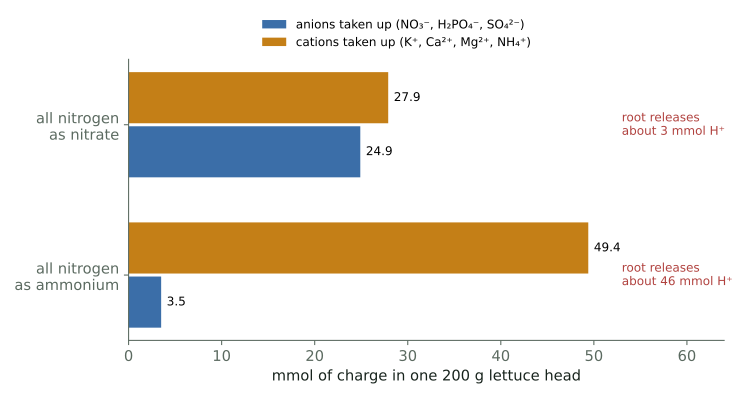
Step 2: add up each side. With all nitrogen taken up as nitrate, the anions total 21.4 + 1.6 + 1.9 = 24.9 mmol of negative charge and the cations 15.3 + 8.5 + 4.1 = 27.9 mmol of positive charge11,12,13. The difference, about 3 mmol in favour of cations, is what the root balances by releasing about 3 mmol of H⁺ over the life of the head5,11,12,13.
Step 3: switch the nitrogen form. If the same head were built from ammonium, the 21.4 mmol of nitrogen move from the anion column to the cation column11,13. The anions fall to 3.5 mmol and the cations rise to 49.4 mmol, a surplus of about 46 mmol of positive charge, so the root must release about 46 mmol of H⁺5,11,12,13. The switch moved the balance by 42.8 mmol of charge, twice the nitrogen uptake, because an anion was removed and a cation added11,12,13.
What the example shows, and what it does not. The swing between nitrate and ammonium is large and certain; the sign of the all-nitrate case is not, for this crop. With nitrogen and potassium at the ends of their Florida ranges instead of the middles, the nitrate case runs from 8 mmol of anion excess (high N, low K) to 12 mmol of cation excess (low N, high K)13. Lettuce leaves are rich in potassium, 6.0% here against 1.0% in Resh’s generic table, which pushes the count towards the cation side11,13; the same Florida table for a younger plant at the eight-leaf stage, N 4.0 to 5.0% and K 5.0 to 7.0%, gives about 10 mmol of anion excess and a rising pH13. The textbook rule that nitrate nutrition gives an anion excess describes the common case, because nitrogen dominates the count5; a crop rich in cations can come close to neutral, and one leaf at one stage is only an estimate of the whole plant13. How far the pH moves per millimole of H⁺ depends on the bicarbonate in the water, the subject of Alkalinity and buffering.
Competition and antagonism between similar ions
Because transport proteins are imperfectly selective, an ion that resembles another can occupy its transporter or change how the cell treats it. Three cases matter in a nutrient solution.
Potassium, calcium and magnesium. Applying potassium and calcium fertiliser often induces magnesium deficiency, partly because K⁺ and Ca²⁺ inhibit Mg²⁺ uptake by roots2. The experiment Marschner cites shows the size of the effect: barley seedlings given magnesium chloride alone took up 165 µmol of labelled magnesium per 10 g of fresh roots in eight hours; adding calcium sulfate at 0.25 mmol/L cut that to 115, and adding potassium chloride as well, also at 0.25 mmol/L, cut it to 152. Jones gives the same hierarchy: potassium uptake is favoured over calcium and magnesium uptake7. Magnesium is the one most easily crowded out, which is why formulations keep it in proportion to potassium and calcium; Reading a formulation shows the ratios.
Ammonium against potassium. Ammonium is effective at inhibiting potassium influx, whereas the reverse is rarely seen2. In maize roots given potassium, root potassium fell from 53.7 to 27.1 µmol per gram of fresh weight as the ammonium sulfate supply rose from 0 to 5 mmol/L over eight hours2. NH₄⁺ competes with K⁺ for the same potassium transporters and in Arabidopsis, reduces how many of one of them the root makes2. Jones gives the grower’s version: when ammonium is the major nitrogen source, uptake of K⁺, Ca²⁺ and Mg²⁺ is reduced7.
Chloride against nitrate. Jones reports that if chloride ions are present in sizeable concentrations, nitrate uptake is reduced7; chloride arrives with the source water, one reason the next article starts with your water report. The practical rule is Jones’s: the solution must be balanced initially and kept in balance, because imbalance between competing ions affects growth even when every element is present7.
Key numbers
| Quantity | Typical value or range | Conditions | Source |
|---|---|---|---|
| Maize demand met by diffusion (soil) | K 156 of 195, P 37 of 40 kg/ha | Barber’s estimate, one soil | 4 |
| Maize demand met by mass flow (soil) | N 150 of 190 kg/ha; Mg 100 supplied against 45 demanded | same | 4 |
| Width of the depletion zone in soil | about 0.2 to 2.0 mm | depends on nutrient mobility | 1 |
| Transport rate, channel vs carrier | about 10⁸ vs 100 to 1,000 ions per second | per protein | 1 |
| pH across the root membrane | cytosol 7 to 7.5; cell-wall space 5 to 6 | set by the proton pump | 5 |
| Membrane potential, pea root | −110 mV | dilute solution | 1 |
| Pea root K⁺, outside vs inside | 1 vs 75 mmol/L | same experiment | 1 |
| Pea root Ca²⁺, outside vs inside | 1 vs 2 mmol/L (passive prediction 5,360) | same experiment | 1 |
| Share of total ion uptake that is nitrogen | up to about 80% | nitrate or ammonium | 3,5 |
| Protons from ammonium assimilation | about 1 H⁺ per NH₄⁺; also written 3 NH₄⁺ → 4 H⁺ | in the root | 3,5 |
| Oxygen shortage that stops root growth | 10 min; 30 min kills the elongation zone | cited experiment | 8 |
| Barley root Mg uptake alone, with 0.25 mmol/L Ca, with Ca + K | 165 → 115 → 15 µmol per 10 g fresh weight, counted in the roots, in 8 h | labelled Mg | 2 |
| Maize root K with ammonium sulfate 0 → 5 mmol/L | 53.7 → 27.1 µmol/g fresh weight | 8 h, K supplied | 2 |
| Charge balance, 200 g lettuce head, nitrate-fed (derived) | cations 27.9, anions 24.9 mmol of charge | mid-range tissue values | 11,12,13 |
| Charge balance, same head, ammonium-fed (derived) | cations 49.4, anions 3.5 mmol of charge | same | 11,12,13 |
Common mistakes
- Thinking of the solution as “feeding fertiliser”. The root takes up individual ions at individual rates, so the mix you add and the mix the plant removes are never the same7,11.
- Treating a static reservoir as equivalent to a circulating one at the same EC. Uptake drains a thin layer against the root, and only flow or mixing refills it1,10.
- Letting the solution go stagnant, then blaming the recipe. Active uptake runs on ATP from respiration, and hypoxia strongly inhibits ion uptake6.
- Being surprised that pH climbs on a nitrate-only recipe. Nitrate uptake takes protons out of the solution; an ammonium share puts them back3,5,7.
- Adding potassium or calcium while a magnesium deficiency develops. Both inhibit magnesium uptake, so the deficiency can worsen while the analysis looks fine2.
Summary
A root takes up ions, not salts. They reach it by mass flow with the transpiration stream and by diffusion down the gradient that uptake creates; in soil, phosphate and potassium depend on diffusion, while in a well-mixed hydroponic solution convection does most of the work and flow keeps depletion zones from forming. At the membrane, a proton pump spends ATP to make the cell interior negative and the outside acidic; that stored energy pulls cations in through channels and drags anions in through proton symporters, which is why uptake needs oxygen. The membrane is selective, so plant and solution compositions differ and the solution drifts as the crop feeds. More cation charge than anion charge taken up means protons released and a falling pH; the reverse means a rising pH; nitrogen is the largest term. Similar ions compete: potassium and calcium against magnesium, ammonium against potassium, chloride against nitrate.
Next in the series: Water quality: what is in your water and why it matters.
References
- Taiz, L. and Zeiger, E. (2002). Plant Physiology, 3rd ed. Sinauer Associates, Sunderland, MA. Chapter 5, Mineral Nutrition, and Chapter 6, Solute Transport.
- White, P. J. (2012). Ion uptake mechanisms of individual cells and roots: short-distance transport. In: Marschner, P. (ed.), Marschner's Mineral Nutrition of Higher Plants, 3rd ed., Chapter 2. Academic Press, London. ISBN 978-0-12-384905-2.
- Hawkesford, M. J. et al. (2012). Functions of macronutrients. In: Marschner, P. (ed.), Marschner's Mineral Nutrition of Higher Plants, 3rd ed., Chapter 6. Academic Press, London. ISBN 978-0-12-384905-2.
- Marschner, P. (ed.) (2012). Marschner's Mineral Nutrition of Higher Plants, 3rd ed., Chapter 12, Nutrient availability in soils. Academic Press, London. ISBN 978-0-12-384905-2.
- Neumann, G. and Römheld, V. (2012). Rhizosphere chemistry in relation to plant nutrition. In: Marschner, P. (ed.), Marschner's Mineral Nutrition of Higher Plants, 3rd ed., Chapter 14, pp. 347–368. Academic Press, London. ISBN 978-0-12-384905-2.
- Marschner, P. (ed.) (2012). Marschner's Mineral Nutrition of Higher Plants, 3rd ed., Chapter 17, Adaptation of plants to adverse chemical soil conditions. Academic Press, London. ISBN 978-0-12-384905-2.
- Jones, J. B. Jr. (2005). Hydroponics: A Practical Guide for the Soilless Grower, 2nd ed. CRC Press, Boca Raton.
- Kafkafi, U. (2008). Functions of the root system. In: Raviv, M. and Lieth, J. H. (eds.), Soilless Culture: Theory and Practice, Chapter 2. Elsevier, Amsterdam. PII B978-0-444-52975-6.50004-6.
- Silber, A. and Bar-Tal, A. (2008). Nutrition of substrate-grown plants. In: Raviv, M. and Lieth, J. H. (eds.), Soilless Culture: Theory and Practice, Chapter 8. Elsevier, Amsterdam. PII B978-0-444-52975-6.50010-1.
- Bar-Yosef, B. (2008). Fertigation management and crops response to solution recycling in semi-closed greenhouses. In: Raviv, M. and Lieth, J. H. (eds.), Soilless Culture: Theory and Practice, Chapter 9. Elsevier, Amsterdam. PII B978-0-444-52975-6.50011-3.
- Resh, H. M. (2013). Hydroponic Food Production: A Definitive Guidebook for the Advanced Home Gardener and the Commercial Hydroponic Grower, 7th ed. CRC Press, Boca Raton. ISBN 978-1-4398-7869-9.
- Dediu, L., Cristea, V. and Zhang, X. (2012). Waste production and valorization in an integrated aquaponic system with bester and lettuce. African Journal of Biotechnology, 11(9), 2349–2358. https://doi.org/10.5897/AJB11.2829
- Hochmuth, G. and Hanlon, E. Plant Tissue Analysis and Interpretation for Vegetable Crops in Florida. University of Florida IFAS Extension, publication HS964, Table 10. https://edis.ifas.ufl.edu/publication/EP081
This article was drafted with the help of AI tools and reviewed and edited by PonicLabs. Sources are listed above; tell us if you find an error.