Kratky and other passive systems: growing with an air gap and no pump
Contents
Standfirst: After reading this article you will be able to explain how a plant in a lidded container of nutrient solution gets its oxygen when nothing stirs or bubbles the water, size a container for a lettuce crop from published consumption figures, and say which crops the method suits and why. You will also know the main ways a passive system fails and the mechanism behind each.
Before you read: Anatomy of a hydroponic system, Dissolved oxygen in the root zone.
A system with nothing moving
A non-circulating hydroponic system is a container of nutrient solution with a plant suspended in its lid, and nothing else. The grower adds all the water and fertiliser before planting and then does nothing until harvest. B. A. Kratky, a horticulturist at the University of Hawaii, published the versions most people now copy, and his 2009 paper states the claim in two sentences: “Three non-circulating hydroponic methods for growing lettuce are described which do not require electricity, pumps or wicks. All of the nutrient solution is added prior to planting or transplanting”1.
Both halves of that claim come from one physical fact. There is no pump because the plant moves the water by drinking it, and there is no aerator because the drinking creates, inside the container, a layer of moist air that the roots breathe from.
The air gap: oxygen without a pump
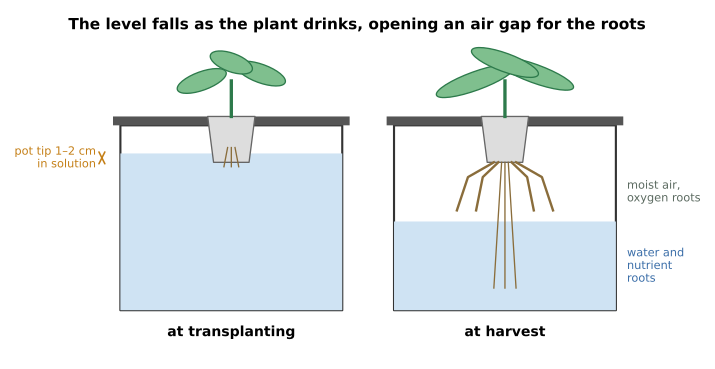
A net pot, a small plastic pot with slits in its sides, sits in a hole in the lid, filled with a growing medium and a seedling. At transplanting the tank is nearly full, so the bottom of the pot dips into the solution: Kratky immerses the lower 1 to 2 cm of the pot in his tanks and the lower 3 cm in his bottle1. Water climbs the medium by capillary action, the pull that lifts water up a paper towel, so the seedling is watered automatically1. From then on the plant drinks, the level falls, and the grower does not refill. Within a few weeks the solution is below the pot, but by then roots have grown out through the slits into the liquid3, and the closed space under the lid stays moist, so the roots in it do not dry out1.
The roots now divide their work. Kratky, citing an earlier non-circulating system described by Imai in Taiwan, calls the roots in the moist air “oxygen roots whose main function is aeration”, and the roots hanging in the solution “water and nutrient roots”1. The oxygen roots become “thicker and more branched so that they may absorb more oxygen”2. The submerged roots elongate little, because “the oxygen content of the nutrient solution becomes progressively lower with depth”1. Nothing stirs the liquid, so oxygen reaches a submerged root only by diffusion, and dissolved oxygen “diffuses so slowly in stagnant water” that in a flooded soil only the top few centimetres stay oxygenated5; Dissolved oxygen in the root zone covers the physics. The oxygen roots bypass that problem by taking their oxygen from air.
The gap grows with the crop: the root system expands as the air space enlarges, so no labour is needed between planting and harvest1; that a larger plant also needs more oxygen, and so is served by the larger gap, is this article’s inference. Kratky tested the alternative: when a floating cover followed the water down so that no air space formed, lettuce yields fell by up to 23 percent compared with a cover fixed to the tank frame1. One rule follows. The level may stay where it is or fall, but it must never be raised, because submerging the oxygen roots makes the plant, in Kratky’s word, “drown”1,2.
Kratky’s three methods and his numbers
Kratky published three versions of the same idea, from a single bottle to a commercial tank1. The table gathers the numbers he printed.
| 4-litre bottle | Tank with a fixed cover | Float-support raceway | |
|---|---|---|---|
| For | one plant; teaching, home, research1 | commercial lettuce under rain shelters1 | commercial lettuce with movable rafts1 |
| Solution at start | bottle filled to within 4 cm of the top1 | 4 to 8 L per plant; 13 cm deep in a 14 cm tank1 | as the fixed-cover tank, 14 cm deep1 |
| Fertiliser | 5 g of a complete hydroponic granular fertiliser1 | two stock solutions in equal volumes to EC 1.5 mS/cm1 | same1 |
| Net pot immersed | lower 3 cm1 | lower 1 to 2 cm; 5 cm pots at 20 × 30 cm spacing1 | same pots and spacing1 |
| Level drop by harvest | 15 to 25 cm1 | 6 to 12 cm1 | cover rests on 10 cm pipes; gap 3 to 9 cm1 |
| Crop time | about 6 to 7 weeks from seeding1 | about 5 weeks from transplanting1 | about 30 to 40 days from transplanting1 |
The bottle is the method in its purest form. In Hilo, Hawaii, “a 200 gram lettuce plant typically only consumes about 3-4 liters of nutrient solution”, and growers aim for heads of 150 to 250 g with consumption of 3 to 6 L per plant1. The same idea scales to 3 or 4 plants in a 20-litre bucket or 6 to 8 in a storage box1.
The covered tank turns the bottle into a bed, lined with black polyethylene and covered with a polystyrene sheet carrying 5 cm net pots1. Kratky’s EC target is 1.5 mS/cm, from one stock of a commercial hydroponic fertiliser plus magnesium sulfate and a second of calcium nitrate1. His 2010 extension bulletin widens the target to about 1 mS/cm in hot weather and up to 2.5 mS/cm in cool weather, with the pH in the usual 5.5 to 6.5 range3. He advises draining and refilling the tank at least after every three crops1. The float-support raceway adds one trick: the board floats at first, then rests on two 10 cm pipes as the level falls, and the tank is refilled with water at the end so the rafts can be floated to the harvest station1.
Two figures describe the method as a whole. Water use is low, in this article’s reading because the container is covered and nothing is drained during the crop: Kratky reports less than 20 L of water per kilogram of lettuce as common and a record of 11 L per kilogram1. And his bulletin draws the boundary in water terms: the method is “intended only for crops that require less than 2 gallons of water per plant for the entire growing season”, about 7.6 L in our conversion3.
The limits, from the mechanism
There is no pump to fail, but there is also no pump to correct anything.
The water runs out, so the crop must finish first
A fixed volume is a clock. The plant drinks until the solution is gone, and Kratky’s rule is that “the crop is terminated when less than 10 per cent of the original nutrient solution remains”2. If the crop needs more water than the container holds, the options are a bigger container or adding water during the crop, and the second breaks the air-gap rule below.
Salts concentrate, and EC and pH drift
Roots take up water and nutrients in different proportions, so the solution left behind changes, and anything the plant does not take, such as sodium and chloride from tap water, concentrates as the volume shrinks. Kratky gives the arithmetic: water with an initial EC of 0.5 mS/cm from salt contaminants “may concentrate to 2.0 mS when 25 percent of the original nutrient solution remains”, which “could lead to tipburn and other problems”1. His remedy is rainwater, or deeper tanks emptied after every crop1. In hot weather plants take up more water than nutrients and the EC rises, so Hawaii growers start hot-season crops at a lower EC3. The pH is usually left alone: Kratky reports cropping cycles “typically completed without altering pH”, with dolomite in a mesh bag or ammonium sulfate as corrections when needed1. Managing a recirculating solution over time explains the drift; in a passive system nothing corrects it until the next fill.
Warm solution holds less oxygen, and the air gap is the only route in
The submerged roots depend on whatever oxygen diffuses into still water, and that reserve shrinks with temperature. Fresh water saturated against moist air at one atmosphere holds 9.08 mg/L of oxygen at 20 °C and 7.54 mg/L at 30 °C4, about 17 percent less in our arithmetic. Demand rises in the same heat: above 20 °C, roots and microbes “can totally deplete the oxygen from the bulk of the soil water in as little as 24 hours”, in the textbook description of a waterlogged soil5; a lidded tank of still solution is, in this article’s inference, the same situation. In an active system an air pump pushes back; here the only defence is the air gap, which must never be flooded. A shallow tank also has little thermal buffer, since, in this article’s inference, a thin layer of solution follows the air temperature in heat and in cold; Resh notes that a polystyrene cover “also acts as an insulating barrier against high temperatures”6.
Light, algae and mosquitoes
Still solution with light on it grows algae, which Resh says compete for nutrients, shift the pH, produce odours, compete with roots for oxygen at night, and release toxic products as they decompose6. Kratky’s bottle “should either be covered or darkened to discourage algae growth”, and his tanks are lined in black and covered with board1. Still water also breeds mosquitoes, “both a health menace as well as a nuisance to workers”; his controls are screens on the shelter, a screen draped in the tank so that larvae are trapped under it as the level falls, salt-tolerant fish, or a Bacillus thuringiensis israelensis treatment1. At home, a tight lid and a snug net pot are the equivalent.
Refilling to the top drowns the oxygen roots
The most common home mistake is to treat the falling level as a fault and top the container up. Kratky’s principle is explicit: the level “may remain the same or be lowered, but it may not be raised or else the roots will ‘drown’”, and raising it by rainfall or additions of more than 2 cm after the roots have emerged “may cause plant injury”2. His bulletin describes what the grower sees: roots that were in the moist air zone become submerged and starved for oxygen, the plants wilt, and they may “drown” and die3. If you must extend a crop, add water only up to a level that keeps the established air gap.
Which crops suit a passive container
The mechanism sets the crop list: anything that finishes before the water does. Kratky’s bulletin names leafy, romaine and semi-head lettuces, coriander (cilantro), green onions, kai choy, pak choi and watercress3, short crops whose total water use, 3 to 6 L per lettuce plant, fits a bottle or a shallow tank1.
Fruiting crops are a different scale. “Tomatoes typically require 25 to 40 liters of water to produce one kg of fruit”, so “a large tank is needed to support this high water requirement”2. In Kratky’s trial, twelve tomato plants in a 0.6 by 3.6 by 0.4 m tank holding 757 L of solution at EC 1.5 mS/cm were cropped until the solution ran out, giving 24.79 kg of marketable fruit, or 30.5 L of solution per kilogram2. He concludes that the expense of such tanks “limits this fill it and forget it method to an academic curiosity except in special situations”2. Cucumbers fare better because one plant can have a 100 to 130 L bin to itself, at EC 2.0 to 2.5 mS/cm for about 80 days, yielding over 7 kg per 120 L container in cool conditions and half of that more normally2. Holding the level in a small bottle with a float valve is possible but, in Kratky’s words, “cumbersome” and “defeats the simplicity feature of this method”2. A long or heavy crop needs either a very large static reservoir or an active system, and Deep water culture is the usual next step.
Passive systems beyond mineral solutions
The air-gap principle does not depend on where the nutrients come from, and its history before Kratky, from Imai’s AVRDC system in Taiwan onward, is told on our passive hydroponics page. PonicLabs has run the same geometry on organic and waste-derived solutions, which are outside this article’s scope. Two observations from our reports are relevant. In a 2020 trial, radishes grew in two 10 L containers fed with vermicompost powder, one with an air pump and one without; the non-aerated container produced the larger bulbs, although the plants looked unhealthy throughout9. In 2021, on a solution made from aged urine, vermicompost and bokashi leachates, a pot-in-pot-in-tray variant, an inverted pot inside a larger pot of coir and perlite fed from a tray below, did nearly as well as a sub-irrigated bucket with less medium, and we credited the wicking plus a moist air space with keeping the roots free of rot10. Both are single unreplicated trials, cited as observations only.
Worked example: one head and a six-head tote
Every input has a source; the container dimensions are our choice, and every result is our arithmetic.
One lettuce head. Kratky reports that a 200 g head consumes about 3 to 4 L of solution in Hilo, and that he fills 4 to 8 L per plant before planting1. A cross-check from first principles: lettuce is normally 4 to 6 percent dry matter (Seginer et al. 2004, as cited in8), so a 200 g head carries about 10 g of dry matter at 5 percent, our estimate from8. A C3 plant in the open field transpires about 500 L of water per kilogram of dry matter, less in a greenhouse7, so 10 g of dry matter corresponds to about 5 L transpired, or 4 to 6 L across the dry-matter range, our calculation from7 and8, which agrees with Kratky’s measured 3 to 6 L1. A 4 L bottle, filled to within 4 cm of the top1, therefore holds a 3 L crop with under 1 L to spare and a 4 L crop with none, our arithmetic from1.
A six-head tote. Take a storage box 60 cm long, 40 cm wide and 15 cm tall, our choice, with a footprint of 0.24 m²; a shallow box, because the net pots in the lid must touch the solution at transplant. Six holes give each plant 400 cm² of lid, tighter than Kratky’s 600 cm² at 20 by 30 cm spacing, so expect smaller heads or an earlier harvest1.
- Fill at 5 L per plant, inside Kratky’s 4 to 8 L range1: 6 × 5 = 30 L.
- Starting depth, our arithmetic: 30 L is 0.030 m³, and 0.030 / 0.24 = 0.125 m, so the solution starts 12.5 cm deep, 2.5 cm below the lid, and a 5 cm net pot in the lid dips about 2.5 cm into it, close to Kratky’s 1 to 2 cm1.
- Consumption at 4 L per head1: 6 × 4 = 24 L, leaving 6 L, which is 0.006 / 0.24 = 0.025 m, or 2.5 cm of solution, 20 percent of the start.
- Level drop: 12.5 − 2.5 = 10 cm, so the oxygen roots hang in a 10 cm air gap at harvest; at 3 L per head1 the drop is 7.5 cm.
Kratky’s tanks show the same geometry: a 20 by 30 cm cell 13 cm deep holds 7.8 L, our arithmetic from1, and his levels drop 6 to 12 cm by harvest1, so the tote’s drop of 10 cm, our result, sits inside his range. If your tap water has an EC of 0.5 mS/cm before fertiliser, then with 20 percent left the contaminant salts alone have risen to 2.5 mS/cm, our arithmetic by Kratky’s rule1, so use rainwater or a larger fill.
Key numbers
| Quantity | Typical value or range | Conditions | Source |
|---|---|---|---|
| Solution filled per lettuce plant | 4 to 8 L | before planting, covered tank | 1 |
| Solution consumed per lettuce plant | 3 to 6 L; about 3 to 4 L for a 200 g head | Hilo, Hawaii | 1 |
| Head mass growers aim for | 150 to 250 g | leaf and semi-head cultivars | 1 |
| Water use | under 20 L per kg lettuce common; 11 L per kg recorded | non-circulating tanks | 1 |
| Net pot immersed at transplant | 1 to 2 cm (tank), 3 cm (bottle) | 1 | |
| Level drop by harvest | 15 to 25 cm (bottle); 6 to 12 cm (tank); gap 3 to 9 cm (raceway) | 1 | |
| Crop time | 6 to 7 weeks from seeding; about 5 weeks from transplanting | leafy and semi-head lettuce | 1 |
| EC of solution | 1.5 mS/cm; 1 mS/cm hot weather to 2.5 mS/cm cool | Hawaii lettuce | 1,3 |
| pH | 5.5 to 6.5, usually not adjusted during a crop | Hawaii lettuce | 1,3 |
| Yield loss with no air gap | up to 23 percent | floating cover without supports | 1 |
| Crop ended when solution left | under 10 percent of the start | 2 | |
| Salt concentration | 0.5 mS/cm rises to 2.0 mS/cm at 25 percent remaining | water contaminants | 1 |
| Oxygen solubility | 9.08 mg/L at 20 °C; 7.54 mg/L at 30 °C | fresh water, moist air, 1 atm | 4 |
| Tomato water need | 25 to 40 L per kg fruit; 30.5 L per kg in a 757 L tank | twelve plants | 2 |
| Cucumber container | 100 to 130 L per plant, EC 2.0 to 2.5 mS/cm, about 80 days | 2 |
Common mistakes
- Topping the container up to the lid when the level falls. The roots above the old level are built for air, and submerging them makes the plant “drown”1,2.
- Starting with the solution below the net pot. Capillary wetting from the immersed 1 to 3 cm of the pot waters the seedling until its roots reach the liquid1.
- Using a clear container or a loose lid. Light grows algae that compete with roots for oxygen at night, and open water breeds mosquitoes1,6.
- Growing a tomato in a lettuce-sized container. A tomato needs 25 to 40 L of water per kilogram of fruit, and a fixed reservoir stops the crop when it empties2.
- Filling with salty tap water. What the plant does not take concentrates as the volume shrinks: 0.5 mS/cm of contaminants becomes 2.0 mS/cm at a quarter remaining1.
Summary
A Kratky system is a lidded container in which the plant pumps the water by drinking it and, in doing so, creates the moist air layer that its upper roots breathe from. The pot touches the solution at transplant, the level falls and is never raised, oxygen roots form in the gap and water roots feed from the pool below. Kratky’s figures for lettuce are 4 to 8 L filled per plant, 3 to 6 L consumed, an EC near 1.5 mS/cm, and a crop in about five weeks from transplanting with the level 6 to 12 cm lower at harvest1. The fixed volume is also the limit: the crop must finish before the water does, unabsorbed salts concentrate, warm solution holds less oxygen, and refilling to the top drowns the roots built for air. Short leafy crops fit; tomatoes need a very large reservoir or an active system.
Next in the series: Deep water culture.
References
- Kratky, B. A. (2009). Three non-circulating hydroponic methods for growing lettuce. Acta Horticulturae, 843, 65–72. https://doi.org/10.17660/ActaHortic.2009.843.6
- Kratky, B. A. (2004). A suspended pot, non-circulating hydroponic method. Acta Horticulturae, 648, 83–89. Author's PDF: https://www.ctahr.hawaii.edu/hawaii/downloads/A_Suspended_Pot_Non-circulating_Hydroponic_Method.pdf
- Kratky, B. A. (2010). A Suspended Net-Pot, Non-Circulating Hydroponic Method for Commercial Production of Leafy, Romaine, and Semi-Head Lettuce. University of Hawaii CTAHR, Vegetable Crops VC-1. https://www.ctahr.hawaii.edu/oc/freepubs/pdf/vc-1.pdf
- Lucas, J. S. and Southgate, P. C. (eds) (2012). Aquaculture: Farming Aquatic Animals and Plants, 2nd ed. Wiley-Blackwell, chapter 3, Table 3.2 (reproduced from Colt 1984).
- Taiz, L. and Zeiger, E. (2002). Plant Physiology, 3rd ed. Sinauer Associates, Sunderland, MA. Chapter 25, Stress Physiology.
- Resh, H. M. (2013). Hydroponic Food Production, 7th ed. CRC Press, Boca Raton. Chapter 5, Water Culture.
- Castilla, N. (2013). Greenhouse Technology and Management, 2nd ed. CABI, Wallingford. Section 11.6.7.
- Dediu, L., Cristea, V. and Zhang, X. (2012). Waste production and valorization in an integrated aquaponic system with bester and lettuce. African Journal of Biotechnology, 11(9), 2349–2358. https://doi.org/10.5897/AJB11.2829
- Sánchez, H. (2020). Turning good waste into radish in organic hydroponics. PonicLabs technical report (video transcript), Malmö. Summarised in library/poniclabs_compressed_context/reports_compressed.md, experiment 8, lines 323–343.
- Sánchez, H. (2021). Bioanthroponics. PonicLabs technical report (video transcript), Malmö. Summarised in library/poniclabs_compressed_context/reports_compressed.md, experiment 9, lines 346–398.
This article was drafted with the help of AI tools and reviewed and edited by PonicLabs. Sources are listed above; tell us if you find an error.