Reading a formulation: Hoagland, Steiner and modern recipes
Contents
Standfirst: After reading this article you will be able to convert any nutrient recipe between milligrams per litre and millimoles per litre, check that its positive and negative charges balance, translate a fertiliser label written in P₂O₅ and K₂O, and put the classic Hoagland and Steiner solutions beside a modern commercial recipe and say what the differences mean.
Before you read: What plants are made of: the essential elements, Fertiliser salts: purity, solubility, compatibility, EC and concentration: what the meter measures.
Two ways to write the same recipe
A nutrient formulation is a list of the mineral elements a solution contains and how much of each. Most recipes give the amounts as parts per million (ppm) of each element, and for a dilute water solution one part per million is one milligram per litre, mg/L4. “210 ppm nitrogen” means that every litre holds 210 mg of the element nitrogen, whatever salt it came from4.
Chemists and most research papers write the same recipe in millimoles per litre, mmol/L. A mole is a counted number of particles, and a millimole is a thousandth of it. The mass of one millimole of an element, in milligrams, is its atomic mass4. The table gives the six macroelements.
| Element | Atomic mass (mg per mmol)4 |
|---|---|
| Nitrogen, N | 14.01 |
| Phosphorus, P | 30.97 |
| Potassium, K | 39.10 |
| Calcium, Ca | 40.08 |
| Magnesium, Mg | 24.31 |
| Sulfur, S | 32.06 |
To go from mg/L to mmol/L, divide by the atomic mass; to go back, multiply. The 210 mg/L of nitrogen above is 210 / 14.01 = 15.0 mmol/L4. Both numbers describe the same solution.
The reason to bother with millimoles is that roots take up ions, not grams. A recipe in mmol/L counts ions directly and makes the chemistry visible: 5 mmol/L of calcium nitrate, Ca(NO₃)₂, is 5 mmol/L of calcium and 10 mmol/L of nitrate, read straight off the formula1. In mg/L the same salt gives 200 mg/L of calcium and 140 mg/L of nitrate-nitrogen, and the link between the two numbers is hidden1,4.
Counting charge: the ion balance
Every dissolved salt splits into a positive ion (a cation) and a negative ion (an anion), and the solution as a whole carries no charge, so the positive charges always equal the negative charges8. Formulators count charge in equivalents: the molar concentration of an ion multiplied by its charge8. Potassium (K⁺), ammonium (NH₄⁺), nitrate (NO₃⁻) and dihydrogen phosphate (H₂PO₄⁻) carry one charge each, so for them 1 mmol/L is 1 milliequivalent per litre, meq/L; calcium (Ca²⁺), magnesium (Mg²⁺) and sulfate (SO₄²⁻) carry two, so 1 mmol/L is 2 meq/L8.
The Dutch fertigation handbook gives the sums in two lines: cation equivalents are NH₄ + K + Na + 2 Ca + 2 Mg, and anion equivalents are NO₃ + Cl + 2 SO₄ + HCO₃ + H₂PO₄, all in mmol/L8. If the sums differ, the recipe or the analysis contains an error; a difference below 10% is accepted as analytical variation8. The handbook also offers a rough estimate of electrical conductivity: EC in mS/cm is about the cation equivalents plus the anion equivalents, divided by 20, a rule for checking calculations rather than a law, for the reasons given in EC and concentration8.
The same element under three names
Fertiliser bags use none of these units. By tradition they state nitrogen as N, phosphorus as phosphoric anhydride, P₂O₅, and potassium as potassium oxide, K₂O, so potassium nitrate is sold as 13-0-44: 13% N, 0% P₂O₅ and 44% K₂O4. Hydroponic recipes state phosphorus as P or as phosphate and potassium as K, so the label has to be converted4.
The conversion factor is the fraction of the element in the compound, worked out from atomic masses4. For nitrate, the atomic mass of nitrogen (14) divided by the molar mass of nitrate (62) gives 0.226, so a nitrate figure multiplied by 0.226 is a nitrogen figure4. For potassium oxide, two potassium atoms weigh 2 × 39.10 = 78.20 and the oxide weighs 78.20 + 16.00 = 94.20, so K₂O × 0.830 = K4. For phosphoric anhydride, two phosphorus atoms weigh 61.94 and the oxide 61.94 + 5 × 16.00 = 141.94, so P₂O₅ × 0.436 = P4. The 44% K₂O on the potassium nitrate bag is therefore 44 × 0.830 = 36.5% potassium4. Nitrogen has a second trap: a recipe may give it as the element (N) or as nitrate (NO₃⁻), so “196 mg/L NO₃-N” and “868 mg/L NO₃” describe the same solution, because 196 / 0.226 = 8684. Read the column heading before comparing two recipes.
Hoagland and Arnon: the research standard
The best-known formulation is the one Dennis Hoagland and Daniel Arnon published at the University of California in 1938 and revised in 1950 as Circular 3471. The circular gives two solutions as millilitres of one-molar stock per litre of final solution, which is the same as mmol/L of each salt. Solution 1 is 1 mmol/L potassium dihydrogen phosphate (KH₂PO₄), 5 mmol/L potassium nitrate (KNO₃), 5 mmol/L calcium nitrate (Ca(NO₃)₂) and 2 mmol/L magnesium sulfate (MgSO₄)1. Solution 2 is 1 mmol/L ammonium dihydrogen phosphate (NH₄H₂PO₄), 6 mmol/L potassium nitrate, 4 mmol/L calcium nitrate and 2 mmol/L magnesium sulfate1. Both receive a micronutrient stock giving 0.5 mg/L boron, 0.5 mg/L manganese, 0.05 mg/L zinc, 0.02 mg/L copper and 0.01 mg/L molybdenum, and iron added separately about twice a week1.
Reading solution 1 salt by salt gives the table below; nitrogen, for instance, is the 5 mmol/L of potassium nitrate plus twice the 5 mmol/L of calcium nitrate1. The mg/L column is each mmol/L value multiplied by the atomic mass4.
| Element | Salts supplying it1 | mmol/L1 | mg/L (derived)1,4 |
|---|---|---|---|
| N, all as nitrate | KNO₃ 5 + Ca(NO₃)₂ 2 × 5 | 15 | 210 |
| K | KH₂PO₄ 1 + KNO₃ 5 | 6 | 235 |
| Ca | Ca(NO₃)₂ 5 | 5 | 200 |
| P | KH₂PO₄ 1 | 1 | 31 |
| Mg | MgSO₄ 2 | 2 | 49 |
| S | MgSO₄ 2 | 2 | 64 |
The charge check works at once: cations are 6 (K) + 2 × 5 (Ca) + 2 × 2 (Mg) = 20 meq/L, and anions are 15 (NO₃) + 1 (H₂PO₄) + 2 × 2 (SO₄) = 20 meq/L1,8. Solution 2 balances the same way at 19 meq/L, with 1 mmol/L of its nitrogen as ammonium and 14 mmol/L as nitrate1.
Two cautions. First, later books reprint the recipe in mg/L with values that do not all follow from the molar recipe: Jones prints 242 mg/L nitrogen and 113 mg/L sulfur for solution 13, and Trejo-Téllez and Gómez-Merino print 34 mg/L magnesium6, where the molar recipe gives 210, 64 and 49 mg/L1,4. When a reprint and a molar recipe disagree, trust the molar recipe. Second, Jones notes that the concentrations were derived from the average elemental content of a tomato plant, for one plant in 4 gallons of solution replaced weekly, and asks how the formulas behave for other crops, volumes and schedules3. The circular says only that the solutions proved satisfactory with various species at Berkeley, and that solution 2 is often preferred because the ammonium salt delays the development of alkalinity, the rise in pH that a nitrate-only solution produces1.
Plant physiology textbooks use a later variant, the modified Hoagland solution after Epstein (1972): 6 mmol/L potassium nitrate, 4 mmol/L calcium nitrate, 2 mmol/L ammonium dihydrogen phosphate and 1 mmol/L magnesium sulfate, giving 224 mg/L N, 235 mg/L K, 160 mg/L Ca, 62 mg/L P, 32 mg/L S and 24 mg/L Mg5. Taiz and Zeiger explain the design: the concentrations are set at the highest levels that produce neither toxicity nor salinity stress, so that plants can grow for long periods without replenishment; phosphorus is offered at 62 mg/L where soil solutions normally hold less than 0.06 mg/L5. That is the sense in which Hoagland is strong: a research solution built for maximal growth with few changes of solution, not a recipe tuned to a crop.
Steiner: ratios, not absolute values
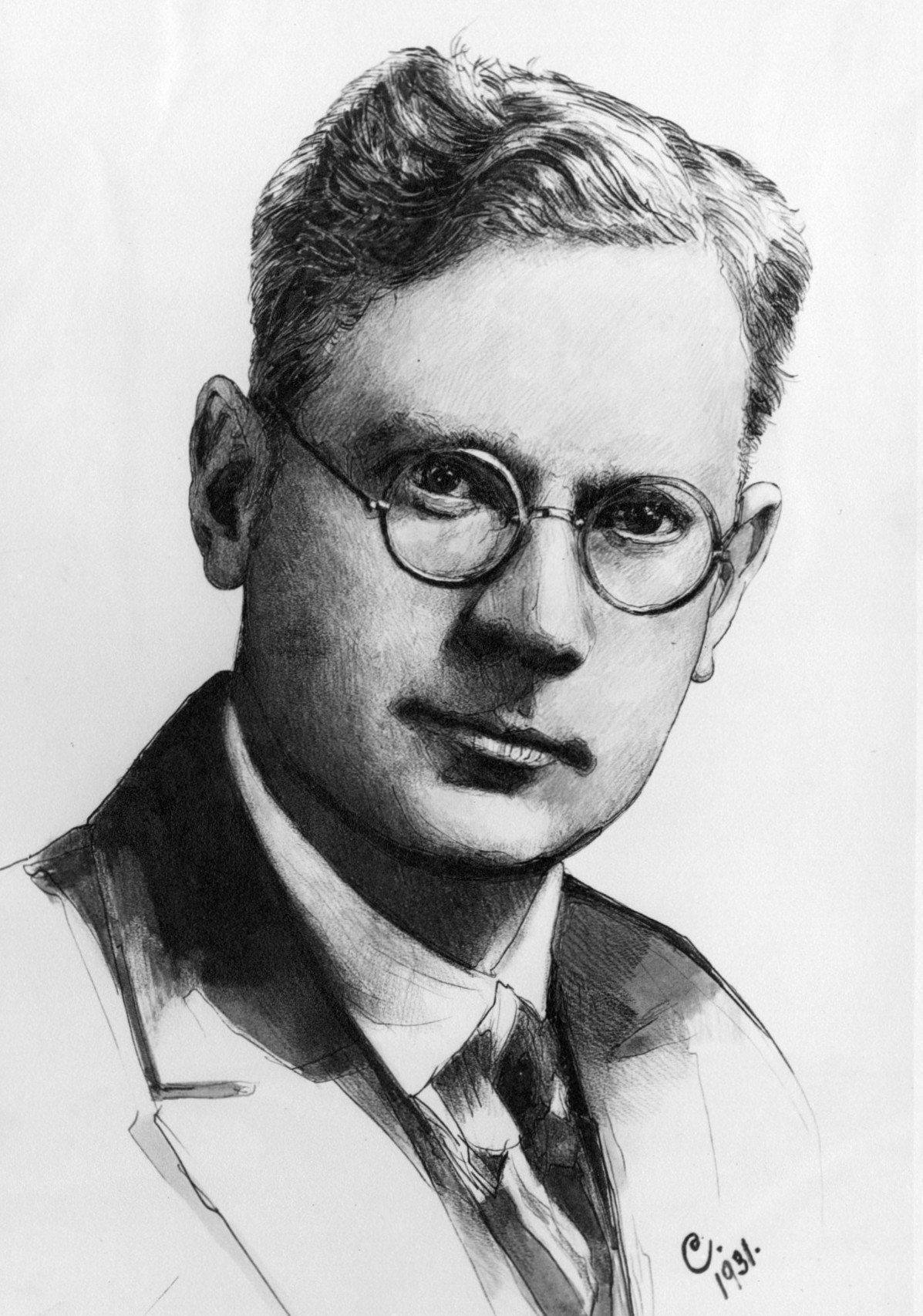
In 1961 Abram Steiner of the Naaldwijk experiment station in the Netherlands published a method for computing in advance a nutrient solution that satisfies chosen requirements for “the relative ratios of the nutrient ions, the total ionic concentration and the pH, without complications due to precipitation”2. His idea, the ionic mutual ratio, is that what matters to the plant is not only the total of each ion but the proportions in which the three major anions (nitrate, dihydrogen phosphate, sulfate) and the three major cations (potassium, calcium, magnesium) are offered together6. Because of the charge balance, no ion can be added without a counter-ion, so changing one concentration changes the proportions of the others6.
Steiner expressed the proportions as percentages of milliequivalents. His universal solution has anions in the ratio NO₃⁻ : H₂PO₄⁻ : SO₄²⁻ = 60 : 5 : 35 and cations in the ratio K⁺ : Ca²⁺ : Mg²⁺ = 35 : 45 : 20, with permitted ranges: nitrate 50% to 70% of the anions, phosphate 3% to 20%, sulfate 25% to 40%; potassium 30% to 40% of the cations, calcium 35% to 55%, magnesium 15% to 30%3. He also set limits on total concentration and pH: above about 30 “mg ions” per litre and above pH 6.5, very few combinations avoid precipitation3. Jones reads Steiner as claiming that one well-balanced formulation serves most plants if the ion balance is kept3.
The absolute values of the universal solution are reprinted by Trejo-Téllez and Gómez-Merino from Steiner’s 1984 paper as 168 mg/L N, 31 mg/L P, 273 mg/L K, 180 mg/L Ca, 48 mg/L Mg and 336 mg/L S6. Converting with the atomic masses gives 12.0 mmol/L nitrate, 1.0 mmol/L phosphate, 7.0 mmol/L potassium, 4.5 mmol/L calcium and 2.0 mmol/L magnesium; the cations come to 7 + 9 + 4 = 20 meq/L and their shares are exactly 35%, 45% and 20%3,4,6. The printed sulfur does not fit: 336 mg/L is 10.5 mmol/L, which would make sulfate 62% of the anions instead of 35%4,6. The 60 : 5 : 35 ratio with 12 mmol/L nitrate and 1 mmol/L phosphate requires 3.5 mmol/L sulfate, 112 mg/L of sulfur, which brings the anions to the same 20 meq/L as the cations3,4. As with Hoagland, the ratio is the design, and a printed mg/L table that breaks the ratio has been copied wrongly somewhere.
Modern recipes: crop-specific and written in mmol/L
Dutch greenhouse practice writes its standard solutions in mmol/L for the macroelements and µmol/L for the micronutrients, following the recommendations of the Naaldwijk research station (De Kreij, Voogt and co-workers 1999), adjusted since from practice, with recipe calculations after Sonneveld and Voogt8. The fertigation handbook edited by Van der Lugt gives the standard solution for lettuce in water culture as 1 mmol/L NH₄, 9.5 K, 4.5 Ca, 1 Mg, 16 NO₃, 2 SO₄ and 1.5 H₂PO₄, at pH 5.3 and an EC of 2.2 mS/cm, with root-zone target values beside it8. For tomato on an inert substrate it gives 1.2 mmol/L NH₄, 9.5 K, 5.4 Ca, 2.4 Mg, 15 NO₃, 4.4 SO₄, 1.5 H₂PO₄ and 1 Cl at EC 2.6 mS/cm, plus adjustments for the start of the crop, fruit set, high water supply and the end of the season: early in the season crops take relatively more calcium than potassium, and from fruit set more potassium than calcium8.
A North American example is the Cornell lettuce handbook, which lists its final solution in both units: 8.9 mmol/L N (125 ppm), 1.0 P (31 ppm), 5.5 K (215 ppm), 2.1 Ca (84 ppm), 1.0 Mg (24 ppm) and 1.1 S (35 ppm), with iron at 16.8 µmol/L (0.94 ppm)7. Its stock recipe includes ammonium nitrate, so the 8.9 mmol/L is total nitrogen, not nitrate alone7.
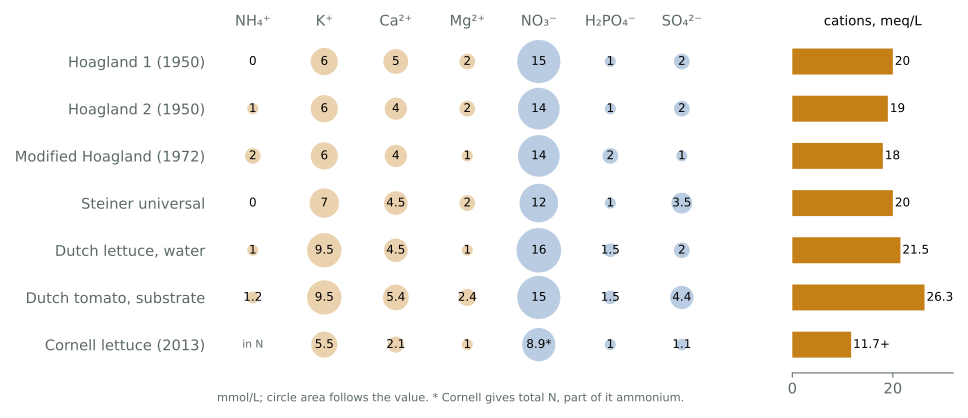
The table puts the recipes side by side in mmol/L, with cation charge as a measure of overall strength. Where the source gives no EC, the last column uses the handbook’s rule of thumb8.
| Recipe | NH₄⁺ | K⁺ | Ca²⁺ | Mg²⁺ | NO₃⁻ | H₂PO₄⁻ | SO₄²⁻ | Cations, meq/L | EC, mS/cm |
|---|---|---|---|---|---|---|---|---|---|
| Hoagland solution 1, 19501 | 0 | 6 | 5 | 2 | 15 | 1 | 2 | 20 | about 2.0 (estimate)8 |
| Hoagland solution 2, 19501 | 1 | 6 | 4 | 2 | 14 | 1 | 2 | 19 | about 1.9 (estimate)8 |
| Modified Hoagland, Epstein 19725 | 2 | 6 | 4 | 1 | 14 | 2 | 1 | 18 | about 1.8 (estimate)8 |
| Steiner universal, ratio form3,6 | 0 | 7 | 4.5 | 2 | 12 | 1 | 3.5 | 20 | about 2.0 (estimate)8 |
| Dutch standard, lettuce in water8 | 1 | 9.5 | 4.5 | 1 | 16 | 1.5 | 2 | 21.5 | 2.28 |
| Dutch standard, tomato on substrate8 | 1.2 | 9.5 | 5.4 | 2.4 | 15 | 1.5 | 4.4 | 26.3 | 2.68 |
| Cornell lettuce, 20137 | part of N | 5.5 | 2.1 | 1.0 | 8.9 total N | 1.0 | 1.1 | at least 11.7 | 1.27 |
Three things stand out. The classic research solutions and the Dutch lettuce standard are of similar total strength, about 20 meq/L of cations, and the Dutch tomato solution is stronger; the Cornell lettuce recipe runs at roughly 60% of that, with less than half the calcium1,5,7,8. What separates research from commercial practice is less the strength than that commercial recipes are written per crop and per growth stage, with root-zone targets and a stated EC, because, as Voogt puts it, the composition must reflect the crop’s uptake ratios6,7,8. Second, the Dutch standards put more potassium against calcium (9.5 against 4.5 or 5.4 mmol/L) than Hoagland (6 against 5) or Steiner (7 against 4.5), and all the modern recipes add a small share of ammonium1,3,6,8. Third, Steiner’s 3.5 mmol/L and the Dutch tomato’s 4.4 mmol/L of sulfate are high because sulfate is the counter-ion that lets potassium and magnesium rise without raising nitrate3,8.
Worked example: from mg/L to mmol/L to a charge balance
Take the modified Hoagland solution as printed in mg/L: 224 N, 235 K, 160 Ca, 62 P, 32 S and 24 Mg, with 2 mmol/L of the nitrogen supplied as ammonium from the 2 mmol/L of ammonium dihydrogen phosphate5. Divide each value by its atomic mass4:
- N: 224 / 14.01 = 15.99 mmol/L, of which 2.00 is ammonium and 13.99 is nitrate4,5.
- K: 235 / 39.10 = 6.01 mmol/L4,5.
- Ca: 160 / 40.08 = 3.99 mmol/L4,5.
- P: 62 / 30.97 = 2.00 mmol/L, present as H₂PO₄⁻4,5.
- S: 32 / 32.06 = 1.00 mmol/L, present as SO₄²⁻4,5.
- Mg: 24 / 24.31 = 0.99 mmol/L4,5.
Now count charge with the handbook’s two formulas8. Cations: 2.00 (NH₄⁺) + 6.01 (K⁺) + 2 × 3.99 (Ca²⁺) + 2 × 0.99 (Mg²⁺) = 17.97 meq/L5,8. Anions: 13.99 (NO₃⁻) + 2.00 (H₂PO₄⁻) + 2 × 1.00 (SO₄²⁻) = 17.99 meq/L5,8. The difference of 0.02 meq/L is rounding in the printed mg/L values; the molar recipe gives exactly 18 on both sides5,8. The rule of thumb puts the EC near (17.97 + 17.99) / 20 = 1.8 mS/cm8.
The same check on the Dutch lettuce standard, already in mmol/L, gives cations 1 + 9.5 + 2 × 4.5 + 2 × 1 = 21.5 meq/L, anions 16 + 2 × 2 + 1.5 = 21.5 meq/L, and an EC estimate of 43 / 20 = 2.15 mS/cm against the stated 2.2 mS/cm8. A recipe that fails this test by more than 10% has a typing error or a missing ion, and Mixing your own solution shows how to find it before weighing anything.
Nitrate, ammonium and the pH of the tank
Every recipe above states how much of its nitrogen is ammonium, and the share is small: none in Hoagland 1, 1 mmol/L in Hoagland 2, 2 mmol/L in the modified Hoagland, 1 to 1.2 mmol/L in the Dutch standards1,5,8. The reason is pH: Hoagland and Arnon noted that solution 2 “may often be preferred” because the ammonium salt delays the alkalinity of a nitrate-only solution1, and Taiz and Zeiger note that a mixture of cation and anion nitrogen reduces the rapid rise in pH seen when all nitrogen is nitrate5. Too much ammonium brings its own problems; Nitrogen form: nitrate, ammonium and pH control covers how large a share is safe.
Key numbers
| Quantity | Typical value or range | Conditions | Source |
|---|---|---|---|
| 1 ppm in a dilute water solution | 1 mg/L | nutrient formulations | 4 |
| Atomic masses N, P, K, Ca, Mg, S | 14.01, 30.97, 39.10, 40.08, 24.31, 32.06 | mg per mmol | 4 |
| Nitrate to nitrogen | × 0.226 | 14 / 62 | 4 |
| K₂O to K; P₂O₅ to P | × 0.830; × 0.436 | fertiliser labels | 4 |
| Accepted cation and anion mismatch | under 10% | laboratory analyses | 8 |
| EC estimate from charge | (cation meq/L + anion meq/L) / 20 | rule of thumb only | 8 |
| Hoagland solution 1 | N 15, K 6, Ca 5, Mg 2, P 1, S 2 mmol/L | 1950 circular, molar recipe | 1 |
| Hoagland micronutrients | B 0.5, Mn 0.5, Zn 0.05, Cu 0.02, Mo 0.01 mg/L | the circular’s supplement | 1 |
| Modified Hoagland | N 224, K 235, Ca 160, P 62, S 32, Mg 24 mg/L | Epstein 1972 | 5 |
| Steiner anion ratio | NO₃ : H₂PO₄ : SO₄ = 60 : 5 : 35 | percent of meq | 3 |
| Steiner cation ratio | K : Ca : Mg = 35 : 45 : 20 | percent of meq | 3 |
| Steiner concentration and pH limits | about 30 “mg ions” per litre; pH 6.5 | precipitation above these | 3 |
| Dutch standard lettuce, water culture | NH₄ 1, K 9.5, Ca 4.5, Mg 1, NO₃ 16, SO₄ 2, H₂PO₄ 1.5 mmol/L; EC 2.2 | pH 5.3 | 8 |
| Dutch standard tomato, inert substrate | NH₄ 1.2, K 9.5, Ca 5.4, Mg 2.4, NO₃ 15, SO₄ 4.4, H₂PO₄ 1.5, Cl 1 mmol/L; EC 2.6 | before stage adjustments | 8 |
| Cornell lettuce | N 8.9, P 1.0, K 5.5, Ca 2.1, Mg 1.0, S 1.1 mmol/L | 2013 handbook | 7 |
Common mistakes
- Comparing a recipe in mg/L of nitrogen with one in mg/L of nitrate. Nitrate weighs 62 / 14, about 4.4, times as much as the nitrogen it carries, so the nitrate figure is 4.4 times larger for the same solution4.
- Reading 44% K₂O on a bag as 44% potassium. The oxide is 83% potassium by mass, so the bag holds 36.5% K4.
- Trusting a reprinted mg/L table of a classic solution. Several reprints of Hoagland and Steiner disagree with the molar recipes they copy; redo the multiplication from the salts1,3,6.
- Adding one ion to a recipe without its counter-ion. The solution must stay electrically neutral, so every extra millimole of potassium arrives with nitrate, sulfate or phosphate that also changes the ratios6,8.
Summary
A formulation can be written in mg/L of each element or in mmol/L, and the two are linked by the atomic mass. Millimoles count ions, which is what the charge balance needs: cations and anions, each multiplied by their charge, must sum to the same meq/L, and the sum divided by 20 is a rough EC8. Fertiliser labels use N, P₂O₅ and K₂O, converted with 0.436 and 0.8304. Hoagland and Arnon’s 1950 solutions are molar recipes of four salts built for research tanks1,5; Steiner’s universal solution is defined by its anion ratio 60 : 5 : 35 and cation ratio 35 : 45 : 20 rather than by absolute values3. Modern recipes are written in mmol/L per crop and per stage, with a small ammonium share and a stated EC7,8. Reprinted tables of the classics contain copying errors; the molar recipe and the charge check expose them.
Next in the series: Mixing your own solution: a worked calculation and SOP.
References
- Hoagland, D. R. and Arnon, D. I. (1950). The Water-Culture Method for Growing Plants Without Soil. California Agricultural Experiment Station, Circular 347 (revised), University of California, Berkeley, pp. 29–32. https://archive.org/details/watercultureme3450hoag (full text: https://archive.org/stream/watercultureme3450hoag/watercultureme3450hoag_djvu.txt
- Steiner, A. A. (1961). A universal method for preparing nutrient solutions of a certain desired composition. Plant and Soil, 15(2), 134–154. https://doi.org/10.1007/BF01347224
- Jones, J. B. Jr. (2005). Hydroponics: A Practical Guide for the Soilless Grower, 2nd ed. CRC Press, Boca Raton.
- Resh, H. M. (2013). Hydroponic Food Production: A Definitive Guidebook for the Advanced Home Gardener and the Commercial Hydroponic Grower, 7th ed. CRC Press, Boca Raton.
- Taiz, L. and Zeiger, E. (2002). Plant Physiology, 3rd ed. Sinauer Associates, Sunderland, MA. Chapter 5, Mineral Nutrition, Table 5.3.
- Trejo-Téllez, L. I. and Gómez-Merino, F. C. (2012). Nutrient solutions for hydroponic systems. In: Asao, T. (ed.), Hydroponics: A Standard Methodology for Plant Biological Researches. InTech, Rijeka, pp. 1–22. Book https://doi.org/10.5772/2215
- Brechner, M. and Both, A. J. (2013). Hydroponic Lettuce Handbook. Cornell University Controlled Environment Agriculture Program, Ithaca, NY. Appendix "Final Fertilizer Solution Concentrations". https://cpb-us-e1.wpmucdn.com/blogs.cornell.edu/dist/8/8824/files/2019/06/Cornell-CEA-Lettuce-Handbook-.pdf
- Van der Lugt, G. (ed.) (2016). Nutrient Solutions for Greenhouse Crops. AkzoNobel, Eurofins Agro, NMI, SQM and Yara, pp. 3, 7, 21–23, 56, 63. Based on De Kreij, C., Voogt, W., van den Bos, A. L. and Baas, R. (1999), Bemestingsadviesbasis substraten, Naaldwijk, and Sonneveld, C. and Voogt, W. (2009), Plant Nutrition of Greenhouse Crops, Springer. https://cdnmedia.eurofins.com/european-west/media/953249/160825_manual_nutrient_solutions_digital_en.pdf
This article was drafted with the help of AI tools and reviewed and edited by PonicLabs. Sources are listed above; tell us if you find an error.