Water in the plant: uptake, transpiration and humidity
Contents
Standfirst: After reading this article you will be able to describe how water travels from the nutrient solution to the air through root, xylem and stomata, explain why that stream carries nutrients and why calcium depends on it, and calculate the vapour-pressure deficit of the air from a temperature and a relative humidity.
Before you read: What a plant needs, Photosynthesis and respiration for growers.
Water moves towards lower energy
Water moves through a plant for the same reason it runs downhill: from higher energy to lower. Plant physiologists measure that energy as water potential, the free energy of water per unit volume, which has the units of pressure and is given in megapascals (MPa); pure water at ambient pressure and temperature is the reference, at zero1.
Three things set it: dissolved solutes, pressure and gravity1. Solutes lower it, because they dilute the water and lower its free energy, so a nutrient solution has a slightly negative water potential and a salty one holds its water more tightly1. Pressure raises it: a cell swollen with water presses on its wall with a positive pressure, turgor, which drives growth and keeps young tissue stiff, and a plant wilts when turgor falls towards zero1. Tension, a negative pressure, lowers it; gravity matters only over large heights1.
A plant can take up water only when its own water potential is lower than that of the solution around its roots, and water leaves a leaf only because the air outside is drier, in energy terms, than the cell walls inside1. Leaves of well-watered plants sit at about −0.2 to −1.0 MPa1: a healthy plant is always at a lower water potential than its solution, and that is what keeps the water coming in.
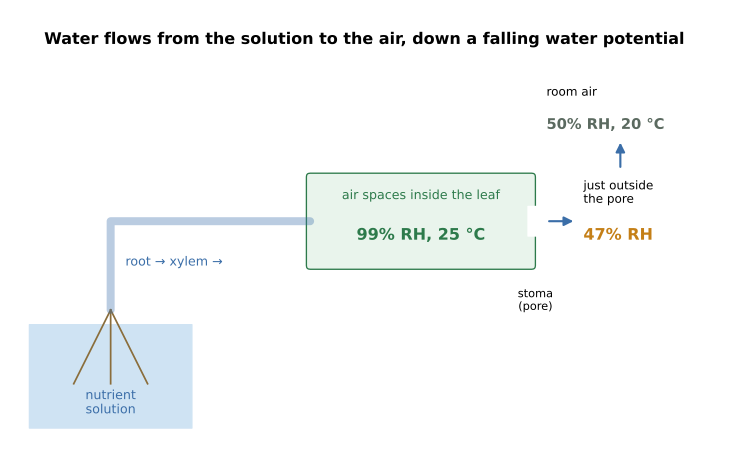
The path: solution, root, xylem, leaf, air
Into the root. At the endodermis, a cell layer inside the root, a waxy band called the Casparian strip blocks the route between cells and forces water and solutes through living cell membranes1. Uptake falls when roots are cold or short of oxygen, because both slow root respiration, and roots that respire less transport less water1. See Dissolved oxygen in the root zone and Root-zone temperature.
Up the xylem. The water then enters the xylem, the plant’s water pipework. Xylem conducting cells die as they mature and keep no membranes or organelles, so they form hollow tubes of very low resistance1. In a plant one metre tall, more than 99.5% of the water’s path lies inside the xylem1.
What pulls it. Evaporation from the wet cell walls inside the leaf creates a large tension in the water left behind, and that tension, transmitted down the continuous water columns of the xylem, pulls water up from the roots1. Water can carry this pull because its molecules cohere strongly, hence the name cohesion-tension theory, which most researchers accept as sound after more than a century of debate1. In a rapidly transpiring plant the xylem pressure can fall to −1 MPa or lower, most negative at midday, and the plant spends no energy directly on moving water1.
Root pressure and guttation. When transpiration is low, as at night in humid air, roots that keep moving ions into the xylem lower its water potential, water follows, and a positive pressure builds up: root pressure1. It is typically below 0.1 MPa and disappears when transpiration is high, so it is not what lifts water by day1. It shows as guttation, droplets of xylem sap forced out through pores at the leaf margins, most noticeable in the humid early morning1.
Stomata are the valves, and the price of carbon dioxide is water
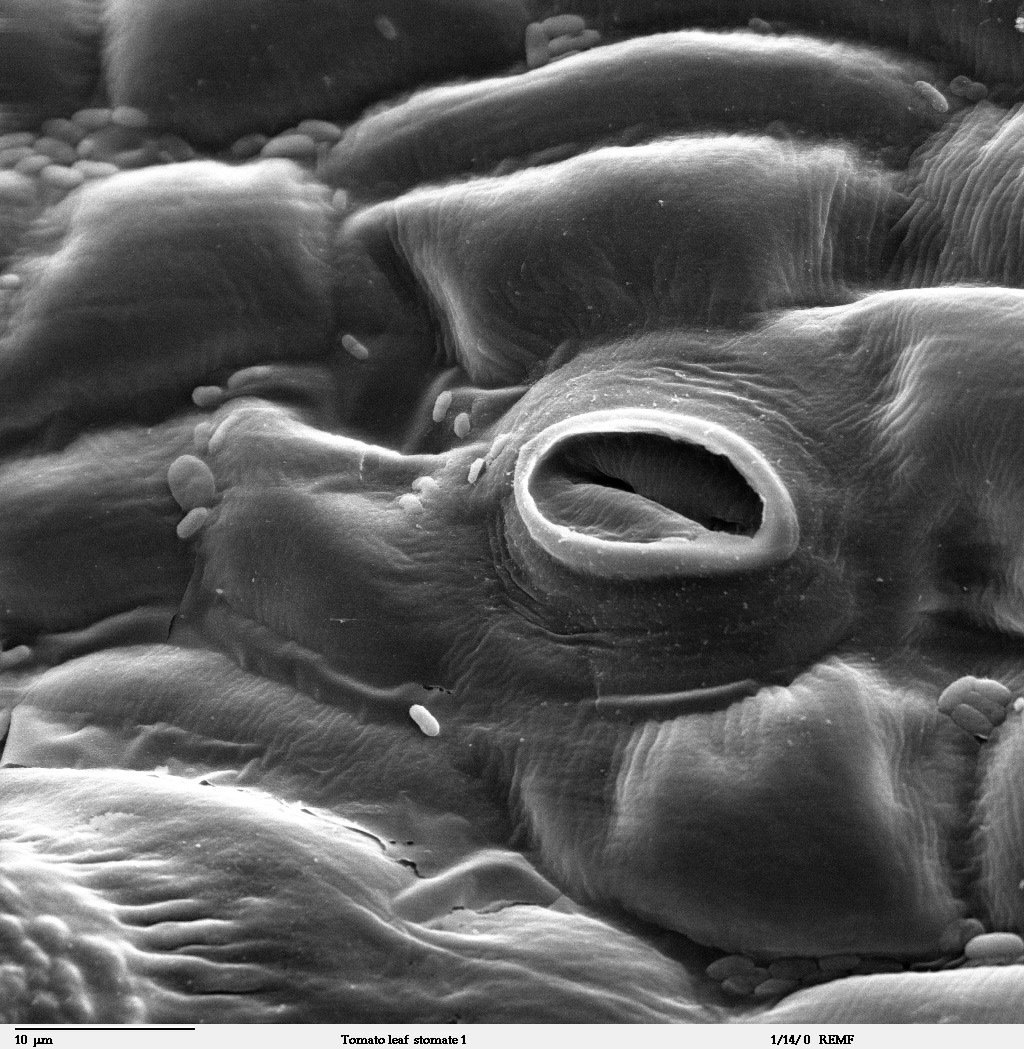
The leaf is covered by a waxy cuticle that is nearly impermeable to water, so almost all water leaves through the stomata, microscopic pores whose width is set by a pair of guard cells; loss through the cuticle is only 5 to 10% of the total1.
The leaf must let carbon dioxide in, and there is no way to let CO₂ in without letting water vapour out through the same pores1,2. The exchange is unequal: the concentration gradient driving water out is about 50 times larger than the gradient driving CO₂ in, because air holds very little CO₂, about 0.03% in the textbook’s figure, while the air inside a leaf is nearly saturated with vapour1. The result is the transpiration ratio: typical C3 plants lose about 500 molecules of water for every molecule of CO₂ fixed1. Transpiration is the price of photosynthesis; the stomata close at night, when there is no demand for CO₂1.
Anything that makes the plant close its stomata also cuts photosynthesis, so the irrigation and climate that keep stomata open are what give yield2. And the plant controls only the pore, not the dryness of the air or the still layer of air on the leaf1; the grower controls those two.
Most of the water passes straight through
Fresh plant tissue is more than 90% water, yet only about 1% of all the water a plant takes up over its life ends up in that tissue; the rest is transpired2. Most of that throughput cools the leaf: a transpiring leaf is cool to the touch1, and when water stress closes the stomata, the leaf loses that cooling and under high light can heat enough to be damaged2.
Castilla gives a maximum transpiration of 6 mm per day for a greenhouse tomato crop under Mediterranean conditions, with other authors placing the peak at 6 to 9 mm per day, or 1 to 1.5 mm per hour6. One millimetre over one square metre is one litre, so a mature tomato canopy can draw 6 to 9 litres per square metre on a bright day6. A reservoir has to be sized for the water the plants breathe out, not the water they contain; see Dimensioning a system.
Nutrients ride the water stream, and calcium cannot leave it
Dissolved ions reach a root in two ways. Diffusion, movement down a concentration gradient, is slow: an ion can take hours or days to cover one centimetre2. Mass flow, the liquid itself moving with everything dissolved in it, covers that centimetre in seconds2. When a plant transpires, the water leaving the leaves is replaced by water moving towards the roots, so transpiration sets up a mass flow of solution to the root surface, carrying nutrients and oxygen2. Inside the plant the same stream carries the absorbed ions up the xylem, and less water in the stream means fewer nutrients delivered2. See How roots take up nutrients for the selective step at the membrane.
For most nutrients the route matters little, because once inside the plant they can be moved again through the phloem, the living tissue that carries sugars from leaves to growing points. Calcium is the exception. Its concentration in phloem sap is very low, so calcium enters growth sinks, the shoot tips, young leaves and fruits, almost exclusively through the xylem; phloem import is negligible3. In castor bean, over nine days, the youngest leaves received 2.4 µmol of calcium through the xylem and 0.03 µmol through the phloem, while for potassium the two routes carried 20.6 and 19.3 µmol3.
The organs that need calcium most are the ones that transpire least: shoot tips, young leaves, especially those enclosed in a head, and fleshy fruits all receive little xylem flow3. That is why calcium disorders are so widespread: tipburn in lettuce, blossom-end rot in tomato, bitter pit in apple3,4. The limiting step is routing, not supply: increasing the transpiration of a growing leaf or fruit raises its calcium more effectively than increasing the calcium in the root zone3.
Root pressure is the second route. At low transpiration the xylem flow is driven by root pressure, so calcium import into low-transpiring organs depends on it3. Stopping the aeration of a tomato crop’s solution at night left calcium in the roots unchanged but cut calcium transport into the stem by 42% and into the leaves by 82%3. Salinity acts the same way: a low osmotic potential in the root zone reduces root pressure and calcium influx and induces the deficiency, and high total salt is linked to blossom-end rot in tomatoes3,4. Temperature, humidity and VPD and Diagnosing nutrient deficiencies and toxicities take these disorders further.
Humidity, and why growers use vapour-pressure deficit
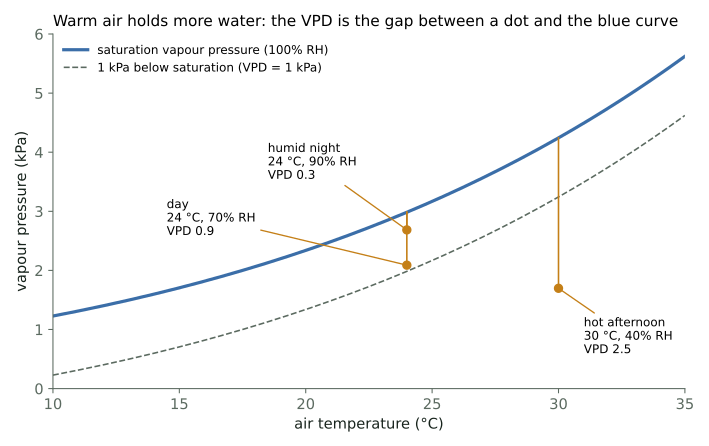
Relative humidity (RH) is the quantity of water vapour in the air as a percentage of the maximum the air can hold at its current temperature; saturated air is at 100%4. Warm air holds far more vapour than cold air: raising the temperature by 10 °C almost doubles the water-holding capacity and so halves the RH4. A greenhouse at 25 °C and 50% RH by day that cools to 15 °C at night rises to about 90% RH without any water being added4.
What drives water out is the difference in water-vapour concentration between the inside of the leaf and the outside air, and that difference depends on temperature1. Inside the leaf the air spaces are nearly saturated, at 99% RH in one textbook example, against 47% just outside the pore1. Growers therefore measure the dryness of the air as the vapour-pressure deficit (VPD): the difference between the saturation vapour pressure at the air temperature and the actual vapour pressure, in kilopascals4. VPD runs opposite to RH: when RH is high, VPD is low4. The higher the VPD, the harder the air pulls on the leaf.
Calculating VPD
You need the air temperature, the RH, and the saturation vapour pressure of water at that temperature, for which FAO Irrigation and Drainage Paper 56 gives the standard equation5:
e°(T) = 0.6108 × exp[17.27 × T / (T + 237.3)]
where e°(T) is the saturation vapour pressure in kPa and T is the air temperature in °C5. A few rows of the paper’s table follow5.
| Air temperature (°C) | Saturation vapour pressure e°(T) (kPa) |
|---|---|
| 20 | 2.338 |
| 22 | 2.644 |
| 24 | 2.984 |
| 25 | 3.168 |
| 26 | 3.361 |
| 28 | 3.780 |
| 30 | 4.243 |
Source: Allen et al. 1998, Annex 2, Table 2.35.
The actual vapour pressure is the saturation value multiplied by the RH as a fraction, and VPD is the difference between the two4,5:
e_a = e°(T) × RH / 100, and VPD = e°(T) − e_a
Worked example
A small grow room runs at 24 °C and 70% RH during the day.
- Saturation vapour pressure at 24 °C: e°(24) = 2.984 kPa from the table; the equation gives 0.6108 × exp(1.586) = 2.984 kPa, the same value5.
- Actual vapour pressure: 2.984 × 0.70 = 2.089 kPa5.
- VPD: 2.984 − 2.089 = 0.895 kPa, about 0.9 kPa5.
Now take the same room at the two extremes a grower meets. On a humid night at 24 °C and 90% RH, VPD = 2.984 × (1 − 0.90) = 0.298 kPa, about 0.3 kPa5. On a hot afternoon at 30 °C and 40% RH, VPD = 4.243 × (1 − 0.40) = 2.546 kPa, about 2.5 kPa, more than eight times the night value5.
What range to aim for
The literature gives a band more than a target. Castilla’s greenhouse textbook, drawing on Grange and Hand’s review of humidity effects, states that humidity has little effect on crop growth and development as long as certain VPD values are not exceeded: 1 kPa in Northern European conditions, while adapted crops in Mediterranean greenhouses may reach 3 kPa, a figure Castilla takes from Lorenzo and co-workers6,7. Grange and Hand’s own summary gives a band rather than a single threshold: between 1.0 and 0.2 kPa, about 55 to 90% RH at 20 °C, humidity has little effect on growth and development; drier air causes water stress, and more humid air encourages disease and growth disorders, although high humidity can be useful for generating root pressure against calcium deficiency7. The same book gives a rule from Berninger: VPD above 1.1 kPa in winter, or 2.7 kPa in spring, should be avoided6. On the low side, high humidity favours leaf expansion but may induce a calcium deficit in the leaf and, if water condenses, lets fungal spores germinate in the droplets6. A greenhouse disease manual adds that most fungi sporulate best in still air at a VPD of 0.6 to 1.2 kPa, so a moderate VPD alone does not keep a crop free of disease8.
The worked example sits well: the day value of 0.9 kPa is below the 1 kPa level, the night value of 0.3 kPa is in the zone where transpiration nearly stops and calcium delivery depends on root pressure, and the hot-afternoon value of 2.5 kPa exceeds both the 1 kPa level and the 1.1 kPa winter limit3,5,6,7. We found no primary source for the narrower per-stage VPD bands often quoted for indoor crops, so none is printed; Temperature, humidity and VPD will set crop targets.
What goes wrong at the extremes
Very high humidity, low VPD. The gradient out of the leaf is small, so transpiration is slow; Lieth and Oki put the point at which water movement from the leaf becomes slow at an RH above 95%2. With little water moving, little calcium moves, and the young leaves and fruits that depend on xylem flow run short first3,6. Condensation at night gives fungal spores the water film they need6,8.
For lettuce and other heading crops there is a twist: high transpiration by the whole shoot can direct the xylem flow to the outer, high-transpiring leaves at the expense of the inner ones3. Raising humidity at night shifts the flow towards the inner leaves: in Chinese cabbage, higher night humidity raised inner-leaf calcium by 64% and cut the share of heads with tipburn by 90%3. So the rule is not “keep humidity low” but “dry enough by day to move calcium, humid enough at night for root pressure to finish the job”.
Very low humidity, high VPD. As the air dries, VPD and transpiration rise; if the roots cannot supply the water, the stomata progressively close to prevent dehydration6. Closed stomata mean less photosynthesis, and before any wilting shows, leaf and stem expansion slow, because they are among the processes most sensitive to water stress2. In fruits the calcium effect runs the other way: red pepper fruits kept at 40% RH held 55.4 µmol of calcium per gram of dry matter against 32.7 µmol at 90% RH3.
What a hydroponic grower controls
The plant sets the pore; the grower sets three things around it.
Solution temperature and oxygen. Water uptake falls when roots are cold or short of oxygen1. A cold or stagnant reservoir throttles the stream from the root end and, at night, weakens root pressure, with the calcium consequences above1,3.
Air humidity. By day, ventilate or dehumidify when the air approaches saturation, so that VPD does not collapse towards zero: raising the air temperature lowers RH, and so does bringing in colder outside air, which gains heat faster than moisture4,6. In hot, dry weather the opposite applies: an excessive rise of VPD past the limits above must be avoided6. At night, let humidity rise but prevent condensation, remembering that the air inside the canopy is more humid than the room4,6.
Air movement. A layer of still air clings to every leaf, and vapour must diffuse across it before the room air carries it away; the thicker this boundary layer, the slower the loss, and in very still air it can be the main barrier1,2. Moving air thins the layer, so a fan is the most direct way to raise transpiration inside a dense canopy without changing the room’s VPD, and Resh recommends horizontal air-flow fans to lower the RH within the crop1,2,4. Moving air also evaporates the droplets in which fungal infection starts8.
Key numbers
| Quantity | Typical value or range | Conditions | Source |
|---|---|---|---|
| Leaf water potential | −0.2 to −1.0 MPa | well-watered plants | 1 |
| Xylem pressure | −1 MPa or lower | midday, rapid transpiration | 1 |
| Root pressure | typically under 0.1 MPa | low transpiration | 1 |
| Share of the water path inside the xylem | over 99.5% | plant 1 m tall | 1 |
| Transpiration through the cuticle | 5 to 10% of leaf total | intact cuticle | 1 |
| Transpiration ratio | about 500 molecules H₂O per CO₂ fixed | typical C3 plants | 1 |
| Water-loss gradient relative to CO₂-uptake gradient | about 50 times larger | leaf to air | 1 |
| Water in fresh tissue | over 90% | typical plant | 2 |
| Water retained as fresh matter | about 1% of water taken up | whole plant life | 2 |
| RH above which water movement from the leaf is slow | 95% | air around the leaf saturated | 2 |
| Peak greenhouse tomato transpiration | 6 mm/day; 6 to 9 mm/day; 1 to 1.5 mm/h | Mediterranean, mature crop | 6 |
| Ca import into youngest leaves, castor bean | xylem 2.4 µmol, phloem 0.03 µmol per plant in 9 days | 3 | |
| Night humidity and Chinese cabbage | inner-leaf Ca +64%, tipburn −90% | higher night RH | 3 |
| Stopping night aeration, tomato | Ca transport −42% to stem, −82% to leaves | 3 | |
| Red pepper fruit Ca | 55.4 µmol/g dry matter at 40% RH; 32.7 at 90% RH | fruit environment | 3 |
| Saturation vapour pressure | 2.338 kPa at 20 °C; 2.984 at 24 °C; 3.168 at 25 °C; 4.243 at 30 °C | 5 | |
| Warming air by 10 °C | almost doubles water-holding capacity, halves RH | rule of thumb | 4 |
| VPD level above which humidity limits growth | 1 kPa (Northern Europe); up to 3 kPa reached (Mediterranean) | greenhouse crops | 6,7 |
| VPD to avoid | above 1.1 kPa in winter, 2.7 kPa in spring | greenhouse rule of thumb | 6 |
| VPD at which most fungi sporulate best | 0.6 to 1.2 kPa | still air | 8 |
| Worked example | 24 °C and 70% RH gives VPD 0.9 kPa | 5 |
Common mistakes
- Sizing a reservoir for the water the plants contain. About 1% of the water taken up stays in the plant; a mature fruiting crop can transpire several litres per square metre per day2,6.
- Reading relative humidity without the temperature. The same air is 50% RH at 25 °C and about 90% at 15 °C; the leaf responds to the vapour-pressure difference4,5.
- Treating tipburn or blossom-end rot as a shortage of calcium in the solution. Calcium reaches young leaves and fruit almost only in the xylem stream, so the usual cause is too little water flow into those organs3,4.
- Keeping the air dry around the clock to push calcium. Higher night humidity, with root pressure, is what raised inner-leaf calcium and cut tipburn in Chinese cabbage3.
- Switching off the air pump at night. Stopping night aeration cut calcium transport to tomato leaves by 82%3.
Summary
Water moves through a plant from higher to lower water potential, in at the root and out of the leaf as vapour. Evaporation in the leaf puts the xylem water under tension, and that tension, not a pump, pulls water up from the roots. The stomata cannot admit carbon dioxide without releasing water, so a C3 crop loses about 500 molecules of water per molecule of CO₂ fixed and keeps only about 1% of the water it takes up1,2. Calcium, which barely moves in the phloem, reaches young leaves and fruit only in that water stream, which is why tipburn and blossom-end rot are disorders of water flow. Vapour-pressure deficit, computed from temperature and relative humidity, expresses how hard the air pulls on the leaf; a day value near 0.9 kPa sits below the level at which humidity limits growth5,6,7. The grower’s levers are solution temperature and oxygen, air humidity by day and night, and air movement.
Next in the series: What plants are made of: the essential elements.
References
- Taiz, L. and Zeiger, E. (2002). Plant Physiology, 3rd ed. Sinauer Associates, Sunderland, MA. Chapter 3, Water and Plant Cells; Chapter 4, Water Balance of Plants; Chapter 25, Stress Physiology.
- Lieth, J. H. and Oki, L. R. (2008). Irrigation in soilless production. In: Raviv, M. and Lieth, J. H. (eds), Soilless Culture: Theory and Practice. Elsevier, Amsterdam, chapter 4. https://doi.org/10.1016/B978-044452975-6.50006-X
- Marschner, P. (ed.) (2012). Marschner's Mineral Nutrition of Higher Plants, 3rd ed. Academic Press, London. Chapter 3, Long-distance Transport in the Xylem and Phloem, section 3.4.3, printed pp. 63–64.
- Resh, H. M. (2013). Hydroponic Food Production: A Definitive Guidebook for the Advanced Home Gardener and the Commercial Hydroponic Grower, 7th ed. CRC Press, Boca Raton.
- Allen, R. G., Pereira, L. S., Raes, D. and Smith, M. (1998). Crop Evapotranspiration: Guidelines for Computing Crop Water Requirements. FAO Irrigation and Drainage Paper 56. FAO, Rome. Chapter 3, Equations 11 and 19; Annex 2, Table 2.3. https://www.fao.org/4/x0490e/x0490e07.htm and https://www.fao.org/4/x0490e/x0490e0j.htm
- Castilla, N. (2013). Greenhouse Technology and Management, 2nd ed. CABI, Wallingford.
- Grange, R. I. and Hand, D. W. (1987). A review of the effects of atmospheric humidity on the growth of horticultural crops. Journal of Horticultural Science, 62(2), 125–134. https://doi.org/10.1080/14620316.1987.11515760 (abstract; the 1 kPa level is also quoted by Castilla [6])
- Albajes, R., Gullino, M. L., van Lenteren, J. C. and Elad, Y. (eds) (2000). Integrated Pest and Disease Management in Greenhouse Crops. Developments in Plant Pathology 14. Kluwer Academic Publishers, Dordrecht. Chapter 8, Managing the Greenhouse, Crop and Crop Environment, printed p. 115.
This article was drafted with the help of AI tools and reviewed and edited by PonicLabs. Sources are listed above; tell us if you find an error.