Water quality: what is in your water and why it matters
Contents
Standfirst: After reading this article you will be able to read a water report line by line, sort each constituent into useful, harmless up to a limit, or a cause of trouble, compare tap, rain, reverse-osmosis and well water, and decide with published limits whether a given water suits lettuce and how much calcium and magnesium it already brings to your recipe.
Before you read: How roots take up nutrients.
Water is never just water
A nutrient solution is water plus dissolved ions, and the water you start with already contains some, so it is already a partial nutrient solution. Building a recipe starts with finding out what is in it.
The reason is geology. Rain forms with almost nothing dissolved in it: across Texas, total dissolved solids in rainwater range from 2 mg/L to 20 mg/L, against 100 ppm to more than 800 ppm in municipal supplies9. The difference is what the water picked up from soil and rock. Water from limestone aquifers can carry as much as 100 mg/L of calcium and 30 mg/L of magnesium, which Jones calls not unusual, often with sodium, bicarbonate, sulfate, chloride and sometimes boron2.
Some of those ions are plant nutrients and some are not. Resh asks for an analysis of at least calcium, magnesium, iron, boron, molybdenum, carbonate, sulfate and chloride before any water is used, so that correspondingly less of each goes into the recipe1. In his injector example the raw water held 30 ppm of calcium and 20 ppm of magnesium, both counted toward the final 200 ppm of calcium and 40 ppm of magnesium1.
How to read a water report
Municipal utilities publish an annual water quality report, and any agricultural laboratory will analyse a sample. Jones advises a complete analysis before use, repeated whenever the source changes, plus an organic analysis for water from a river, a shallow well or another surface source, because pesticides affect plant growth even at low concentrations2.
| Line on the report | What it measures | Usual unit | Why it matters to a grower |
|---|---|---|---|
| EC or TDS | Total dissolved salts, by conductivity or by weight | dS/m (= mS/cm = mmho/cm); mg/L | The salinity you start from before adding fertiliser1,2 |
| pH | Acidity of the water as delivered | pH units | Says little on its own; alkalinity decides how hard the pH is to move1,2 |
| Alkalinity (bicarbonate, carbonate) | Capacity to neutralise acid | mg/L as CaCO₃, mg/L HCO₃⁻, or meq/L | Makes the solution pH rise and resist correction1,2 |
| Hardness | Calcium plus magnesium | mg/L as CaCO₃ | Mostly useful nutrients; also the cause of scale1,3 |
| Ca, Mg, SO₄ | Nutrient ions already present | mg/L | Subtract from the recipe1,2 |
| Na, Cl | Ions plants need little or none of | mg/L or meq/L | Harmless up to a limit; accumulate when recirculated1,2,5 |
| B | Boron | mg/L | Needed at a fraction of a milligram per litre; toxic not far above1,2 |
| Fe, Mn | Dissolved iron and manganese | mg/L | Precipitate, stain and coat pipes3 |
| Heavy metals (Pb, Cu, Zn, Cd) | Contaminants from pipes, roofs or source | mg/L or µg/L | Low in treated supplies; a concern in roof-collected rain7 |
| Chlorine, chloramine | Disinfectant residual | mg/L | Added by utilities; chloramine persists3 |
A note on units. One milligram per litre is one part per million by weight, because a litre of dilute solution weighs about one kilogram1,9. Laboratories also report the major ions in milliequivalents per litre (meq/L), which counts charge rather than weight; Resh calls it the most meaningful way to express the major constituents of water1. To convert, divide mg/L by the atomic weight to get mmol/L, then multiply by the ion’s charge; the atomic weights used here are calcium 40.08, magnesium 24.31, sodium 22.99 and chlorine 35.451. Conductivity in dS/m, mS/cm or mmho/cm is one and the same unit, and Resh’s rule of thumb is about 650 ppm of salt per 1 mS/cm; Jones quotes 650 to 700 ppm1,2.
Two lines are easy to confuse. Hardness is caused by calcium and magnesium3. Alkalinity is the capacity to neutralise acid; laboratories report it either as bicarbonate alkalinity or as total alkalinity expressed as calcium carbonate2. Resh describes hardness as a measure of the bicarbonate content1, which reflects how often the two travel together: ground water from limestone and dolomite dissolves calcium and magnesium carbonates, so it arrives both hard and alkaline1. The grower needs them separately: the calcium is welcome, the bicarbonate is the problem.
Sorting the constituents
Useful: calcium, magnesium and sulfate
Resh states that hard waters are normally just as suitable as soft water, because calcium and magnesium are essential and the amount in hard water is ordinarily much less than a nutrient solution contains1. Most hard waters carry them as carbonates or sulfates; sulfate is itself an essential nutrient, carbonate is not1. Jones adds that hard water may supply part or all of the crop’s calcium and magnesium, but only an elemental analysis can decide that2. A guideline for plug growers treats 50 to 125 mg/L of calcium and 5 to 25 mg/L of magnesium in the water as nutritionally beneficial2.
Harmless up to a limit: sodium and chloride
Chloride is a micronutrient and sodium at most a beneficial element, so a plant needs little of either (What plants are made of). Harm at higher concentration comes by two routes. The first is osmotic: the total solute concentration lowers water uptake, which Resh names as the cause of the inhibitory effect of saline solutions, with symptoms of stunting, smaller and darker green leaves, marginal leaf burn, and bluing or bleaching1. The second is specific toxicity: ions taken up with the water accumulate in the leaves as the water transpires away, over many days or weeks5. Sodium injury appears as leaf burn along the outer edges, first on older leaves; chloride injury starts at the leaf tips5.
Published limits for source water differ, and the differences are informative.
| Source and context | Sodium | Chloride |
|---|---|---|
| Resh, general statement | sodium chloride at 50 ppm or more is not suitable for optimum growth1 | (same, as NaCl) |
| Resh, formulation example | raw water plus fertilisers not to exceed 100 to 150 ppm Na1 | 152 ppm Cl from calcium chloride described as tolerable1 |
| Verwer and Wellman 1980, rockwool culture | 30 to 50 mg/L maximum2 | 50 to 100 mg/L maximum2 |
| Farnham et al. 1985, irrigation (UC Davis) | SAR below 3 no problem2 | below 70 mg/L no problem; 70 to 345 increasing; above 345 severe2 |
| Smith 1999, general hydroponic use | below 180 mg/L2 | below 70 mg/L2 |
| Faulkner 1998, plug culture | below 50 mg/L2 | below 100 mg/L2 |
| Whipker et al. 2003, high-quality irrigation water | below 50 ppm desired; 69 ppm upper limit2 | below 71 ppm desired; 108 ppm upper limit2 |
| FAO 29, sprinkler irrigation | below 3 meq/L no restriction5 | below 3 meq/L no restriction5 |
Three meq/L is 69 mg/L of sodium or 106 mg/L of chloride1,5. The spread reflects the system: 30 to 50 mg/L of sodium for rockwool culture against 180 mg/L for general use2, for a reason explained below.
Crops differ. Resh notes that watercress and mint tolerate more sodium and chloride than tomatoes and cucumbers1. The FAO salt-tolerance table gives lettuce full yield up to an irrigation-water EC of 0.9 dS/m, 90% at 1.4 dS/m and 75% at 2.1 dS/m, against 1.3 dS/m for spinach and 1.7 dS/m for tomato and cucumber at full yield5. Those values are for soil, where the root zone ends up about 1.5 times saltier than the water5. In recirculating soilless culture, Sonneveld and van der Burg found thresholds of 2.3 to 3.5 dS/m for tomato, cucumber and sweet pepper, with yields falling 2.3% to 7.6% per dS/m above them, measured on the whole solution, nutrients included6.
Trouble: alkalinity
Carbonate and bicarbonate make the pH rise or stay high, and once present they make it resist dropping1. This is buffering, and a little is welcome: Resh cites Smith (1987), who advised growers to hold 30 to 50 ppm of carbonate and bicarbonate against sudden pH swings, adding potassium carbonate or bicarbonate to very pure water that has none1. More than that costs acid. Whipker and co-workers set 40 to 65 ppm of alkalinity as calcium carbonate as the desired level and 150 ppm as the upper limit2; Farnham’s irrigation guideline puts bicarbonate below 40 mg/L in the no-problem class and 40 to 520 mg/L in the increasing-problem class2. The remedy can be as simple as acidifying the water2; how much acid, and why alkalinity rather than pH is the number to watch, is the subject of Alkalinity and buffering.
Trouble: boron
Boron has the narrowest margin of any element. Resh gives the normal requirement in solution as 0.30 mg/L and warns that some waters carry two to three times that or more, in which case it must be removed by reverse osmosis; boron toxicity is relatively common with saline waters1. Hydroponic and greenhouse guidelines cluster between 0.3 and 1 mg/L: below 0.3 mg/L desired and 0.5 mg/L upper limit in Whipker’s table, 0.7 mg/L maximum for rockwool culture, below 1 mg/L for general hydroponic use, and 1.0 mg/L as the edge of the no-problem class for irrigation2. The FAO table of boron tolerance, built on field crops in soil, lists lettuce as moderately tolerant at 2.0 to 4.0 mg/L5. The gap is not a contradiction: in a nutrient solution the boron in the water adds to the boron in the fertiliser, and in a recirculating system it accumulates, so the source-water limit must sit well below the plant’s tolerance.
Trouble: iron and manganese
Groundwater without oxygen can hold several milligrams per litre of ferrous iron and still be clear when pumped; in air the iron oxidises to the ferric form and turns the water reddish-brown3. Above 0.3 mg/L it stains laundry and fixtures3. Manganese stains above 0.1 mg/L, and at 0.2 mg/L it often coats pipes and sloughs off as a black precipitate3. The same chemistry means that iron and manganese in the water are not reliably available to the plant: they precipitate, and the precipitate ends up on filters and roots. Greenhouse guidelines set 1 mg/L as the upper limit for each, with Whipker’s table allowing 5 mg/L of iron and 2 mg/L of manganese as ceilings2. The iron a recipe relies on is supplied as a chelate for this reason; see Micronutrients and chelates.
Trouble: chlorine and chloramine
Utilities disinfect with chlorine, which most people taste well below the health-based guideline of 5 mg/L, some at 0.3 mg/L3. Many now use chloramine instead, formed by adding ammonia to chlorinated water; monochloramine is the only useful chloramine disinfectant, less effective than free chlorine but persistent, which is why it is chosen to hold a residual through long distribution systems3. A residual designed to survive the pipe network will also survive the trip to your tank. Date and co-workers grew lettuce in a nutrient solution carrying 0.5 mg/L of chlorine as hypochlorous acid together with 0.67 meq/L of ammonium, which converts it to chloramine, and saw root injury and growth inhibition unless a reducing agent was added to remove the chlorine10.
Why sodium matters more in a recirculating system
Plants take up water much faster than sodium. In a drain-to-waste system the sodium leaves with the drainage; in a recirculating system it stays, and every litre of make-up water adds more. Resh describes the process: closed systems add raw water to the returning solution to replace what the plants transpired, so more ions arrive with every addition, and if the raw water carries significant levels this eventually leads to toxicity; the salts accumulate until the solution has to be changed1.
Raviv and Lieth draw the practical conclusion: 100% recirculation is not yet possible where the supply water contains ions the plant cannot use, and growers must keep the freedom to discard solution once an ion such as sodium has accumulated to a toxic level4. Sonneveld and van der Burg found that absorption of sodium and chloride differed with crop and concentration, so some crops reach the limit sooner6. This is why Resh ties long-lived recirculating solutions to very pure raw water or reverse-osmosis treatment1. Managing a recirculating solution over time shows how to track sodium with a simple mass balance.
Tap, rain, reverse osmosis and well water
| Source | What it typically contains | Sources |
|---|---|---|
| Tap (municipal) | Whatever the local source held, minus what treatment removed, plus a chlorine or chloramine residual; 100 to over 800 ppm dissolved solids; a published report | 3,9 |
| Rain | 2 to 20 mg/L dissolved solids before it touches a roof; soft; little or no alkalinity; whatever the roof, gutters and tank add | 1,7,9 |
| Reverse osmosis | Most dissolved ions removed, including calcium, magnesium, sodium, chloride, iron and nitrate; 20% to 30% of the feed recovered as product in household units | 8 |
| Well | Depends on the rock: often high calcium, magnesium and alkalinity in limestone country; sometimes iron, manganese, sulfide or boron; organics possible in shallow wells | 1,2,3 |
Tap water is the easiest to characterise, because the utility has measured it; the disinfectant residual is the one constituent no other source carries3.
Rainwater is the nearest thing to pure water a grower can collect for free: soft, and in Texas 2 to 20 mg/L of dissolved solids before collection9. What it contains afterwards depends on the roof. A survey of 53 rainwater tanks in South Australia found that roof material was related to the levels of lead, zinc, copper and cadmium7; 47 tanks, 88.6%, exceeded the drinking-water guideline of 0.01 ppm for lead at least once, the highest lead value was 3.24 ppm, and household filters did not bring the metals below guideline concentrations, apart from two cadmium samples7. Tank pH ranged from 4.5 to 8.4, and acidic rainwater dissolves metals from roof and tank materials7, lead solder in older gutters and copper flashings among them9. Rain also has almost no buffering, which is why Resh passes on the advice to add 30 to 50 ppm of bicarbonate to very pure water1.
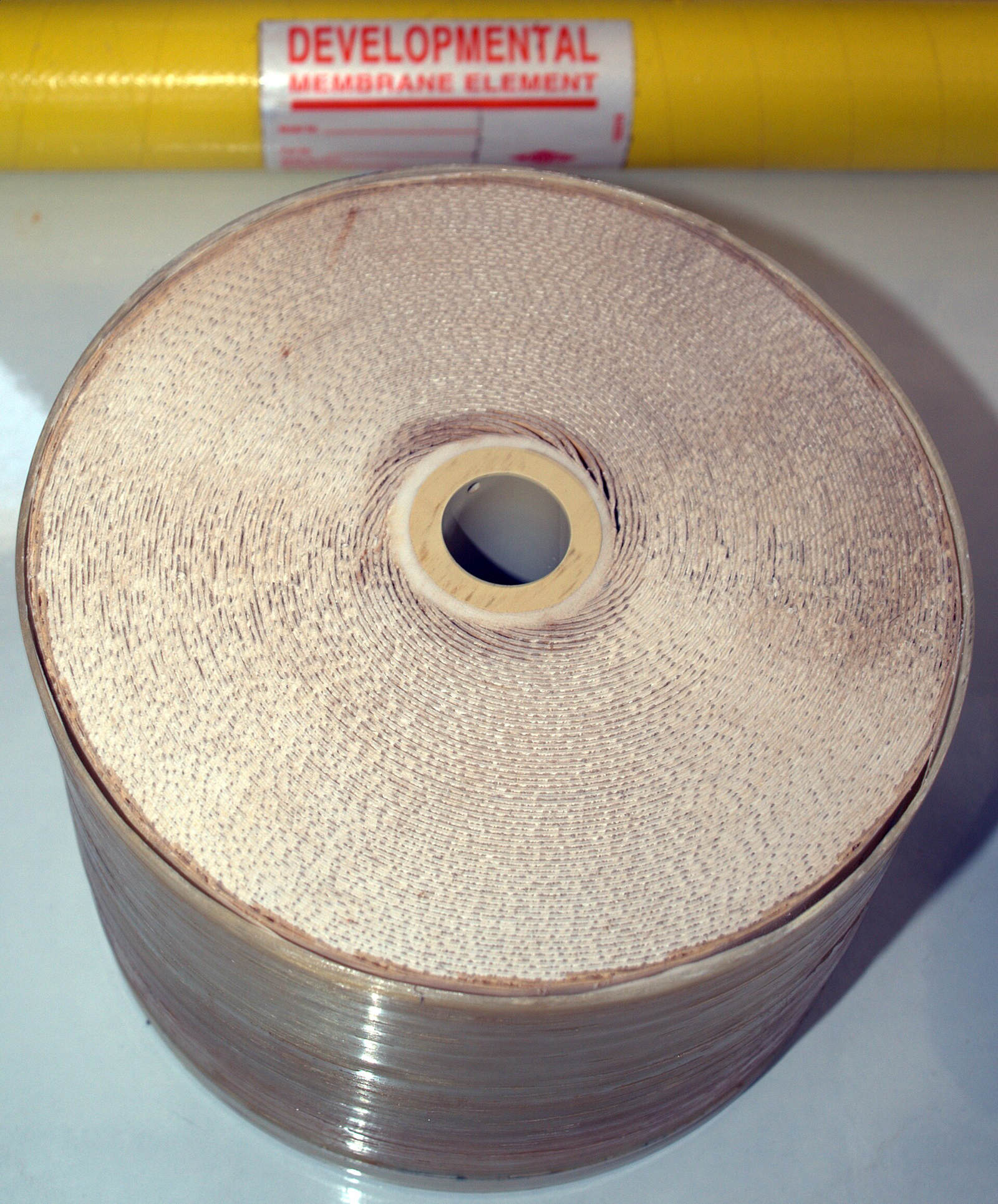
Reverse osmosis forces water through a membrane that rejects most dissolved ions. The Nebraska extension guide lists calcium, magnesium, sodium, chloride, iron and nitrate among what it removes, gives a rejection example of 85%, states that most household units recover only 20% to 30% of the feed water as product, and notes that RO water can be more corrosive than untreated water8. Resh recommends RO where the raw water carries too much boron or too much sodium chloride1. For the recipe this is the mirror image of hard water: calcium and magnesium are near zero, so the salts supply the full amounts, and some bicarbonate may need adding back1.
Well water is the least predictable. Jones gives 100 mg/L of calcium and 30 mg/L of magnesium as not unusual upper values for limestone aquifers2, and Resh notes that some well waters carry so much magnesium that none needs adding1. Wells can also deliver sulfide, with its rotten-egg smell2, ferrous iron that oxidises in the tank3, and pesticides where a shallow well sits in farmed land2. A well needs a full laboratory analysis first.
Worked example: does this water suit lettuce?
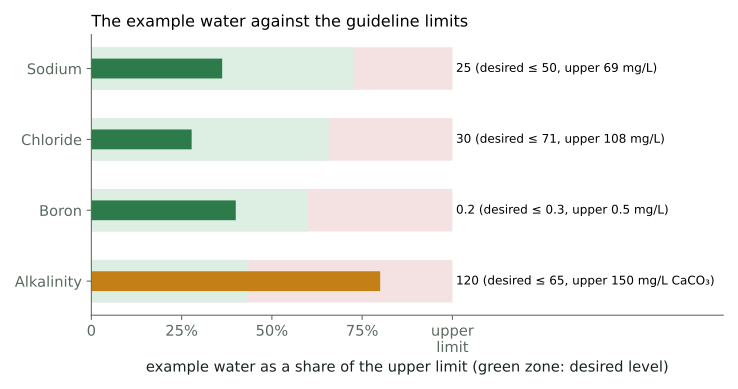
Take the following analysis. The calcium and magnesium values are the raw-water values from Resh’s injector example1. The other values are chosen for this example, inside the desired column of Whipker’s guideline table except alkalinity, which we set between the desired level and the upper limit on purpose2. This is an example, not a real sample.
| Parameter | Example value |
|---|---|
| pH | 7.6 |
| EC | 0.45 dS/m |
| Alkalinity | 120 mg/L as CaCO₃ |
| Calcium | 30 mg/L |
| Magnesium | 20 mg/L |
| Sodium | 25 mg/L |
| Chloride | 30 mg/L |
| Sulfate | 20 mg/L |
| Boron | 0.20 mg/L |
| Iron | 0.10 mg/L |
| Manganese | 0.02 mg/L |
| Free chlorine | 0.5 mg/L |
Step 1, salinity. An EC of 0.45 dS/m is below Farnham’s 0.75 dS/m no-problem limit2 and below the 0.9 dS/m at which the FAO table still gives lettuce full yield5. By Resh’s rule of thumb, 0.45 mS/cm × 650 ≈ 290 ppm of dissolved salts, below Farnham’s 480 mg/L1,2.
Step 2, sodium and chloride. 25 mg/L of sodium is below the 30 to 50 mg/L rockwool maximum, the 50 ppm desired level and the 69 ppm upper limit; 30 mg/L of chloride is below the 50 to 100 mg/L rockwool maximum and the 70 to 71 mg/L limits2. In milliequivalents, 25 ÷ 22.99 = 1.09 meq/L of sodium and 30 ÷ 35.45 = 0.85 meq/L of chloride, both under the FAO 3 meq/L line1,5. The water passes, with the recirculation caveat above.
Step 3, boron. 0.20 mg/L is below the 0.3 mg/L desired level, the 0.5 mg/L upper limit and the 0.7 mg/L rockwool maximum2. It is also two-thirds of Resh’s 0.30 mg/L requirement, so the recipe should add only 0.30 − 0.20 = 0.10 mg/L of boron from boric acid1.
Step 4, iron and manganese. 0.10 mg/L of iron is below the 0.3 mg/L staining threshold and 0.02 mg/L of manganese below the 0.1 mg/L threshold3; both are far under the 1 mg/L greenhouse limits2. Neither value is counted toward the recipe, because the iron will not stay in solution3.
Step 5, alkalinity. 120 mg/L as CaCO₃ is above the desired 40 to 65 ppm but below the 150 ppm upper limit2. Whipker’s table equates 150 ppm with 3 meq/L, so 120 ppm is 2.4 meq/L of acid-neutralising capacity2. This water will push the pH up and hold it there; Alkalinity and buffering shows how much acid that takes.
Step 6, what the water contributes. Calcium: 30 mg/L ÷ 40.08 = 0.75 mmol/L1. Magnesium: 20 mg/L ÷ 24.31 = 0.82 mmol/L1. Against Resh’s targets of 200 ppm calcium and 40 ppm magnesium, the water supplies 30 ÷ 200 = 15% of the calcium and 20 ÷ 40 = 50% of the magnesium, so the salts need to supply 170 mg/L of calcium and 20 mg/L of magnesium1. The 20 mg/L of sulfate is counted toward the recipe in the same way1.
Step 7, disinfectant. 0.5 mg/L of free chlorine is a tenth of the drinking-water guideline3. Lettuce roots were injured at 0.5 mg/L of chlorine once ammonium had turned it into chloramine10, so check the utility report for chloramine, which persists3, and let the water stand or treat it before use.
Verdict. The water suits lettuce. Subtract 30 mg/L of calcium, 20 mg/L of magnesium, 20 mg/L of sulfate and 0.20 mg/L of boron from the recipe1, budget acid for 2.4 meq/L of alkalinity2, and in a recirculating system watch sodium1,4.
Key numbers
| Quantity | Typical value or range | Conditions | Source |
|---|---|---|---|
| Dissolved solids in rainwater | 2 to 20 mg/L | Texas, before collection | 9 |
| Dissolved solids in municipal water | 100 to over 800 ppm | Texas supplies | 9 |
| Ca and Mg in limestone-aquifer water | 100 and 30 mg/L | not unusual | 2 |
| Minimum analysis before use | Ca, Mg, Fe, B, Mo, carbonate, SO₄, Cl | any source | 1 |
| EC to ppm rule of thumb | about 650 ppm per mS/cm | dilute solutions | 1 |
| Source-water EC, no problem | below 0.75 dS/m | Farnham et al., irrigation | 2 |
| Lettuce yield vs irrigation EC | 100% up to 0.9 dS/m; 90% at 1.4; 75% at 2.1 | FAO, soil, 15% to 20% leaching | 5 |
| Salinity threshold, recirculating | 2.3 to 3.5 dS/m, then 2.3% to 7.6% loss per dS/m | tomato, cucumber, sweet pepper | 6 |
| Sodium limit | 30 to 50 mg/L (rockwool); 50 ppm desired, 69 upper; 180 mg/L general | by source, see table | 2 |
| Chloride limit | 50 to 100 mg/L (rockwool); 70 to 71 mg/L; 108 ppm upper | by source, see table | 2 |
| Sodium chloride | 50 ppm or more not suitable for optimum growth | Resh | 1 |
| Alkalinity | 40 to 65 ppm as CaCO₃ desired; 150 upper | Whipker et al. | 2 |
| Buffering to keep | 30 to 50 ppm carbonate plus bicarbonate | Smith, cited by Resh | 1 |
| Boron required in solution | 0.30 mg/L | Resh | 1 |
| Boron in source water | below 0.3 desired; 0.5 upper; 0.7 rockwool; below 1 general | by source | 2 |
| Boron tolerance, lettuce | 2.0 to 4.0 mg/L (moderately tolerant) | FAO, soil | 5 |
| Iron and manganese staining | above 0.3 and 0.1 mg/L | drinking water | 3 |
| Chlorine guideline | 5 mg/L; tasted at 0.3 mg/L by some | drinking water | 3 |
| Household RO recovery | 20% to 30% of feed water | household units | 8 |
| Roof-collected rain, lead | 88.6% of 53 tanks above 0.01 ppm at least once; maximum 3.24 ppm | South Australia | 7 |
| Example water, Ca and Mg contribution | 0.75 mmol/L Ca, 0.82 mmol/L Mg; 15% and 50% of a 200/40 mg/L recipe | 30 and 20 mg/L in raw water | 1 |
Common mistakes
- Building a recipe without a water analysis. The water already contains calcium, magnesium, sulfate and sometimes boron, and the full recipe on top over-supplies them1,2.
- Treating pH as the number that matters. The pH of water with few ions is hard even to measure; alkalinity decides how far the pH drifts and how much acid holds it1,2.
- Reading a sodium value that passes every limit as safe for a recirculating system. The plant leaves sodium behind while it takes water, and every top-up adds more1,4.
- Counting the iron in well water as part of the recipe. Ferrous iron oxidises in air and precipitates, so it stains and clogs instead of feeding the plant3.
- Switching to reverse-osmosis or rain water without changing the recipe. Those waters bring almost no calcium, magnesium or bicarbonate, so the salts must supply all of it1,8,9.
- Assuming roof-collected rain is as pure as rain. Roof and gutter materials add lead, zinc and copper7.
Summary
The water you start with is a partial nutrient solution, so building a recipe begins with its analysis. Calcium, magnesium and sulfate in the water are nutrients and are subtracted from the recipe. Sodium and chloride are harmless up to limits that vary by system, from about 30 to 50 mg/L of sodium for rockwool culture to 180 mg/L for general use, and the stricter figures apply wherever the solution recirculates, because sodium accumulates with every top-up2. Alkalinity pushes the pH up and resists correction, boron has the narrowest safe margin, iron and manganese precipitate and stain, and a chloramine residual persists. Rain and reverse-osmosis water are nearly empty and need calcium, magnesium and buffering added; tap water comes with a report; well water needs a full analysis. In the worked example, 30 mg/L of calcium and 20 mg/L of magnesium in the water supplied 15% of the calcium and half the magnesium of a standard recipe1.
Next in the series: pH: what it is and why 5.5 to 6.5.
References
- Resh, H. M. (2013). Hydroponic Food Production: A Definitive Guidebook for the Advanced Home Gardener and the Commercial Hydroponic Grower, 7th ed. CRC Press, Boca Raton. ISBN 978-1-4398-7869-9.
- Jones, J. B. Jr. (2005). Hydroponics: A Practical Guide for the Soilless Grower, 2nd ed. CRC Press, Boca Raton. Chapter 7, Tables 7.1 to 7.6, which reproduce Verwer & Wellman (1980), Farnham, Hasek & Paul (1985, UC Davis Leaflet 2995), Waters, Geraldson & Woltz (1972), Smith (1999), Faulkner (1998) and Whipker, Dole, Cavins & Gibson (2003, Ball Redbook vol. 2).
- World Health Organization (2011). Guidelines for Drinking-water Quality, 4th ed. WHO, Geneva. Chapter 10, Acceptability aspects, and Annex 5.
- Raviv, M. and Lieth, J. H. (eds.) (2008). Soilless Culture: Theory and Practice. Elsevier, Amsterdam. Chapter 13, Growing plants in soilless culture: operational conclusions. https://doi.org/10.1016/B978-044452975-6.50015-0
- Ayers, R. S. and Westcot, D. W. (1985, rev. 1994). Water Quality for Agriculture. FAO Irrigation and Drainage Paper 29. FAO, Rome. Table 1, Table 4, Table 16 and section 4. https://www.fao.org/4/t0234e/t0234e00.htm
- Sonneveld, C. and van der Burg, A. M. M. (1991). Sodium chloride salinity in fruit vegetable crops in soilless culture. Netherlands Journal of Agricultural Science, 39(2), 115–122. https://doi.org/10.18174/njas.v39i2.16546
- Chubaka, C. E., Whiley, H., Edwards, J. W. and Ross, K. E. (2018). Lead, zinc, copper, and cadmium content of water from South Australian rainwater tanks. International Journal of Environmental Research and Public Health, 15(7), 1551. https://doi.org/10.3390/ijerph15071551
- Dvorak, B. I. and Skipton, S. O. Drinking Water Treatment: Reverse Osmosis. University of Nebraska–Lincoln Extension, NebGuide G1490. https://extensionpubs.unl.edu/publication/g1490/
- Texas Water Development Board (2005). The Texas Manual on Rainwater Harvesting, 3rd ed. Austin, TX. pp. 1, 6, 21. https://www.twdb.texas.gov/publications/brochures/conservation/doc/RainwaterHarvestingManual_3rdedition.pdf
- Date, S., Hano, F., Naba, K., Terabayashi, S. and Fujime, Y. (2005). Effects of adding reducing agent to the nutrient solution containing chloramine on the occurrence of root browning and growth in lettuce. Horticultural Research (Japan), 4(3), 297–301. https://doi.org/10.2503/hrj.4.297 (English abstract)
This article was drafted with the help of AI tools and reviewed and edited by PonicLabs. Sources are listed above; tell us if you find an error.