What a plant needs: the seven inputs
Contents
Standfirst: After reading this article you will be able to list the seven inputs a plant needs to grow, say what each one does inside the plant, and explain why a plant grown without soil is not missing anything. You will also be able to estimate how many litres of water a head of lettuce moves through itself before harvest.
Before you read: none. If the word hydroponics is new to you, What is hydroponics defines it.
A plant builds itself from air and water
A plant builds its own body from few raw materials. Fresh plant matter is about 80% to 95% water1. The dry matter left after drying is roughly 10% to 20% of the fresh weight, and over 90% of that dry matter is only three elements: carbon, oxygen and hydrogen1. Water supplies the hydrogen and part of the oxygen; carbon dioxide from the air supplies the carbon and the rest of the oxygen1.
So nearly everything a plant is made of arrived as a gas or as water, assembled with energy from light. The fertiliser elements are what remains: if 15% of a plant is dry matter and 90% of that is carbon, oxygen and hydrogen, all the other elements together are about 1.5% of the fresh weight (0.15 × 0.10 = 0.015)1.
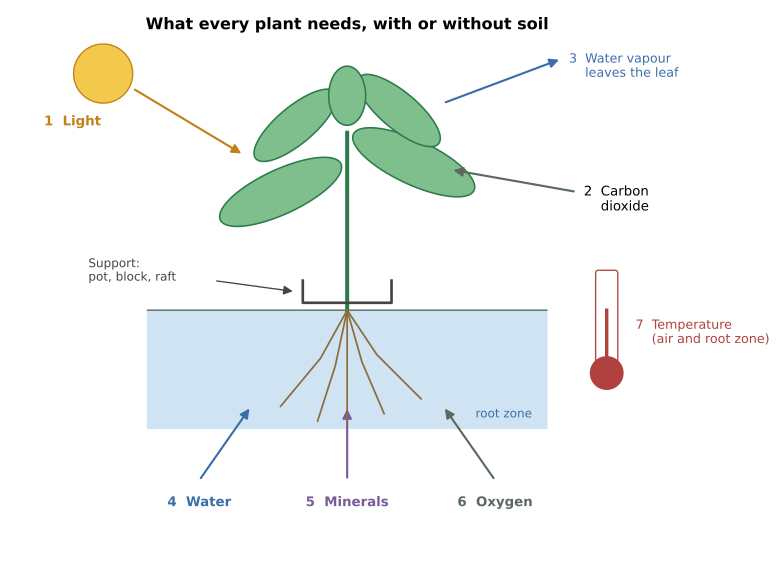
That picture gives the list: light, carbon dioxide, water, oxygen at the roots, a short list of mineral elements, a temperature inside a workable range, and something to hold the plant up. Temperature is a condition and support is a mechanical need, but a plant fails without either, so we count seven inputs.
Light: the energy source
Photosynthesis means, literally, synthesis using light. In the leaf, light energy drives the synthesis of carbohydrates from carbon dioxide and water, and oxygen is released as a by-product2,3. The energy stored in the sugar later powers every other process in the plant, and it is the energy source for almost all other life3.
Without light there is no sugar, and without sugar no new tissue, no root growth and no fruit. Soil never supplied light, so leaving soil changes nothing about the need for it; what changes indoors is that light becomes something you buy. Part D covers how light is measured and how much a crop needs, starting with Light: PPFD, DLI, spectrum and photoperiod.
Carbon dioxide: the carbon source
Carbon dioxide is a trace gas. When Taiz and Zeiger’s textbook was written it made up about 0.037% of the air, or 370 parts per million; oxygen is about 20% of the air and nitrogen nearly 80%3. Jones gives the ambient range as 300 to 400 parts per million2. It keeps rising: the monthly mean at Mauna Loa Observatory, Hawaii, for September 2026 was 426.07 parts per million4, about 0.04% of the air3,4.
The gas enters the leaf by diffusion through the stomata, the adjustable pores in the leaf surface, and then dissolves in the water of the cells3. At the normal concentration of the air the supply of carbon dioxide limits how fast photosynthesis can run; with enough light, a higher concentration supports a higher rate3.
Two consequences follow. Plants in a closed space use up the gas around them: in a closed greenhouse they may lower the concentration within one hour by enough to reduce growth rates1. And because supply limits rate, commercial greenhouses add carbon dioxide, with two to five times the atmospheric level, 1,000 to 1,500 parts per million, as the usual optimum1. For a home system the lesson is that the air around the plants must be exchanged with the room; CO₂ and air movement covers when enrichment pays.
Water: solvent, transport, pressure, and a large loss
Water does four jobs in the plant, and then most of it leaves.
It is the solvent. Taiz and Zeiger call water the most abundant and arguably the best solvent known: the medium in which molecules move within and between cells, the environment of most of the cell’s chemical reactions, and a direct participant in many of them3. It is also a raw material, supplying the hydrogen in every sugar and part of its oxygen1.
It is the transport medium. The stream of water that the roots take up carries dissolved minerals to the root surface, where they are absorbed, and then up to the leaves3. A nutrient solution works because the plant was always taking its minerals dissolved in water.
It is the pressure that holds the plant up. Plant cells have walls, so they can build up a large internal water pressure called turgor pressure3. Turgor is needed for cell enlargement, for gas exchange in the leaves and for transport in the phloem, the tissue that carries sugar, and it gives rigidity to every plant tissue that is not woody3. A wilted seedling is one whose cells have lost turgor.
And most of it is lost to the air. Most of the water a plant takes up evaporates from the leaves while the stomata are open to let carbon dioxide in; this loss is called transpiration, and over its life a plant may lose water equal to 100 times its fresh weight3.
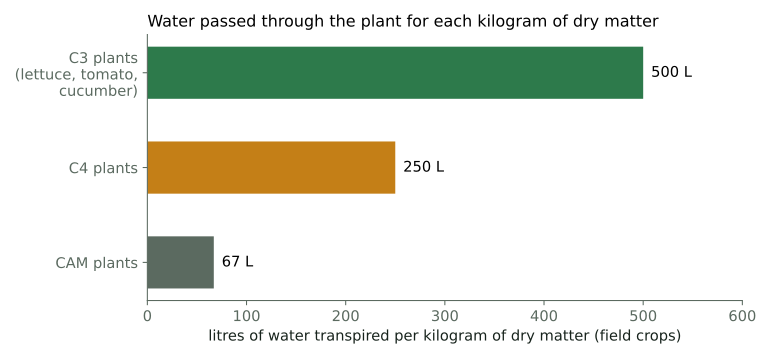
The size of the loss relative to growth is the transpiration ratio. In plants with the common C3 type of photosynthesis, about 500 molecules of water are lost for every molecule of carbon dioxide fixed, mainly because the gradient driving water out of the leaf is about 50 times larger than the one driving carbon dioxide in3. In mass terms, that is roughly 500 grams of water absorbed, transported and lost for every gram of organic matter made3, or, in Castilla’s figure for field crops, about 500 litres of water per kilogram of dry matter in C3 plants, against 250 in C4 plants and about 67 in CAM plants, the two groups with water-saving variants of photosynthesis3,5. Tomato, cucumber and lettuce are C3 plants2, so the 500 figure applies to most hydroponic crops; the worked example below turns it into litres per head. Water in the plant explains transpiration and how humidity controls it.
Oxygen at the roots
Roots do not photosynthesise. They get their energy by respiration, the breakdown of sugar sent down from the leaves, and respiration consumes oxygen: in Resh’s table of element functions, oxygen is the terminal acceptor of hydrogen in aerobic respiration1.
Oxygen diffuses about ten thousand times faster through gas than through water, so submerged roots soon run out of it3. Roots without oxygen transport less water to the shoot, so plants in waterlogged soil wilt while standing in water3. Oxygen shortage also strongly inhibits the uptake of mineral ions, because metabolism without oxygen generates less energy and active uptake needs it; in some species root growth stops immediately on waterlogging and the roots may die within a few days6.
So a plant can drown in nutrient solution. Every hydroponic system is an answer to how the roots get oxygen: an air gap above the solution, bubbles, a thin flowing film, or a porous medium that holds air as well as water. Part C is organised around that question, and Dissolved oxygen in the root zone gives the numbers.
The mineral elements
The mineral elements are the part of the plant that does not come from air or water, and the only input a hydroponic grower supplies as fertiliser salts. Resh lists 16 elements as generally considered essential: carbon, hydrogen and oxygen; nitrogen, phosphorus, potassium, calcium, sulfur and magnesium as the other macronutrients; and iron, chlorine, manganese, boron, zinc, copper and molybdenum as the micronutrients1. He adds that nickel is now believed to be essential, as part of the enzyme urease1. Taking carbon, hydrogen and oxygen out of the list leaves 14 mineral elements that the roots must find dissolved in the water around them1.
Their jobs, the test for essentiality and the amount of each are the subject of What plants are made of: the essential elements, and the whole of Part B is about delivering them as a solution.
Temperature: the speed of the chemistry
Every process named so far is a chain of chemical reactions run by enzymes, and their speed depends on temperature. Taiz and Zeiger describe both sides for photosynthesis: the rate at which the enzyme rubisco fixes carbon dioxide rises with temperature, but its affinity for carbon dioxide falls as temperature rises, and respiration rates also increase with temperature3. Growth is what photosynthesis makes minus what respiration spends, so there is a range in which the plant does best, below which everything is slow and above which losses outrun gains. Jones puts the optimum range for photosynthesis in C3 plants at 15 to 25 °C2, and a cooler night, when there is no photosynthesis, reduces respiration losses5.
Practical ranges differ by crop, and the sources differ slightly, so we print two. Castilla reproduces a table from Tesi of optimum air temperatures: lettuce 15 to 18 °C by day and 10 to 12 °C by night, tomato 22 to 26 °C by day and 13 to 16 °C by night5. Resh gives general guidelines: cool-season crops do better at 10 °C at night and 16 °C by day, warm-season crops at 16 °C at night and 24 °C by day1. Too cold and growth slows; too warm and growth is soft and leggy1.
Temperature has two parts, the air around the leaves and the solution around the roots. Temperature, humidity and VPD covers the first and Root-zone temperature the second.
Physical support
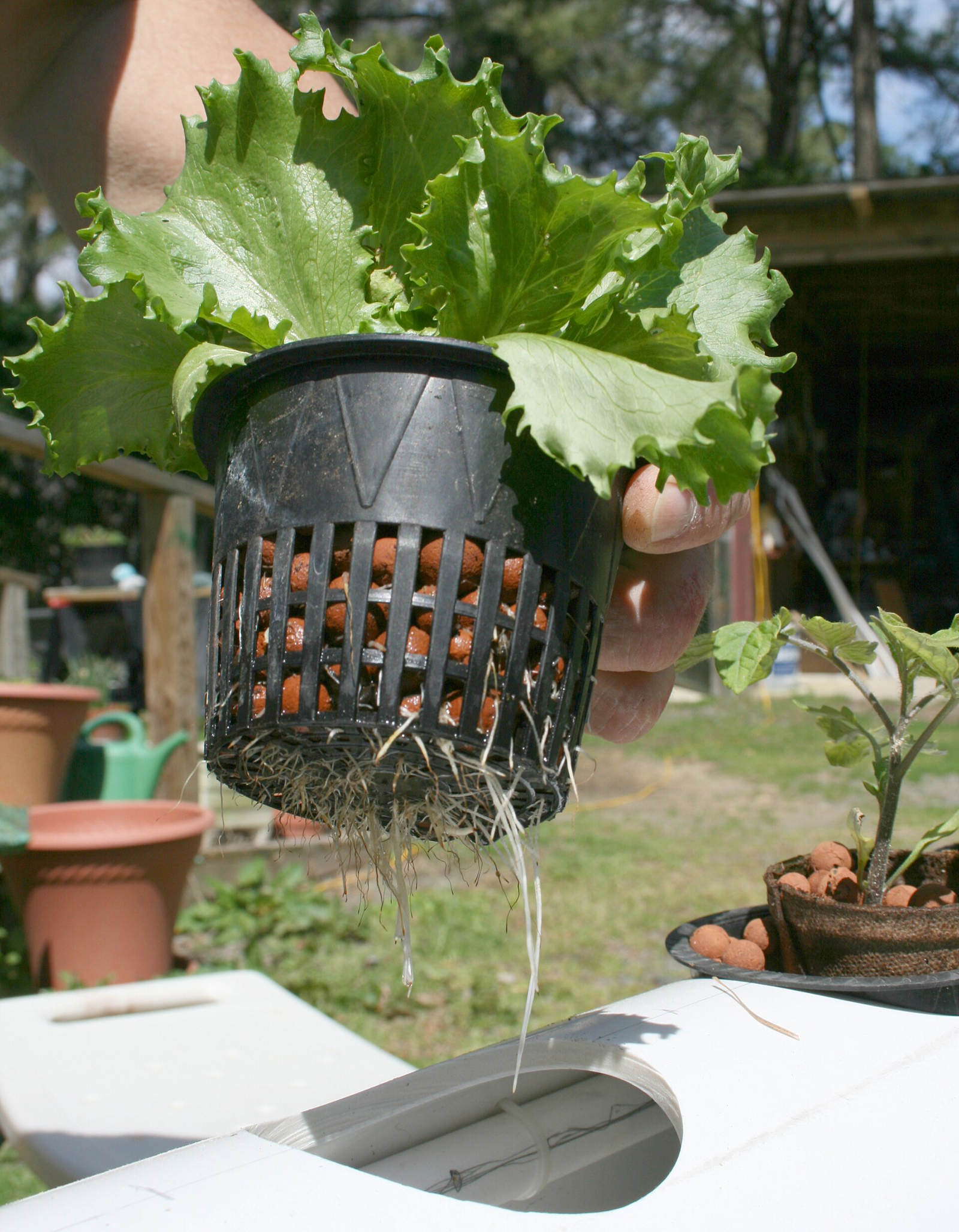
Turgor keeps soft tissues firm3, but it does not hold a plant upright against its own weight, keep the roots in the dark, or keep them in contact with water. In soil, the fourth of the services Resh lists is support for the plant root system1. In soilless culture, support comes from a net pot, a block or slab of growing medium, a raft, or strings from above, and a medium, when one is used, is chosen to provide water, air and anchorage at the same time7. Anatomy of a hydroponic system and Choosing a medium treat the options.
Why soil is optional
Resh states the central idea in one sentence: soil provides for four needs of a plant, a supply of water, a supply of essential nutrients, a supply of oxygen, and support for the root system1. A silt loam in good condition for plant growth is, by volume, about 25% water, 25% air, 45% mineral matter and 5% organic matter; the water with its dissolved salts is the soil solution from which roots take their nutrients, and the air in the pores supplies their oxygen1.
Set that against the seven inputs. Light, carbon dioxide and temperature were never the soil’s job. Each of the four that were can be delivered another way: water and minerals as a solution of fertiliser salts, oxygen as an air gap, bubbles, a flowing film or a porous medium, and support as a pot, a block or a string. The roots receive the same four things from a system that a person designed instead of from a soil that no one designed.
What soil does that is hard to replace
Two services of soil are not on Resh’s list, and both are why hydroponics demands more attention than a garden bed.
The first is buffering. Jones defines buffer capacity as the ability of the nutrient solution or growth medium to resist a change in pH during the period of its use2. Soilless culture has lower buffer and heat capacities than soil culture8: stone wool, perlite, pumice and polyurethane foam are chemically inert, and only organic materials and some volcanic minerals have ion-exchange capacity that buffers pH and nutrient availability7. Castilla makes the same point about water: the small water inertia of substrate crops, from the limited volume of water available to the roots, makes precautions against failures imperative5. A soil absorbs a mistake; a hydroponic system passes it straight to the roots. Alkalinity and buffering explains how to put some buffering back.
The second is microbial life. In soil, competition for food among a large and varied population of micro-organisms results in what plant pathologists call microbial buffering: no single organism, including a pathogen, can increase its population quickly9. Soilless media normally have a low microbial buffering capacity, because they are inert or cannot support an active microbial population9, and a fresh substrate lacks the tremendous competition that makes soil a microbiologically buffered system10. This is why root diseases such as Pythium can move fast in a recirculating system; see Hygiene, cleaning and crop turnover.
The trade is forgiveness for control: you can set water, minerals, oxygen and support exactly, and you must keep them set.
Worked example: how much water passes through a head of lettuce
Each input has a source; redo the arithmetic with a calculator.
- Transpiration ratio. About 500 litres of water transpired per kilogram of dry matter produced in C3 plants, the figure Castilla cites for field crops5, the same as Taiz and Zeiger’s 500 grams of water per gram of organic matter3. Lettuce is a C3 plant2.
- Fresh mass of one head. A commercial hydroponic lettuce operation described by Resh reports heads of 200 grams1.
- Dry-matter fraction. Dediu and co-workers, citing Seginer et al. (2004), give the normal dry-matter content of lettuce as 4% to 6%, so we use 5%11.
The calculation, with inputs from1,3,5,11:
- Dry mass of the head: 0.200 kg × 0.05 = 0.010 kg, that is 10 grams1,11.
- Water transpired to make it: 0.010 kg × 500 L/kg = 5.0 litres per head3,5.
- At 4% and 6% dry matter, the range is 4 to 6 litres5,11.
- Per kilogram of fresh lettuce: 5.0 L ÷ 0.200 kg = 25 litres per kilogram1,3,5,11.
Compare that with the water the head contains: 200 g minus 10 g of dry matter is about 190 g, so the plant moved roughly 26 times its own water content through its leaves while growing1,11.
An independent measurement points the same way, with a caveat: a 2023 bachelor’s thesis from Ljubljana, not peer-reviewed, found that hydroponically grown lettuce in a greenhouse required 23.7 litres of water per kilogram of fresh weight and 474 litres per kilogram of dry weight, at 5.0% dry matter12; scaled to a head with 10 grams of dry matter, that is 4.7 litres (our arithmetic); the thesis’s own plants were larger and used 11.7 litres each12. Two cautions. The 500 litres per kilogram is a field-crop figure, and water use efficiency in greenhouses is considerably higher because radiation and wind are lower5, so an indoor crop may transpire less. And the thesis measured the fall in solution level in the hydroponic basins, which its author says included leakage from the basin lining and so cannot be compared with the soil treatments; it is an upper bound on transpiration, not a measurement of it12. A few litres per head is the quantity to plan for, and Dimensioning a system starts there.
Where the series goes next
The seven inputs are the map of the rest of the series: light, carbon dioxide and air temperature in Part D, starting with Light: PPFD, DLI, spectrum and photoperiod; water and the mineral elements in Part B, after Water in the plant and What plants are made of: the essential elements; oxygen at the roots and physical support in Part C, starting with Anatomy of a hydroponic system.
Key numbers
| Quantity | Typical value or range | Conditions | Source |
|---|---|---|---|
| Water in fresh plant matter | 80% to 95% | varies with species and turgor | 1 |
| Carbon, oxygen and hydrogen in dry matter | over 90% | most plant matter | 1 |
| Mineral elements as share of fresh weight | about 1.5% | 15% dry matter, 10% of it mineral | 1 |
| Carbon dioxide in air | 370 ppm (0.037%) in the 2002 textbook; 300 to 400 ppm (Jones); 426.07 ppm | Mauna Loa monthly mean, September 2026 | 2,3,4 |
| Oxygen and nitrogen in air | about 20% and nearly 80% | 3 | |
| Carbon dioxide enrichment target | 1,000 to 1,500 ppm | two to five times atmospheric, commercial greenhouses | 1 |
| Transpiration ratio, C3 plants | about 500 molecules of water per molecule of CO₂; about 500 g water per g organic matter | typical C3 plant | 3 |
| Transpiration efficiency by photosynthetic type | 500, 250 and 67 L water per kg dry matter | C3, C4 and CAM plants, open field | 5 |
| Diffusion of oxygen, gas against water | about ten thousand times faster through gas | 3 | |
| Essential elements | 16 in Resh’s list, plus nickel; 14 mineral elements | 1 | |
| Optimum temperature for photosynthesis, C3 plants | 15 to 25 °C | 2 | |
| Optimum air temperature, lettuce and tomato | 15 to 18 / 10 to 12 °C; 22 to 26 / 13 to 16 °C (day / night) | Tesi 2001, as reproduced by Castilla | 5 |
| General guideline, cool- and warm-season crops | 10/16 °C and 16/24 °C (night/day) | Resh | 1 |
| Soil composition, silt loam in good condition | 25% water, 25% air, 45% mineral, 5% organic matter | by volume | 1 |
| Lettuce head; lettuce dry matter | 200 g; 4% to 6% | commercial hydroponic head; normal unstressed plants | 1,11 |
| Water applied per kg hydroponic lettuce (measured; bachelor’s thesis, includes basin leakage) | 23.7 L/kg fresh, 474 L/kg dry | greenhouse, Ljubljana 2023 | 12 |
| Water transpired per head of lettuce (derived) | about 5 L (4 to 6 L); 25 L per kg fresh | 500 L/kg dry matter, 10 g dry matter | 1,3,5,11 |
Common mistakes
- Judging a crop’s water need by the water in the harvest. A head of lettuce holds about 190 g of water but transpired on the order of 5 litres to grow1,3,5,11.
- Keeping roots fully submerged in still solution. Oxygen moves about ten thousand times more slowly through water than through air, so submerged roots run out of it and the plant wilts3.
- Treating temperature as comfort rather than as an input. Enzyme rates and respiration both rise with temperature, so each crop has an optimum range: lettuce around 15 to 18 °C by day, tomato around 22 to 26 °C3,5.
- Expecting a hydroponic system to forgive a mistake the way soil does. Soilless culture has lower buffer and heat capacities than soil and little microbial buffering, so a dosing error reaches the roots at once8,9.
Summary
A plant is mostly water, and most of its dry matter is carbon, oxygen and hydrogen taken from carbon dioxide and water and assembled with the energy of light. It needs seven inputs: light for energy, carbon dioxide for carbon, water as solvent, transport medium, pressure and raw material, oxygen at the roots for respiration, fourteen mineral elements dissolved in that water, a workable temperature, and physical support. Most of the water it takes up leaves through the leaves, about five hundred times the dry matter it makes, so a head of lettuce transpires on the order of five litres. Soil supplies four of the seven, water, minerals, oxygen and support, and each can be supplied another way; that is what hydroponics is. What soil also gives, chemical buffering and a competitive microbial population, is hard to replace, so a soilless system is more controllable and less forgiving.
Next in the series: How plants are built: cells, tissues, roots and shoots.
References
- Resh, H. M. (2013). Hydroponic Food Production: A Definitive Guidebook for the Advanced Home Gardener and the Commercial Hydroponic Grower, 7th ed. CRC Press, Boca Raton. ISBN 978-1-4398-7869-9.
- Jones, J. B. Jr. (2005). Hydroponics: A Practical Guide for the Soilless Grower, 2nd ed. CRC Press, Boca Raton.
- Taiz, L. and Zeiger, E. (2002). Plant Physiology, 3rd ed. Sinauer Associates, Sunderland, MA. Chapters 3, 4, 7, 9 and 25.
- NOAA Global Monitoring Laboratory. Trends in Atmospheric Carbon Dioxide: Mauna Loa monthly mean. https://gml.noaa.gov/ccgg/trends/ (accessed 2026-10-15)
- Castilla, N. (2013). Greenhouse Technology and Management, 2nd ed. CABI, Wallingford.
- Marschner, P. (ed.) (2012). Marschner's Mineral Nutrition of Higher Plants, 3rd ed. Academic Press, London. Chapter 17, Adaptation of plants to adverse chemical soil conditions, section 17.4.3.
- Raviv, M. and Lieth, J. H. (eds) (2008). Soilless Culture: Theory and Practice. Elsevier, Amsterdam. Chapter 12, Inorganic and synthetic organic components of soilless culture and potting mixes, section 12.4.2.
- Raviv, M. and Lieth, J. H. (eds) (2008). Soilless Culture: Theory and Practice. Elsevier, Amsterdam. Chapter 8, Nutrition of substrate-grown plants.
- Albajes, R., Gullino, M. L., van Lenteren, J. C. and Elad, Y. (eds) (2000). Integrated Pest and Disease Management in Greenhouse Crops. Developments in Plant Pathology 14. Kluwer, Dordrecht. Chapter 23, Biological control of soilborne pathogens, section 23.3.2.
- Raviv, M. and Lieth, J. H. (eds) (2008). Soilless Culture: Theory and Practice. Elsevier, Amsterdam. Chapter 10, Pathogen detection and management strategies in soilless plant growing systems, section 10.3.
- Dediu, L., Cristea, V. and Zhang, X. (2012). Waste production and valorization in an integrated aquaponic system with bester and lettuce. African Journal of Biotechnology, 11(9), 2349–2358. https://doi.org/10.5897/AJB11.2829
- Pustatičnik, B. (2023). The influence of cultivation systems on water consumption and nitrate content in lettuce (Lactuca sativa L.). Bachelor's thesis, Biotechnical Faculty, University of Ljubljana. https://repozitorij.uni-lj.si/IzpisGradiva.php?id=146960
This article was drafted with the help of AI tools and reviewed and edited by PonicLabs. Sources are listed above; tell us if you find an error.