Bioponia
A bioponia é uma abordagem inovadora da hidroponia orgânica que se concentra na criação de soluções nutritivas sustentáveis e ecológicas para o crescimento das plantas [1]. Ao utilizar vários materiais orgânicos residuais e empregar bactérias benéficas e processos energeticamente eficientes, a bioponia oferece uma alternativa viável aos fertilizantes inorgânicos convencionais [2]. Tradicionalmente, a maioria das pessoas interage com a bioponia simplesmente comprando soluções orgânicas comerciais como alternativa às soluções minerais/inorgânicas mais extrativas. Vamos explorar o conceito de bioponia, as suas fontes de nutrientes e os métodos utilizados para converter resíduos orgânicos em nutrientes disponíveis para as plantas.
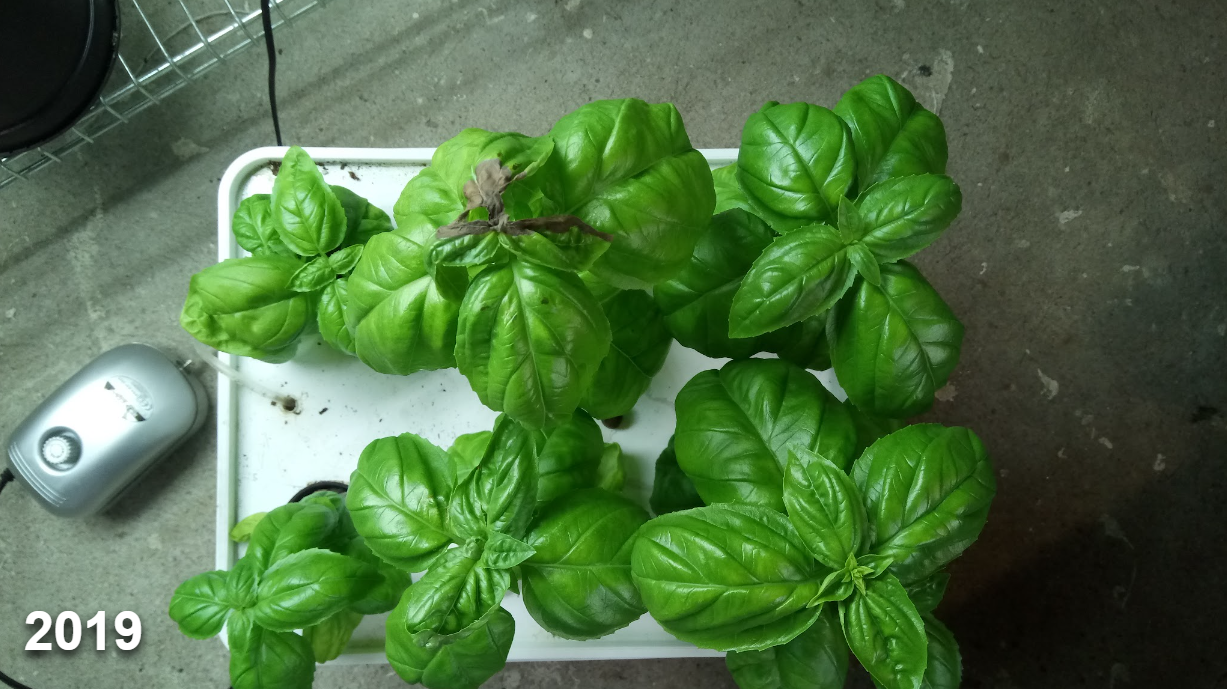
Bioponic basil in a simple DWC configuration, using dried & crushed vermicompost powder as the nutrient source, Henrique Sánchez 2019
Fontes de Nutrientes
- Lixiviado de Vermicomposto: O vermicomposto, produzido pela decomposição de matéria orgânica através da ação de minhocas vermelhas, pode ser usado para criar um lixiviado rico em nutrientes [3]. O extrato líquido do vermicomposto contém nutrientes essenciais para as plantas e microrganismos benéficos [4].
- Lixiviado de Composto Bokashi: O Bokashi é um processo de fermentação que utiliza uma mistura de microrganismos para decompor a matéria orgânica [5]. O lixiviado de composto resultante é rico em nutrientes e pode ser usado como fertilizante líquido em sistemas de bioponia [6].
- Vermicomposto Seco e Triturado: O vermicomposto pode ser seco e triturado em um pó fino, que pode então ser dissolvido em água para criar uma solução nutritiva [7]. Este método permite um fácil armazenamento e transporte do fertilizante orgânico.
- Lodo de Biogás de Resíduos Verdes: O biogás, produzido através da digestão anaeróbica de resíduos orgânicos, gera um lodo rico em nutrientes como subproduto [8]. Este lodo pode ser processado e utilizado como fertilizante líquido em sistemas de bioponia [9].
- Chá de Composto: O chá de composto é feito ao embeber o composto em água, permitindo que os microrganismos benéficos e os nutrientes sejam extraídos para o líquido [10]. Esta solução rica em nutrientes pode ser usada para alimentar as plantas em sistemas de bioponia [11].
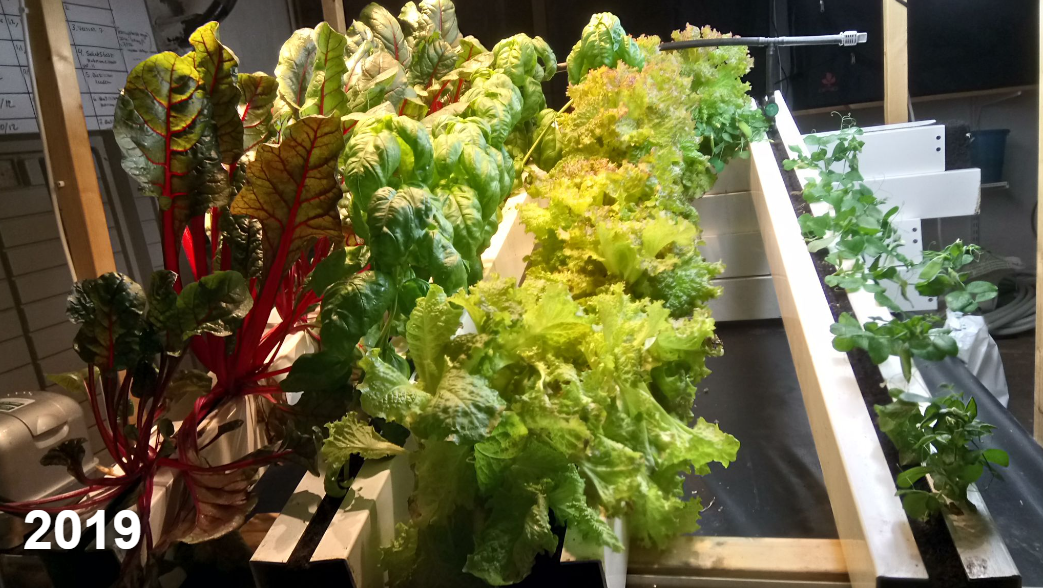
Bioponics NFT system powered by an MBBR, using green waste biogas slurry as the nutrient source, Henrique Sánchez 2019
Métodos de Conversão
- Aeração e Recirculação de Água: Para manter níveis ótimos de nutrientes e evitar a estagnação, os sistemas de bioponia frequentemente empregam técnicas de aeração e recirculação de água [12]. Bombas de ar e bombas de água são usadas para oxigenar a solução nutritiva e garantir uma distribuição uniforme dos nutrientes para as plantas [13].
- Aquecimento: Alguns materiais orgânicos residuais, como o composto bokashi, podem exigir aquecimento para acelerar o processo de decomposição e libertar os nutrientes na solução líquida [14].
- Trituração e Peneiração: O vermicomposto seco ou outros materiais orgânicos sólidos podem ser triturados e peneirados para obter um pó fino, que pode ser facilmente dissolvido em água para criar uma solução nutritiva homogénea [15].
- Centrifugação: A centrifugação pode ser usada para separar os componentes líquidos e sólidos das lamas de resíduos orgânicos, como a lama de biogás [16]. Este processo permite a extração da fração líquida rica em nutrientes, que pode ser usada como fertilizante em sistemas de bioponia [17].
A bioponia representa uma abordagem sustentável e ecológica da hidroponia orgânica, utilizando várias fontes de nutrientes derivadas de resíduos alimentares e de jardim [18]. Ao empregar bactérias benéficas e métodos de conversão energeticamente eficientes, a bioponia permite a criação de nutrientes disponíveis para as plantas a partir de materiais orgânicos [19]. À medida que a procura por produção alimentar sustentável e orgânica cresce, a bioponia oferece uma solução promissora que minimiza o desperdício e promove uma economia circular na agricultura [20].
Referências
- Schmautz, Z., et al. (2020). Bioponics: A review of the history, current trends, and future directions. Agronomy, 10(12), 1885.
- Goddek, S., et al. (2019). The role of organic fertilizers in bioponics: A review. Agronomy, 9(11), 726.
- Arancon, N. Q., et al. (2004). Effects of vermicomposts on growth and marketable fruits of field-grown tomatoes, peppers and strawberries. Pedobiologia, 47(5-6), 731-735.
- Pant, A. P., et al. (2009). Vermicompost leachate as a liquid fertilizer for marigold production. Bioresource Technology, 100(19), 4664-4671.
- Boechat, C. L., et al. (2019). Bokashi: A sustainable organic fertilizer for improving soil fertility and crop production. Journal of Cleaner Production, 234, 1328-1335.
- Kim, M. J., et al. (2016). Evaluation of bokashi as an organic fertilizer for organic farming of green chili pepper. Korean Journal of Organic Agriculture, 24(1), 51-60.
- Adhikary, S. (2012). Vermicompost, the story of organic gold: A review. Agricultural Sciences, 3(7), 905-917.
- Makádi, M., et al. (2012). Digestate: A new nutrient source – Review. In Biogas (pp. 295-310). InTech.
- Fuchs, J. G., et al. (2008). Effects of digestate on the environment and on plant production – results of a research project. Compost and digestate: sustainability, benefits, impacts for the environment and for plant production. Proceedings of the international congress CODIS 2008, 27-29 February 2008, Solothurn, Switzerland (pp. 101-110).
- Scheuerell, S., & Mahaffee, W. (2002). Compost tea: Principles and prospects for plant disease control. Compost Science & Utilization, 10(4), 313-338.
- Pant, A. P., et al. (2012). Vermicompost tea: A novel liquid compost extract for the suppression of plant pathogens and promotion of plant growth. In Microorganisms in Sustainable Agriculture and Biotechnology (pp. 183-199). Springer, Dordrecht.
- Goto, E., et al. (2005). Plant production in closed ecosystems: The basics and applications. In Plant Production in Closed Ecosystems (pp. 1-7). Springer, Dordrecht.
- Savvas, D., & Passam, H. (Eds.). (2002). Hydroponic production of vegetables and ornamentals. Embryo publications.
- Quiroz, M., et al. (2014). Bokashi as an amendment and source of nitrogen in sustainable agricultural systems: a review. Journal of Soil Science and Plant Nutrition, 14(2), 238-248.
- Álvarez, M. L., et al. (2018). Vermicompost and compost as growing media for potted plant production. In Organic Fertilizers-From Basic Concepts to Applied Outcomes. IntechOpen.
- Möller, K., & Müller, T. (2012). Effects of anaerobic digestion on digestate nutrient availability and crop growth: A review. Engineering in Life Sciences, 12(3), 242-257.
- Stoknes, K., et al. (2016). Liquid digestate from anaerobic treatment of source-separated household waste as fertilizer to barley. Waste Management & Research, 34(12), 1271-1276.
- Kawamura-Aoyama, C., et al. (2014). Study on the hydroponic culture of lettuce with microbially degraded solid food waste as a nitrate source. Japan Agricultural Research Quarterly: JARQ, 48(1), 71-76.
- Shinohara, M., et al. (2011). Microbial mineralization of organic nitrogen into nitrate to allow the use of organic fertilizer in hydroponics. Soil Science and Plant Nutrition, 57(2), 190-203.
- Liedl, B. E., et al. (2006). Liquid effluent from poultry waste bioremediation as a potential nutrient source for hydroponic tomato production. Acta Horticulturae, 742, 385-392.
**Nota: A informação prévia foi parcialmente ajudada na sua escrita e/ou edição com ferramentas LLM. **